


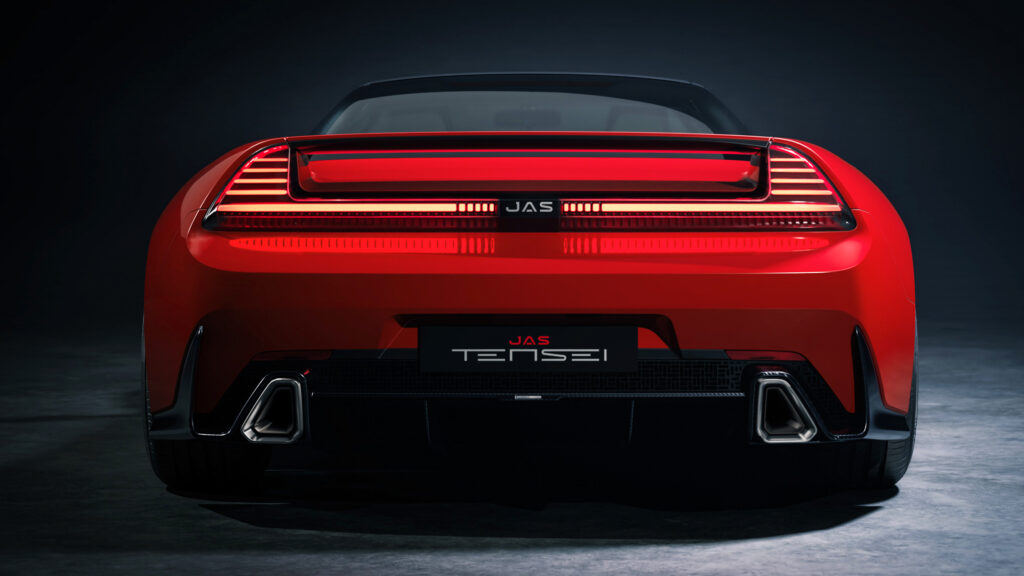
The restomod project of the Honda NSX, being developed by Pininfarina and JAS Motorsport, revealed new details at Design Week in Milan. The car, named Tensei, has undergone significant changes in its proportions and technical specifications.
Updated Proportions and Design
Pininfarina’s designers focused on the body geometry. Compared to the original NSX, the Tensei has gained a longer wheelbase, a shorter rear overhang, a wider track, a lower stance, and larger wheels. Chief designer Dimitri Vicedomini noted that after implementing these changes, “the car almost constructed itself.”
Widened rear fenders and arches created what Pininfarina calls “triangular gestures in the top view” – a characteristic touch recognizable in many of their most famous works. The new car hints at features of the Ferrari 288 GTO, also created by Pininfarina. Despite radical changes, key elements of the original, such as the pop-up headlights and integrated rear spoiler, have been preserved in a modified form.
The Heart and Soul of the Car
Beneath the carbon body lies a naturally aspirated V6, based on the architecture of the original NSX engine. It was developed for maximum power, torque, and responsiveness. It is paired with a six-speed manual transmission.
No turbos, no electrification, and no nonsense with paddle shifters. Such a powertrain will make buyers of modern supercars feel they’ve backed the wrong horse, even if the Tensei produces far fewer horses.
Interior and Historical Context
The developers are also working on updating the interior, preserving the original’s driver-oriented ergonomics and cabin visibility but adding “higher perceived quality.” Signature controls and luxurious materials are expected. There is hope that the instruments will be analog, not digital.
The collaboration between Pininfarina and Honda has deep historical roots, dating back to 1984 when they jointly created the HP-X concept car – a mid-engine sports car that essentially foreshadowed the arrival of the NSX several years before its creation.
Production and Prospects
The Tensei car will be hand-built at the JAS Motorsport atelier in Arluno near Milan. Options for individual customization will be handled at Pininfarina’s own facility in Cambiano, Turin. The full presentation of the car is scheduled for 2026, at which time its price and limited production run will also be announced.
The emergence of such a project in the era of mass electrification and autonomy is a bold gesture. It appeals not to cold acceleration figures or efficiency but to emotions and the purity of the driving experience. The work of Pininfarina and JAS Motorsport reminds us that a car is not just a means of transportation but also an object of art, technical heritage, and cultural code. The success of Tensei could become an important signal to other manufacturers that the market is still ready to value mechanical perfection and design with a soul.