


Thai company RRS transforms the new Toyota Hilux into a powerful dump truck
The ninth-generation Toyota Hilux, introduced a few months ago, immediately caught the attention of tuning shops. One of them is the Thai company Rung Rueng Service (RRS), which already has experience converting the popular Japanese “workhorse” into heavy dump trucks and trucks.
The single-cab Hilux Travo, as this truck is called in Thailand, has now received a lifting body designed to carry loads that would make a regular midsize pickup “weep.”
Chassis and body modifications
The rear part of the truck can be either a cut-down factory body or a specially designed structure made of high-strength steel, available in different heights and configurations. Standard body dimensions are typically 2500 mm (98.4 inches) in length, 1760 mm (69.3 inches) in width, and 600 mm (23.6 inches) in height, although custom heights up to 800 mm (31.5 inches) are also available.
For those who need serious payload capacity, RRS can install a floating rear axle paired with reinforced rear leaf springs and upgraded shock absorbers with a 20 mm (0.78 inch) core. These changes allow the truck to carry up to 5000 kg (11,023 lbs) of cargo while remaining stable under maximum load.
Hydraulic system and additional equipment
The hydraulic system for the lifting mechanism is available in two versions. Most customers choose the electric unloading system, which can lift from 3000 to 5000 kg (6614-11,023 lbs) depending on the configuration. For more intensive use, there is an engine-driven system (PTO) that is powered by the diesel engine.
One of the most interesting options is a 1000 kg (2205 lb) crane that can be installed behind the cab. This allows for self-loading and unloading of heavy equipment or materials, effectively turning the humble Toyota into a self-sufficient mobile work station.
Modularity and preservation of factory functions
RRS claims that the dump truck designs do not require cutting or welding the chassis frame of the donor vehicle. Instead, they are designed as modular kits with individual configurations. Additionally, the rearview camera and parking sensors are transferred to the new dump truck chassis, ensuring that all factory systems continue to operate.
Other RRS projects
The company has shared photos of several Hilux-based projects on its social media. Some are based on initial white trim levels, while others have a more rugged look with additional bumpers, underbody protection, additional LEDs, and Lenso alloy wheels with mud tires. All dump trucks feature a single-cab body, prioritizing cargo bed size.
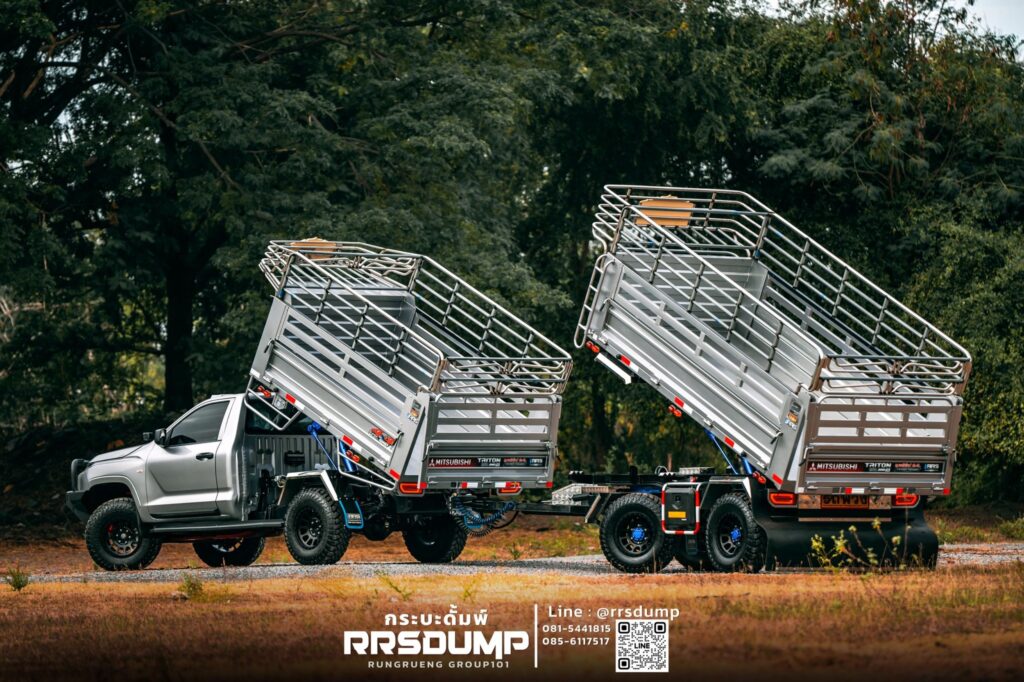
In addition to the Toyota Hilux, RRS applies the same approach to several other midsize pickups, including the recently introduced Ford Ranger Super Duty. Another interesting project is the new Mitsubishi Triton with a double dump truck, which looks like a small “road train.” Finally, some projects are based on older models, meaning it’s never too late to become a dump truck.
This approach by RRS demonstrates how pickups, traditionally considered versatile vehicles, can be adapted for highly specialized tasks without losing their basic reliability. The modularity of the design allows owners to easily upgrade their vehicles, and the preservation of factory functions, such as the rearview camera, makes such conversions practical and convenient for everyday use. It also indicates that the commercial vehicle market in Southeast Asia continues to actively develop, offering non-standard solutions for various industries, from construction to agriculture.