


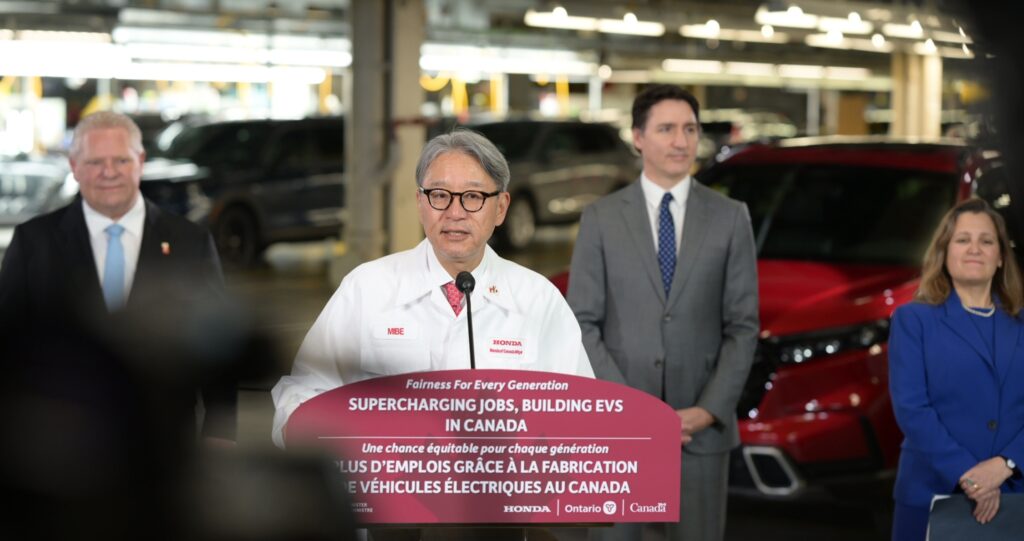
Honda has suspended plans to build a new electric vehicle plant in Ontario, Canada. This is the second major blow to the company’s electric future in North America in recent months. Previously, in 2024, a massive project worth 15 billion Canadian dollars ($11 billion USD) was announced, but in 2025 it was already postponed by two years. Now, the company has decided to “freeze” the plans indefinitely, reassessing the market.
Reasons for Project Suspension
The main reason for this decision was that demand for electric vehicles in the US turned out to be lower than Honda expected. Instead of focusing entirely on electricity, the company is betting on hybrids, which are currently selling well. Additionally, the situation was impacted by policy changes: the elimination of federal incentives for electric vehicles in the US made them more expensive, and the easing of efficiency standards reduced pressure on automakers. Uncertainty over tariffs and trade relations between the US and Canada also adds risks for long-term investments.
Canada’s Minister of Industry, Melanie Joly, stated: “American tariffs and changes in US domestic policy are creating real pressure on automakers, forcing some to postpone or scale back investments in electric vehicle and battery production projects.”
Delays and Cancellations of Models
Honda had already delayed the Alliston project in May 2025, pushing back the launch timelines for the vehicle and battery plant by two years, despite having purchased land and securing financial support from Canada. Now everything is completely frozen, although at the existing Alliston plant, which opened back in 1986, production of the Civic and CR-V will continue.
The strategic shift has already impacted plans for new models. The company is winding down production of the Prologue EV, developed jointly with GM. Earlier this year, Honda canceled three promising Honda and Acura electric models that were in the final stages of development for North America. Furthermore, Honda and Sony abandoned the launch of electric vehicles under the Afeela brand.
Focus on Hybrids
Instead of electric vehicles, Honda will focus on hybrids in North America, which are gaining popularity, and will continue production of existing models to save costs. This does not mean a complete abandonment of electricity. The company has flexible production lines in Ohio that can manufacture gasoline, hybrid, or electric models depending on demand, having spent $1 billion on their modernization. However, at least for the foreseeable future, fully electric models will not be part of Honda’s future in the US or Canada.
This change in Honda’s course is indicative of the entire North American automotive market. The company, which was among the first Japanese manufacturers to announce ambitious electrification plans, is now forced to adjust its strategy under pressure from real demand and political instability. The decision to “freeze” a multi-billion dollar project in Canada shows that even major players are not ready to take risks without clear signals from the market. In effect, Honda is choosing a pragmatic path, betting on hybrids as a “bridge” between traditional engines and electricity, allowing it to remain profitable amidst uncertainty. This also demonstrates how a change in US political direction can significantly impact the long-term investment decisions of global corporations.