


The Official Pursuit Version
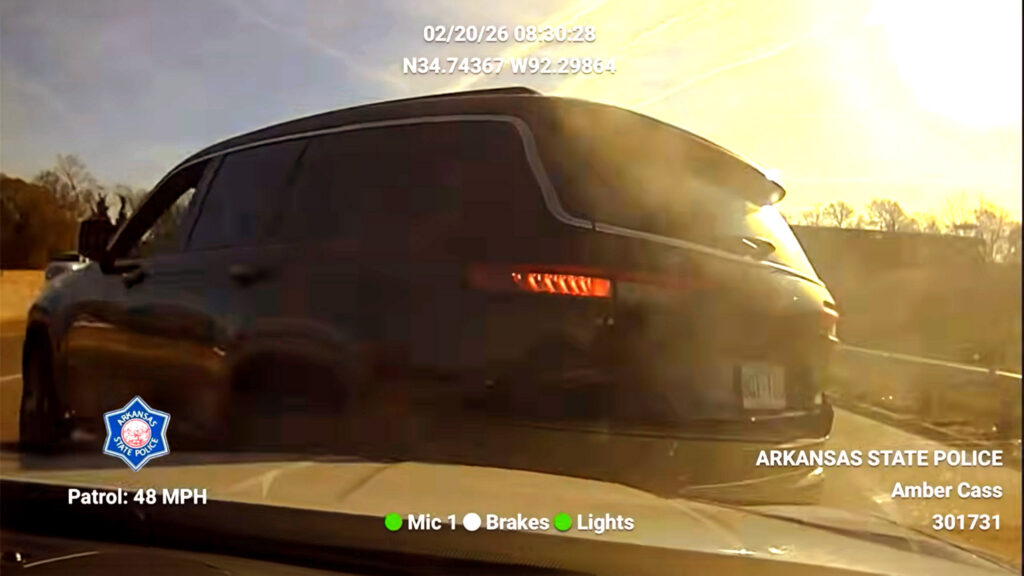
High-speed pursuits leave little room for nuance, at least in the official version of events. The Arkansas State Police report states that a black Jeep was initially clocked at 72 miles per hour in a 60 mph zone. It notes that the driver passed exits, did not stop upon command, and that traffic ahead was increasing. According to the officer, the pursuit needed to be terminated, and she took decisive action to do so.
What the Recordings Showed
However, dashcam footage shows that throughout the pursuit, the Jeep driver did not make any aggressive maneuvers. On the contrary, he slowed down, turned on his hazard lights, and moved into the slow lane. Even the officer’s report notes that the driver reduced speed. But this did not stop the PIT maneuver that followed. Inside the vehicle were two young children, one of whom had a medical issue, which is why the father behind the wheel was rushing to the hospital.
The driver, identified as Dillon Hess, was detained and explained to police that he was heading to Arkansas Children’s Hospital due to a medical emergency. Prosecutors later dropped the charges, but not before state police blamed Hess himself for the situation.
This incident highlights the importance of communication when it is necessary to transport a person with a medical emergency by private vehicle, which happens regularly in Arkansas.
It might seem the matter could be closed here. But this case is not isolated.
A Troubling Trend
In 2020, an incident went viral where Arkansas police used a PIT maneuver against a pregnant woman who had already slowed down and turned on her hazard lights, looking for a safe place to stop at night on a rural highway. The maneuver flipped her SUV. She survived and filed a lawsuit, claiming she was trying to safely comply with the order. The case drew nationwide attention and intensified criticism of Arkansas’s aggressive PIT policy.
Then there are cases of mistaken identity. Earlier this year, an Arkansas police officer lost his job after performing a PIT on the wrong vehicle on I-630, the same highway as in the latest incident. That vehicle also contained a child. The driver had not violated any rules. In 2023, another officer resigned after performing a PIT on a vehicle that was not a suspect in a separate case. This is no longer a philosophical debate about tactics. It is a pattern of hitting the wrong vehicle.
Leadership’s Defense of the Policy
Arkansas State Police leadership, including Director Mike Hagar, has repeatedly defended the use of PIT. The agency argues that fleeing itself is dangerous and that quickly terminating pursuits protects the public. Certainly, there are scenarios where forceful intervention is justified. For example, when pursuing a confirmed violent criminal fleeing at extremely high speeds through dense traffic.
But this case was not like that.
Unanswered Questions
At the moment the maneuver was executed, the Jeep’s hazard lights were on. It was blocked by yielding traffic. It had slowed down. The report contains no indication that at that specific moment the car was hitting other vehicles, maneuvering uncontrollably, or threatening lives. And although prosecutors dropped the charges, another question remains: who will pay for the damaged Jeep? If the family now faces repair costs on top of the medical bills they have, what recourse do they have for compensation?
Arkansas law provides for fleeing charges that can escalate to serious felonies. But the PIT maneuver has consequences that extend far beyond a fine, sometimes even fatal ones. Fortunately, that did not happen this time.
Photo: Arkansas State Police
Similar incidents point to a systemic problem where standard procedure is applied without a full assessment of context. Even if police actions formally comply with instructions, society expects law enforcement to be able to distinguish a real threat from a citizen’s desperate situation. The question of responsibility for material damage and psychological trauma to affected families often remains overlooked after criminal cases are closed. This creates a sense of powerlessness and undermines trust in the institutions meant to protect. Discussing such cases can contribute to revising training programs and protocols so that similar tragedies are not repeated in the future.