


Beverly Hills Police Intensifies Crackdown on Loud Exhausts
California has long regulated many aspects of vehicle use and ownership, but now the Beverly Hills Police Department has added sound to the equation. The department recently partnered with PipeDown Solutions for specialized training in controlling loud exhausts, marking the first appearance of such a program in Southern California.
After theoretical classes and practical sessions, officers took to the streets and immediately applied their newly acquired knowledge. Some expensive cars found themselves on the other side of the operation.
Caught Porsche Carrera GT
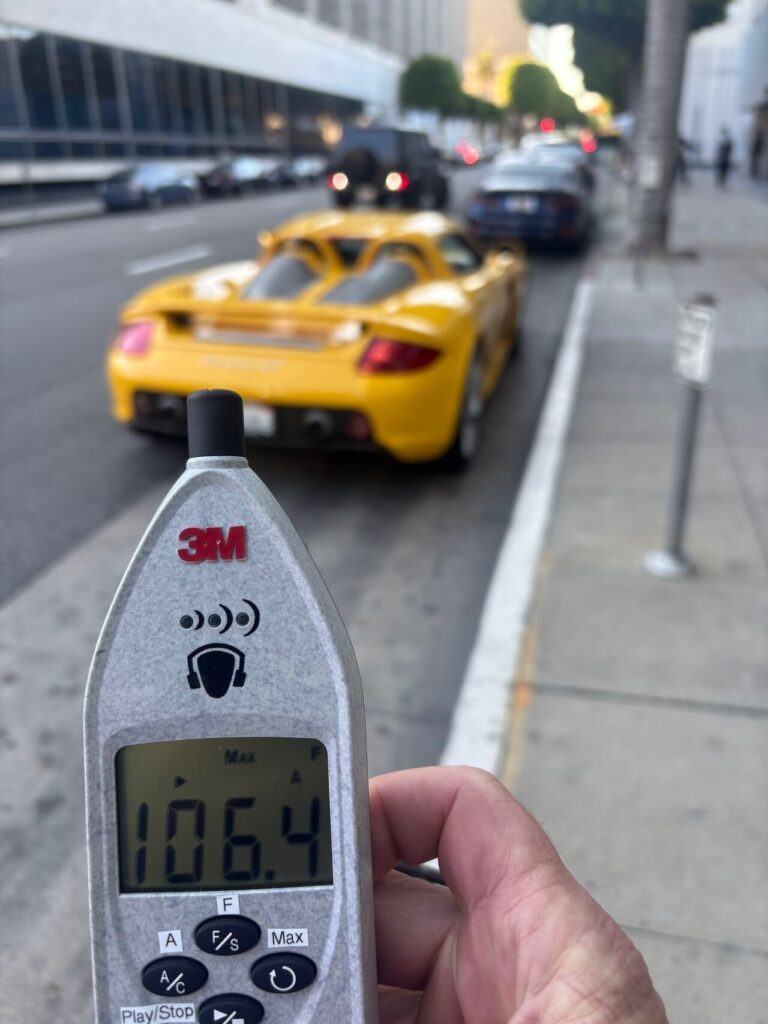
Photos released by the department show officers stopping and inspecting various vehicles, including a yellow Porsche Carrera GT, a Chevrolet Corvette C8, and an Audi R8. In one image, a sound meter positioned behind the Carrera GT records a reading of 106.4 decibels. The Audi registered 108 decibels, and the Corvette hit 116. For comparison, this is roughly the same loudness as a chainsaw, though undoubtedly much more pleasant to the ears of most car enthusiasts.
How the Test Actually Works
Importantly, California’s Vehicle Code does not rely simply on an officer’s decision that a car “sounds loud.” The state uses a standardized testing procedure known as SAE J1492. In simple terms, officers measure exhaust noise using a decibel meter positioned at a specific angle and distance from the exhaust pipes while the engine runs at a set RPM. The exact target RPM varies depending on the vehicle.
This is where the equipment in the photo comes into play. The handheld device appears to be a calibrated sound meter intended specifically for law enforcement work. Instead of relying on subjective opinion, officers can obtain an actual decibel reading, which can later be used in court to support a fine.
The threshold values themselves vary. California generally limits passenger cars and many new models to 95 decibels under the testing standard, though factory-certified systems and vehicle age can complicate matters. A reading above this level does not tell the whole story, as testing conditions matter, but the Carrera GT at 106.4 dB certainly falls into the range that attracts attention.
Unsurprisingly, officers reported that several community members approached them during the operation, asking what was going on. When they learned that the police were specifically targeting loud exhausts, the responses were almost identical: “Finally” and “It’s about time.” Let it be known: if you are in Beverly Hills, a loud exhaust can get you into trouble.
Credit: BHPD
This initiative in Beverly Hills is part of a broader trend in California, where local authorities are increasingly focusing on noise pollution from vehicles. While many sports car drivers consider engine sound part of the driving experience, for residents of dense urban areas it can be a source of constant discomfort. The use of standardized tests such as SAE J1492 makes the process more objective and less dependent on an officer’s personal opinion, potentially reducing disputes in court. It is worth noting that such measures are not unique to California, and other states are also considering or already implementing similar regulations to combat excessively loud vehicles, reflecting a growing focus on quality of life in cities.