


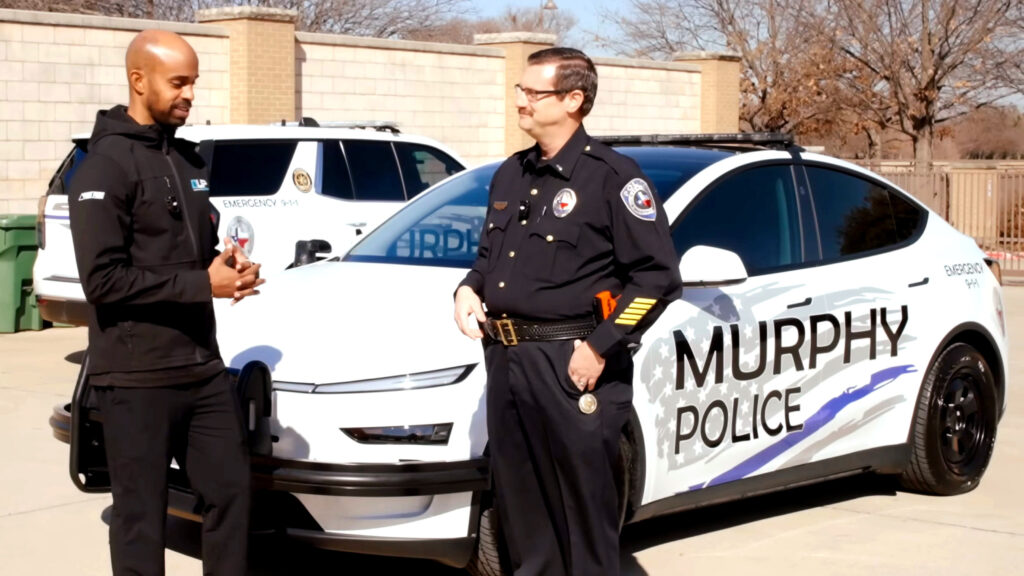
Real-World Pilot Project
The Murphy Police Department in North Texas became the first service to put into operation an updated 2026 Tesla Model Y police car, modified by Unplugged Performance. Instead of immediately replacing the entire fleet, the department decided to first test the electric vehicle in real-world conditions of daily patrol service to ensure its reliability.
Economic Justification
The most convincing argument in favor of electric vehicles is the financial benefit. According to estimates, each such patrol vehicle will provide significant savings compared to traditional internal combustion engine vehicles.
According to data from the city of Murphy, the projected annual savings per vehicle range from $4,100 for vehicles used by a single officer to $12,000 for cars operating on a shift schedule of over 140 hours per week.
The main part of the savings comes from forgoing fuel purchases, although the department will still incur electricity costs. At the same time, maintenance costs will decrease by approximately 75% compared to gasoline vehicles such as the Chevrolet Tahoe or Ford Explorer.
No Idling Wear
The savings are not limited to just fuel and fluid changes. Electric vehicles do not have an engine that wears out from constant idling, which accounts for approximately 60% of a patrol car’s operating time. Consequently, they are expected to last twice as long in service as comparable ICE vehicles.
Considering that each hour of idling is equivalent to wear from driving 33-35 miles, this difference accumulates quickly. Without an internal combustion engine under the hood, the Model Y can remain at a scene, powering lights, laptops, and the climate control system from the battery, without shortening its service life.
Technical Features of the Police Modification
The updated Tesla Model Y Juniper was converted into a patrol unit by the UP.FIT division, which specializes in fleet creation. Compared to the standard version, the car received a front protective bumper, additional LED lights at the front and sides, a roof-mounted siren, and 18-inch forged aluminum wheels with pursuit-rated tires.
The police vehicle is offered in rear-wheel and all-wheel drive versions, using standard electric powertrains and providing a range of 321 to 357 miles on a single charge. This is more than sufficient for daily duties. Since police work sometimes involves pursuits, the braking system was upgraded with six-piston calipers, stainless steel brake lines, specialized fluids, thermally enhanced components, and reinforced brake rotors.
Interior Equipment and Additional Options
Inside, officers get ventilated seats and improved sound insulation. Each vehicle is equipped with a configurable center console, a laptop mount, two weapon mounts, enhanced interior lighting, and one partition for a detainee in the rear seat.
Additional options include ballistic protection for the front doors and individual reflective graphic elements. UP.FIT does not disclose the final Manufacturer’s Suggested Retail Price (MSRP) for the Murphy units but insists that the total cost of ownership is lower than all other offerings in this segment. Besides the Model Y, the company also offers police modifications for the Cybertruck, Model S/X, and Model 3, should a local department need patrol vehicles of a different form factor.
The transition of police departments to electric vehicles, especially in states like Texas, which is traditionally associated with the oil industry, is a telling example of changing priorities in public procurement. Financial efficiency seems to be becoming a decisive factor even in conservative sectors. The success of this pilot project could accelerate similar initiatives in other municipalities, which, in turn, would promote the further development of electric vehicle infrastructure and specialized services for adapting them for official needs. Durability and reduced operating costs make electric patrol cars not just an ecological choice, but an economically justified solution for local budgets.