


A New Look at a Legend
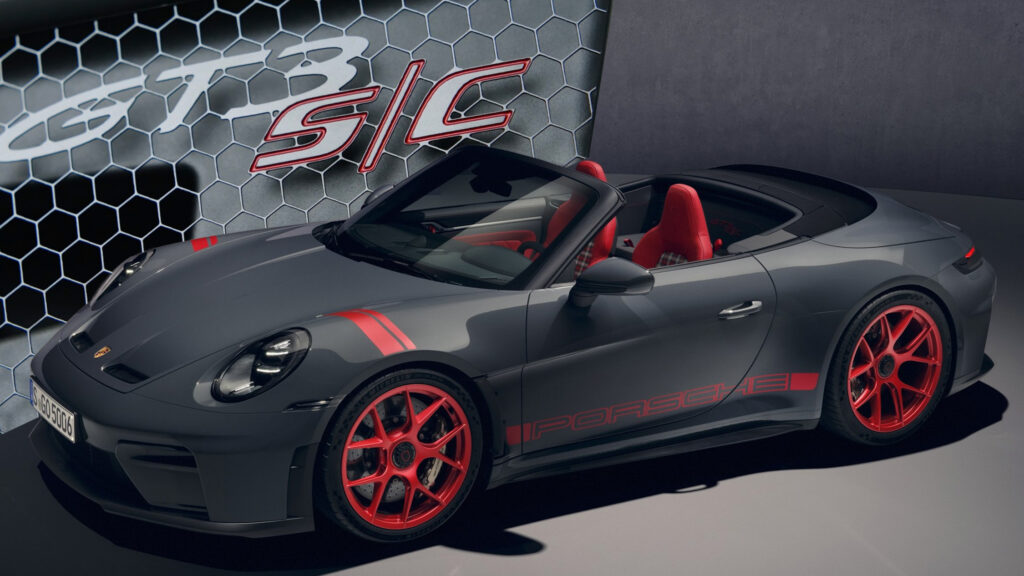
The 2027 Porsche 911 GT3 S/C is a car that will instantly spark controversy. Take the sharp coupe version, built with track precision in mind, remove the roof and some structural rigidity, add mass and weight – and everyone will have an opinion. But here’s the thing: this might be the very GT3 worth buying.
Heir to the S/T Philosophy
If you forget about the cabriolet aspect for a moment, the recipe looks very similar to the one used to create the limited-edition 992.1-generation 911 S/T in 2023. This means you get a share of the design, chassis, and powertrain typically reserved for the GT3 RS, but exclusively paired with a six-speed manual transmission, which the lap-time-oriented RS does not offer.
Like the S/T, the S/C does not get the sawtooth ventilation slots in the carbon fiber front fenders like the RS, but the fenders themselves are shaped to flow seamlessly into the RS-style doors with a beveled edge, also made from composites. The GT3 RS’s carbon fiber hood with dual vents, wide rear arches, and the tiny Gurney lip spoiler at the base of the GT3 Touring-style rear spoiler are also present.
GT3 Power and Identical Performance
Under the engine cover lies the 4.0-liter naturally aspirated flat-six from the GT3. Porsche states it has camshafts from the RS, although its power is rated at the same 502 hp as the regular GT3, not the 517 hp of the RS version. It revs to 9,000 rpm and is available only with a six-speed manual transmission.
It must be slower, right? Not according to the official stats. The 0-60 mph (97 km/h) sprint takes the same 3.7 seconds Porsche claims for the manual GT3 coupe, and the top speed of 194 mph (312 km/h) also exactly matches the Touring’s figures (the winged GT3 is 1 mph slower).
The Weight Myth
These performance figures seem to back up Porsche’s claim that the S/C doesn’t actually weigh much more than the Touring coupe, despite having a full-fledged electric roof that closes in 12 seconds, not one of those emergency-only types you traditionally get with a 911 Speedster. Porsche states the S/C’s weight is 1,507 kg, while the brand’s US configurator lists the Touring’s weight at 1,469 kg.
So, the difference is still 38 kg, but that’s far less than the 84 kg penalty you pay for choosing the cabriolet option at the Carrera S level in the 911 lineup. Porsche achieved this by fitting the aforementioned carbon body panels along with PCCB carbon-ceramic brakes (saving 20 kg) and center-lock magnesium wheels (lighter by 8.6 kg).
Hidden Technologies
Then come the lightweight components you don’t see, such as the carbon fiber rear anti-roll bar. Like other GT3 cars, the S/C also gets a full double-wishbone front suspension instead of the cheaper and less sophisticated setup used by junior 911 models.
Undoubtedly, Porsche’s weight calculations also factor in the optional carbon fiber bucket seats, which, unlike GT3 seats, have access loops to the rear compartment where buyers can order a pair of storage bins to increase luggage capacity. If you forgo the carbon seat option, you get still-comfortable but more daily-usable Porsche sports seats. But in any case, Porsche gives you a perforated leather – and perfectly round – steering wheel and a key instead of an engine start button.
Series Production and Exclusive Options
Porsche limited production of the old S/T to just 1,963 units, but the S/C is a full series-production model and could be much more numerous. Therefore, any owners obsessed with standing out might consider the optional Street Style package from Porsche Exclusive Manufaktur.
Adorned with graphics on the wings and ‘Porsche’ lettering on the sides, executed in the same red color as the wheels on the GT3 RS, with Slate Grey Neo wheels and body panels, and Victory Gold brake calipers, the true standout feature of Street Style is its interior. The red houndstooth fabric looks like it’s sewn from 1970s golf pants and certainly won’t be to everyone’s taste, but the fully leather-trimmed dashboard looks elegant, and the open-pore walnut gear lever is a nice touch.
Accessories for True Enthusiasts
If you choose the Street Style package, you can go all the way and get the Porsche Design 911 GT3 S/C watch, offered exclusively to S/C buyers. It’s based on a lightweight titanium case, which can be ordered with a black titanium carbide coating, features a GT3-themed dial, a rotor modeled after the car’s forged wheels, and is finished with a strap made from Porsche seat leather.
Pricing and Market Context
Porsche hasn’t said how much the watch costs, but we know the S/C will arrive at US dealers this fall priced at $275,350, including delivery. That’s significantly higher than the $238,150 for the GT3 and GT3 Touring Coupe, but it’s cheaper than the $286,650 Turbo S Cabriolet. And if we had just spent $256,650 on the much less exciting 911 Spirit 70 cabriolet, we’d be very sorry to read about the S/C’s debut.
So why did we say this heavier, less rigid, and more expensive GT3 might be the one actually worth buying? Because most GT3s live their lives on the road, not chasing lap records. The S/C will still be incredible in terms of driving feel, even if a pro might tell you it’s a tad less composed than the coupe, and most importantly, you’ll hear even more of that atmospheric engine music. I don’t consider myself a cabriolet fan, but I truly understand their appeal.
The arrival of the Porsche 911 GT3 S/C clearly demonstrates a shift in priorities even within the brand’s most race-oriented models. The emphasis on daily usability, the unique open-top sensations, and its series-production status make it not just an experiment, but a logical extension of the GT family. This is a car that doesn’t demand sacrificing comfort for character, offering the same soundtrack and driving qualities, but in a new, more emotional format. Its price is undoubtedly high, but in the context of the exclusive sports car market, it places it in a unique niche between hardcore coupes and luxurious cabriolets. The success of this model may determine whether Porsche will further experiment with open-top versions of its other track benchmarks.