


Update for Traditional Models
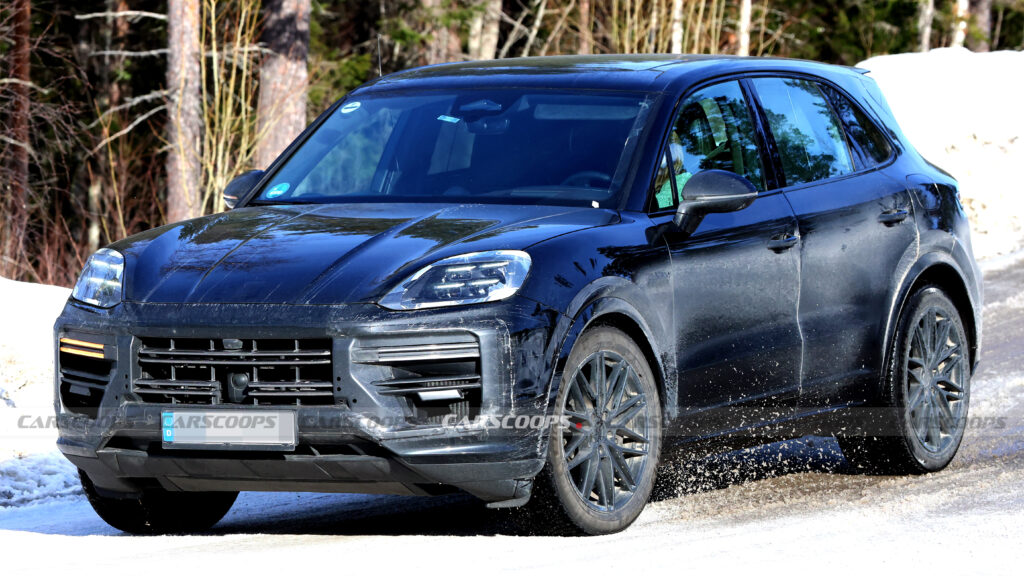
Porsche is actively working on launching its first fully electric Cayenne, but the gasoline version is not planning to give up its positions. Fresh spy photos demonstrate updated prototypes during tests, confirming that conventional and hybrid SUVs still have a lot of life left. The expected update this year will not be a radical change but may bring real improvements.
Two Different Prototypes
Photographers captured two separate prototypes covering test miles. One looks like a regular Cayenne E-Hybrid or, perhaps, a slightly more powerful and luxurious S E-Hybrid version. The other is much harder to miss and appears to be a Turbo E-Hybrid — a high-performance SUV that already demonstrates outstanding characteristics.
The next Porsche sedan may replace both the Panamera and the Taycan
Exterior and Design
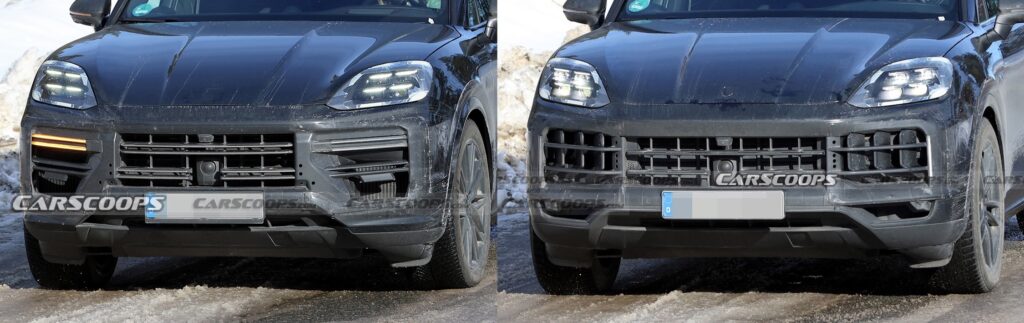
The more modest prototype retains a radiator grille very close to the current Cayenne. This is not surprising, as Porsche already conducted a significant facelift of the SUV in 2024. Camouflage on the headlights indicates a somewhat different internal design, but the external dimensions of the headlight units have remained unchanged.

Innovations from Sports Models
However, the Turbo E-Hybrid has borrowed several tricks from Porsche sports cars. The most obvious are the vertical active cooling louvers in the front bumper — a design already used on the latest 911 GTS and 911 Turbo S. If they work the same way, these louvers close for smoother airflow and open when the engine needs additional cooling.
Signs of a Powerful Version
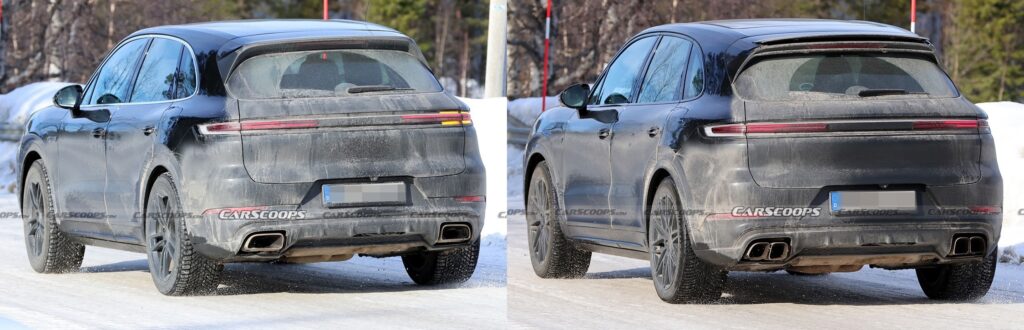
There are other details indicating that this is the most powerful version in the Cayenne family. Instead of the dual exhaust system of the base hybrid, it received a true quad-pipe system, which is always a reliable way to declare serious power. The rear spoiler also looks somewhat larger, with a raised or extendable surface, giving the large SUV an even more aggressive stance.

Interior and Technologies
The interior remains a mystery for now, as these prototypes carefully hide their cabins. However, there is a high probability that Porsche may borrow the instrument panel with numerous screens from the new electric Cayenne. That model is built on a completely different platform, but Porsche likes to spread its latest technologies across the entire lineup.
Improvements to Hybrid Systems
Under the hood, the formula is likely not to change much. A combination of V6 and V8 engines with a plug-in hybrid system is expected, but with a few additional horsepower and a slightly greater electric-only range. The current Cayenne E-Hybrid already develops 464 hp thanks to an electrically boosted 3.0-liter V6, accelerating to 100 km/h in 4.9 seconds and covering approximately 80 km on electric power alone.
At the other end of the spectrum is the Turbo E-Hybrid with a 4.0-liter V8, producing a massive 729 hp. It accelerates to 100 km/h in just 3.7 seconds, although its electric range is about 68 km.
Future of the Model Line
The electric Cayenne will be a major event for Porsche this year, considering it’s the first electric version. However, Porsche recently scaled back its electrification efforts somewhat and promised to invest in traditional models. These hybrids, as well as the non-hybrid V6 and V8 Cayenne versions debuting alongside them, still have many years ahead.
The appearance of updated hybrid Cayenne versions parallel to the debut of the first electric variant clearly illustrates the brand’s transitional strategy. Porsche is in no hurry to completely abandon proven internal combustion engines, instead integrating them with modern technologies to enhance efficiency and performance. Active aerodynamic elements borrowed from the 911 indicate a desire to transfer sports car DNA into the SUV segment, making these models attractive to those not ready for a full switch to electric vehicles but who value technical innovation and high dynamics.