 by
by Porsche Develops Technology That Changes Car Color
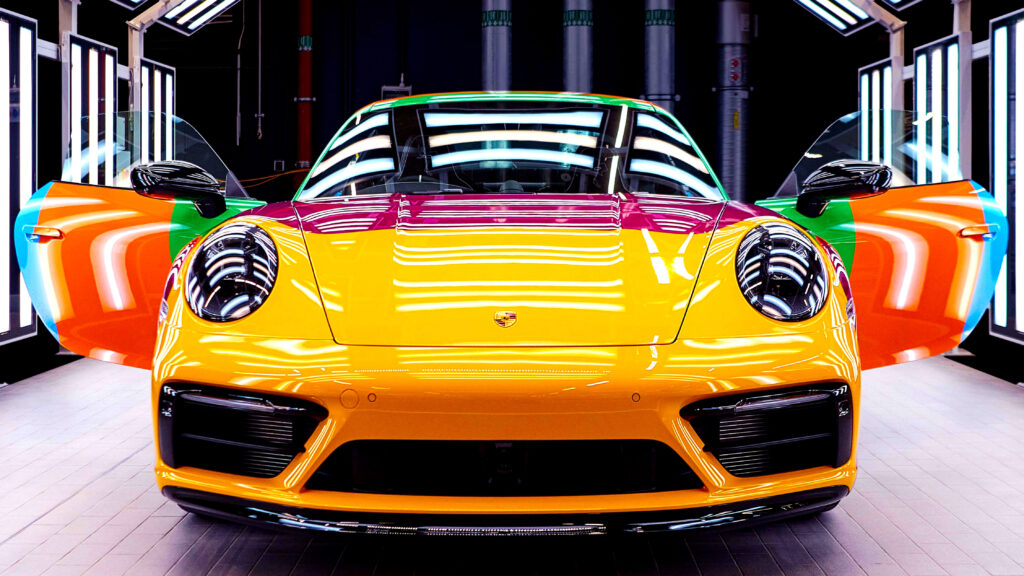
Porsche, known for its exclusive customer offerings, has patented a revolutionary coating system capable of changing color. Instead of choosing a single paint shade, the owner will be able to adapt the appearance of their car in real-time. The system is based on a special coating activated by an electric current.
Currently, the Porsche Sonderwunsch personalization program offers clients two main options: Paint to Sample with a catalog of over 220 approved historical colors and Paint to Sample Plus, where a color can be created from any sample, such as a piece of fabric or a bottle of nail polish, costing over $30,000.
How the New System Works
The patent, published by the World Intellectual Property Organization, describes a system that analyzes the surrounding environment or the driver’s clothing using a camera. Based on this visual input, the special coating on the body changes its color.
The heart of the system is an “actively controlled, optically variable coating” applied to at least parts of the body.

The technology involves using electrical stimulation to activate pigment particles in the coating. It consists of separate layers for red, green, and blue colors. This RGB methodology theoretically allows for reproducing a wide spectrum of shades to match anything—from clothing color to a sunset.
Practical Challenges and Competition
Despite the exciting prospects, many practical questions remain: the durability of the coating, maintenance, repair costs, and what exact area of the body will be covered by such technology. The patent provides no indication of whether this idea will be implemented in series production or when.

However, Porsche is not the only company exploring this area. BMW is also actively working on its own color-changing system using E Ink technology, which they plan to implement in series models by 2027. The company has already presented a concept based on the i5, where electricity animates the car’s appearance, turning the body into a canvas for moving graphics.
The implementation of such technologies could fundamentally change the concept of a car’s individuality. Instead of a static color chosen once for many years, the car will gain a dynamic, adaptive exterior. This opens the way not only for personalization based on the driver’s mood but also for functional applications, such as changing color to improve energy efficiency in different climatic conditions or to enhance road safety. The success of this innovation will depend on how well engineers can overcome technical barriers and offer a solution viable for series production while maintaining the high standards of quality and reliability inherent to premium brands.