


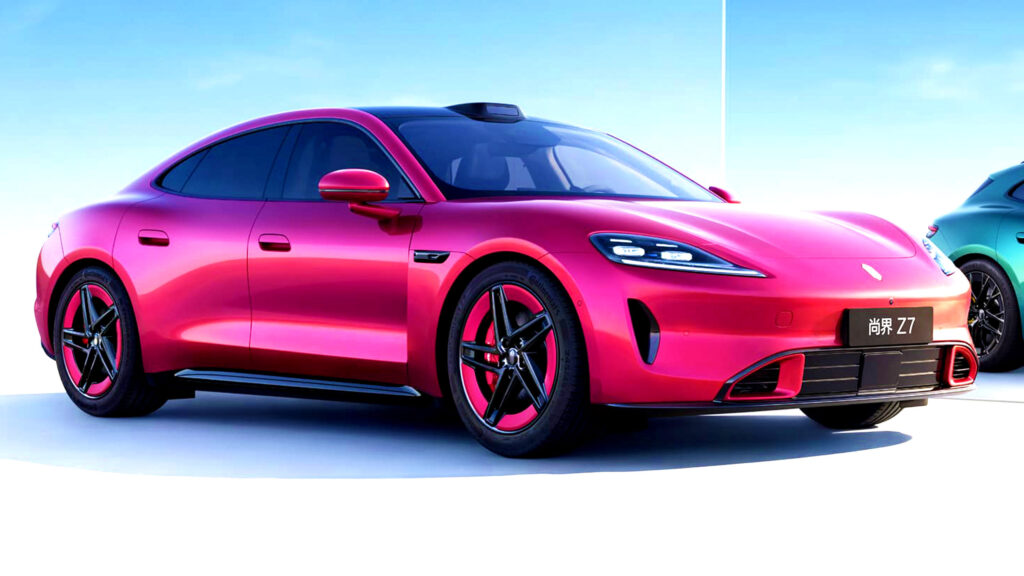
Chinese electric car SAIC Z7: An affordable alternative to the Porsche Taycan
China continues to strengthen its position as a global leader in the production of affordable electric vehicles. The latest confirmation of this is the new SAIC Z7, which visually resembles the Porsche Taycan but costs significantly less. The company announced that the starting price of the model is only 219,800 yuan (about $32,200). For comparison, this is the price of a mid-range Toyota Camry in the USA. This is much lower than expected and significantly less than the Taycan’s starting price of 918,000 yuan ($134,500).
In fact, even with a few additional options in the Porsche configurator, you can spend more than an entire SAIC Z7 costs. Unsurprisingly, auto giants’ executives, like Jim Farley from Ford, warn about pressure from Chinese manufacturers.
Variants and Specifications
Unveiled earlier this year as a competitor to the popular Xiaomi SU7, the Z7 debuts at the Beijing Auto Show. SAIC has confirmed several versions: the standard sedan is called the Z7, and the station wagon is called the Z7T. Such a car in the showroom truly makes the Taycan look like an expensive way to buy a badge.
The base Z7 is equipped with a rear electric motor producing 359 hp and an 81 kWh battery. A version with a 100 kWh battery and a dual-motor setup producing 590 hp is also available. In this configuration, the car accelerates to 100 km/h in 3.44 seconds, which is a very impressive figure.
For comparison, the base Porsche Taycan for 918,000 yuan ($134,500) has 408 hp and accelerates to 100 km/h in 4.8 seconds. The Taycan 4 costs 1,038,000 yuan ($152,100), has 517 hp, and does it in 3.9 seconds. The Taycan GTS with 700 hp reaches 100 km/h in 3.3 seconds, and its price is 1,298,000 yuan ($190,000). The most powerful Taycan Turbo with 884 hp accelerates in 2.7 seconds and costs from 1,568,000 yuan ($230,000).
Prices and Range
The base Z7 Max model costs from 219,800 yuan ($32,200) and offers a range of 732 km. The Z7 Max+ version with a larger 100 kWh battery increases the range to 905 km, with the price rising to 249,800 yuan ($36,600). The most powerful dual-motor Z7 Ultra version with the same 100 kWh battery has a range of 791 km and costs from 299,800 yuan ($43,900).
Three versions of the Z7T station wagon are also available: Z7T Max, Z7T Max+, and Z7T Ultra. The cheapest Z7T Max costs 229,800 yuan ($33,700) with an 81 kWh battery and a range of 712 km. The Z7T Max+ with a 100 kWh battery has a range of 873 km and costs 259,800 yuan ($38,000). The top-end Z7T Ultra version is priced at 309,800 yuan ($45,400) and has a range of 776 km.
Technology and Equipment
All versions of the Z7 are built within the Harmony Intelligent Mobility Alliance framework led by Huawei. The cars have rich equipment, including lidars and the latest intelligent driving system. On paper, this puts them on par with much more expensive competitors.
Photo: SAIC
Interestingly, the SAIC Z7 doesn’t just copy the design but offers technical specifications that surpass the base versions of the Taycan at a significantly lower price. This is another proof that Chinese manufacturers are not only catching up but also surpassing traditional players in the electric vehicle segment, offering consumers truly competitive products. Given the rapid development of technology and the reduction in battery costs, models like the Z7 could significantly change the global market, forcing premium brands to reconsider their pricing policies.