


Ford’s First Quarter Financial Results: Profit, Losses, and an Unexpected Tax Bonus
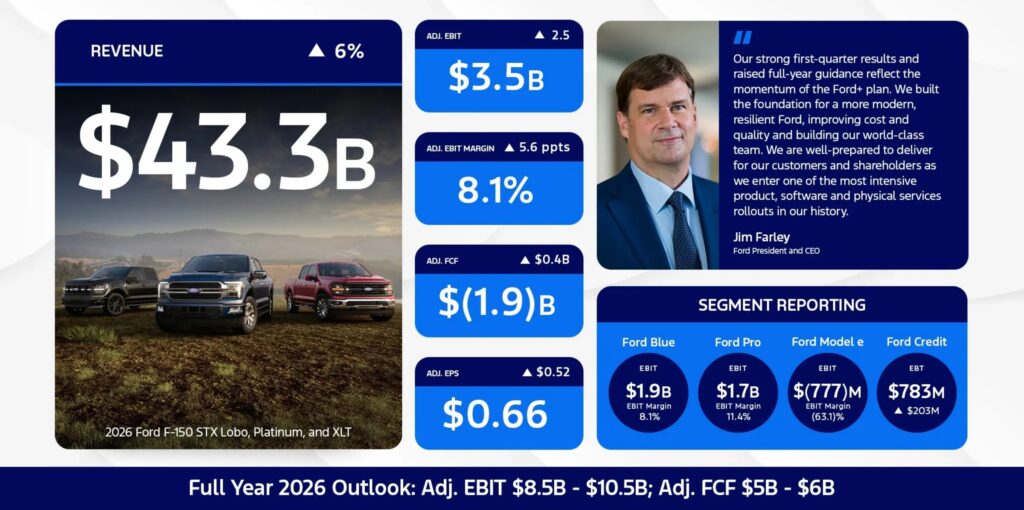
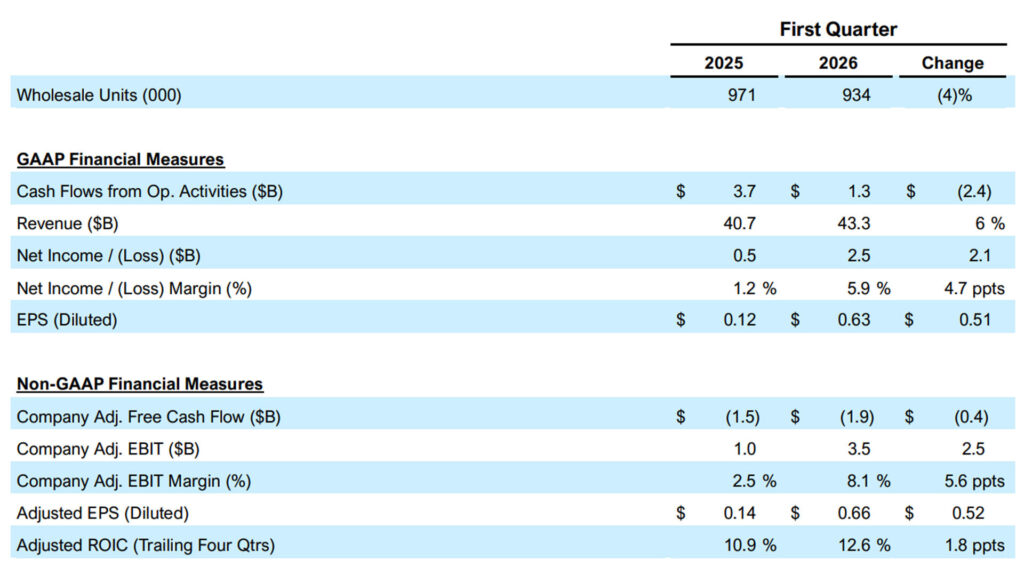
Ford has released its first-quarter financial results, which exceeded expectations despite a decline in US sales. The company’s revenue rose by 6% to $43.3 billion. Net profit reached $2.5 billion, while adjusted earnings before interest and taxes (EBIT) stood at $3.5 billion.
Notably, Ford’s US sales fell by 8.8% in the first quarter to 457,315 units. However, this did not prevent the company from showing strong financial performance.
Tax Reimbursement and Cash Reserves
These results are partly explained by a “one-time benefit from IEEPA tariffs” amounting to $1.3 billion. This is a delicate way of saying that Trump’s tariffs hit the automaker, but the company received a significant reimbursement.
Ford also has a solid cash reserve of $22.0 billion. The company plans to pay shareholders dividends of 15 cents per share on June 1st. This is a decent indicator given that the company’s shares are trading at around $12.
Model e Division: Losses Narrowing
The Ford Model e division, which focuses on electric vehicles, continues to reduce losses. In the first quarter, it lost $777 million. This is still a huge amount, but it is lower compared to the $849 million loss for the same period in 2025.
Ford Blue Division: Profit Thanks to Traditional Models
In contrast, the Ford Blue division earned over $1.9 billion thanks to high sales of models with gasoline and diesel engines, such as the Bronco, Explorer, and Expedition. The company also noted the “continued strength of the F-Series,” although sales of this lineup fell by 16% in the first quarter due to the aftermath of a fire at an aluminum supplier’s plant.
Forecasts for 2026 and Plans
Ford has raised its forecast for 2026. The company now expects adjusted EBIT of $8.5-10.5 billion, up from the initial estimate of $8.0-10.0 billion. It also forecasts adjusted free cash flow of $5.0-6.0 billion and capital expenditures of $9.5-10.5 billion. These expenditures “reflect a shift in focus toward growth opportunities with higher returns, including $1.5 billion for Ford Energy.”

At the same time, the automaker cautioned that “the forecast does not include the potential impact of a prolonged conflict in the Middle East or a significant downturn in the US economy.” Both of these scenarios are real, as the Strait of Hormuz remains closed, gasoline prices are rising, and consumers are concerned.
Cost Reductions and Model Lineup Updates
Despite many factors for concern, Ford reported that it achieved material and warranty cost reductions of $1.5 billion last year. The company plans to cut another $1 billion in 2026. Additionally, Ford noted that 80% of its North American portfolio will be updated by 2029. This includes the new F-150 and F-Series Super Duty, as well as the long-awaited mid-size electric pickup.

Thus, Ford demonstrates the ability to generate profit even amid falling sales, largely thanks to one-time tax revenues. The company is actively investing in the future, particularly in electrification and model lineup updates, but remains vulnerable to external economic and geopolitical risks. The narrowing losses in the electric vehicle division are a positive signal, but this area still requires significant resources. Overall, the company’s financial position appears stable thanks to a strong cash reserve, although the future will depend on the ability to adapt to changing market conditions and successfully launch new models.