


Reuters investigation: Is Tesla’s FSD really as safe as they say?
Tesla and its CEO Elon Musk have emphasized the importance of true autonomous driving for years. During this time, the technology has often been presented as if it is just around the corner — within a few months or after a few software updates. Musk has even stated that the brand’s value directly depends on solving the problem of autonomous driving. However, a new investigation shows that several former and current employees warn: do not believe the hype.
Internal testimony: Problems that were hidden
The investigation, conducted by Reuters, delves deep into Tesla’s Full Self-Driving program. It purportedly contains insider information from those who still work at the company and former employees. The result is both alarming and reassuring.
Reuters reports that it spoke with former data annotators, autonomous driving engineers, researchers, and safety experts, and also studied Tesla’s public safety claims and their methodology. The publication found that employees who helped train FSD regularly reviewed videos in which Tesla had problems with school buses, emergency services, construction sites, pedestrians, and speed control.
Several former employees, according to Reuters, personally would not trust the system to drive them.
One of the most emotional claims concerns an internal Tesla group unofficially called the “trauma team.” Reuters claims these employees focused on near-collisions with pedestrians, including children. Former employees also described videos in which Teslas with FSD allegedly hit animals, missed hazards, or required human intervention at the last moment.
Safety statistics: Is FSD really safer than a human?
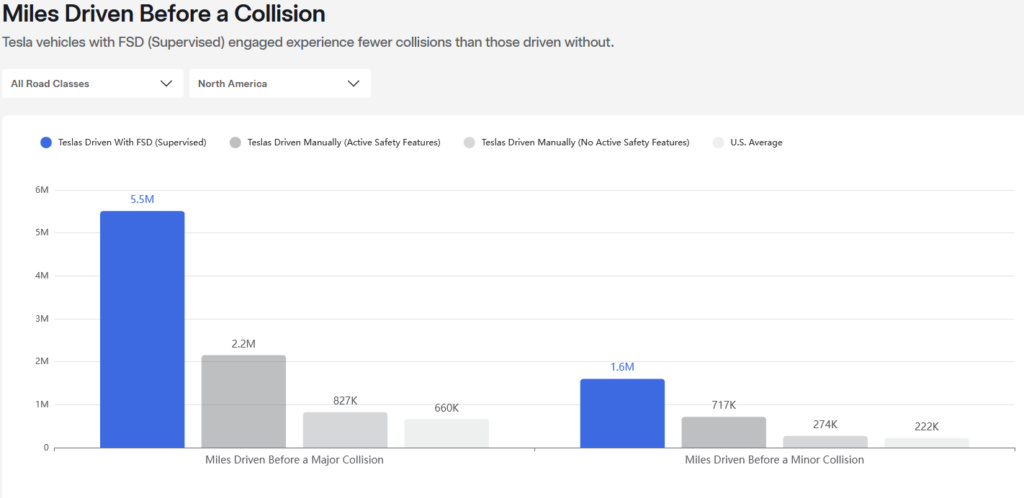
Then there is the statistical side of the story, which may be the most important part of the entire investigation. For many years, Tesla executives, including Elon Musk, have publicly claimed that Full Self-Driving is significantly safer than human drivers. Reuters reports that outside researchers examined Tesla’s methodology and found several serious problems with the comparisons used.
Reuters claims that Tesla compared accidents involving airbag deployment in cars with FSD to broader federal accident datasets that included less severe incidents. Researchers also criticized Tesla for comparing relatively new cars with the entire US fleet, whose average age is significantly over ten years.
The investigation also claims that Tesla only counts certain accidents if they occur within five seconds of FSD disengagement, although federal reporting standards use a longer 30-second interval. Researchers interviewed by Reuters claim that this selection could create a much more optimistic picture of FSD safety than a stricter comparison would show.
Double standards: Geofences and reality
Of course, some of the biggest “revelations” may not surprise those who closely follow the field of autonomous vehicles. To some extent, they may even be reassuring. Reuters pays significant attention to Tesla’s alleged use of mapped zones for robotaxis and the careful preparation of routes before launches in places like Austin and California. Former employees described how teams annotated roads, curbs, loading zones, signs, and complex road situations to ensure successful demonstrations and smoother operation.
Elon Musk in 2019: “If you need a geofence, you don’t have true self-driving!”
This is notable because Musk has repeatedly criticized competitors like Waymo for their heavy reliance on mapped operational zones, rather than generalized artificial intelligence capable of working anywhere. In the clip above, he literally says: “If you need a geofence, you don’t have true self-driving.” At the same time, the report reveals something else: Tesla appears obsessively review edge cases, safety interventions, and system failures inside the company.
Honestly, if Tesla were not doing this, it would be much more alarming.
The Reuters investigation inadvertently exposes a strange duality at the heart of Tesla’s autonomous driving ambitions. Internally, the company seems deeply aware of how challenging autonomous driving remains. Employees review failures, annotate hazards, retrain scenarios, and track disengagements with painstaking detail. Externally, Tesla’s leadership continues to talk about autonomy as if it is constantly “just about to happen.” This gap between engineering reality and public rhetoric may be the real story.

Credit: Tesla
This investigation highlights that, despite loud claims, FSD technology still faces fundamental challenges requiring significant human oversight and preparation. Tesla’s internal efforts to analyze errors suggest the company understands the complexity of the task, but public optimism may mislead consumers about the system’s real level of readiness. It is a reminder that the path to true autonomous driving remains long and thorny, even for industry leaders.