


Electric Vehicle Market Dynamics
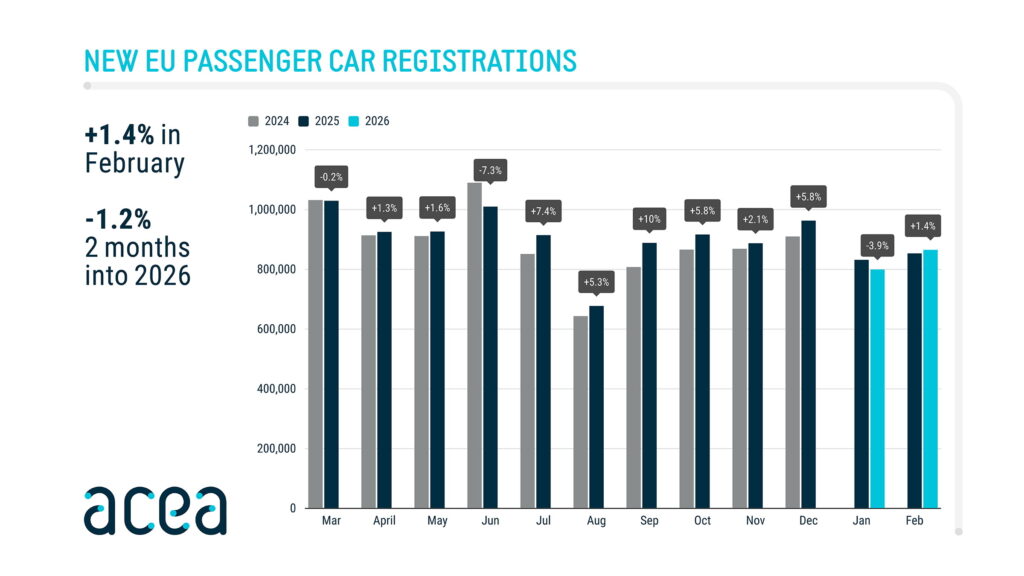
Sales of battery electric vehicles in the European Union continue to grow and are already approaching the figures for gasoline cars. Due to the ongoing war in Iran and the sharp jump in oil prices, demand for electric cars could increase even further. However, the overall market situation remains ambiguous: the total number of new car registrations in the EU, Britain, and EFTA countries in February increased by only 1.7%, to 979,321 units, indicating moderate overall growth.
Registration Statistics
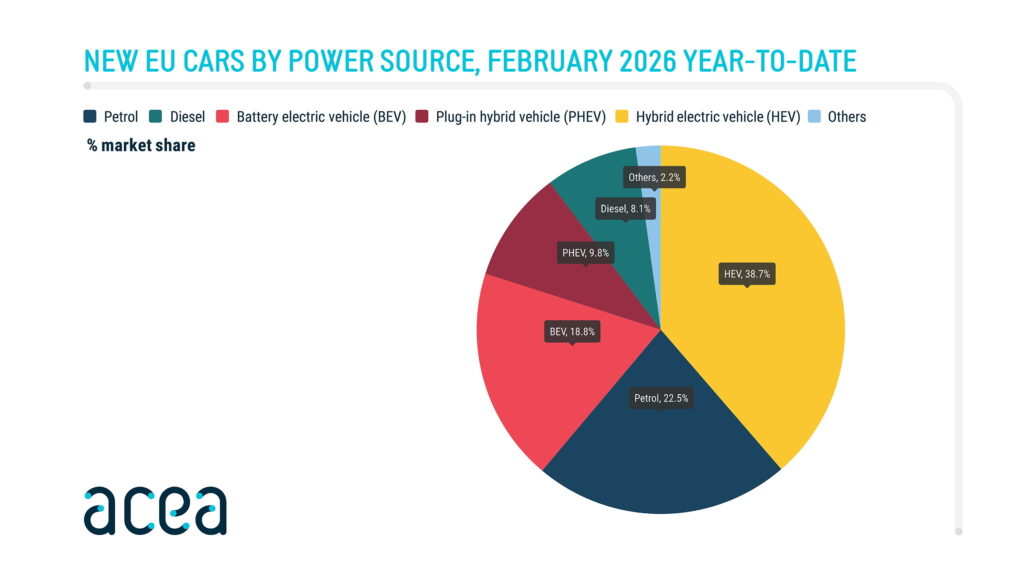
Registration data from the European ACEA shows that electric vehicles accounted for 18.8% of the new market in January and February, a noticeable increase compared to 15.2% for the same period last year. In total, 312,369 electric vehicles were registered in the first two months of the year, partly thanks to France (an increase of 38.5%) and Germany (an increase of 26.3%).
This growth is supported by a wave of more affordable electric vehicle models and national incentive programs that continue to encourage their purchase.
However, not every European country bought more electric vehicles. In fact, sales of electric cars declined significantly – by 34.9% in the Netherlands and by 11% in Belgium.


Competition Between Leaders
Notably, Tesla registrations increased by 11.8% year-on-year, breaking a prolonged decline, although the brand still lagged behind BYD by a small margin. Both brands had a market share of 1.8%, while BYD’s sales for the same period more than doubled, indicating intensifying competition in the upper segment of electric vehicles.
Popularity of Hybrids
Hybrid cars remain the most popular powertrain choice in Europe, accounting for 38.7% of the market. This puts hybrids (HEV) significantly ahead of cars running solely on gasoline, whose share this year was 22.5% of new registrations.
In February alone, battery electric vehicles, plug-in hybrids, and conventional hybrids together accounted for 67% of registrations, compared to 58.5% a year earlier.

Decline of Gasoline Cars
Sales of gasoline cars are also declining, falling by 23.3% in February, with France reporting a massive drop of 48.5%. Registrations also fell by 22.8% in Germany, 20.8% in Spain, and 18.6% in Italy. Last year, gasoline cars had a 29% market share, and if current trends continue, electric vehicles could overtake them as early as next year.
Other Powertrain Types
Plug-in hybrids (PHEV) ranked fourth in popularity after conventional hybrids, gasoline cars, and electric vehicles, gaining a 9.8% market share, up from 7.4% last year. Sales reached 162,751 in the first two months, partly thanks to Italy (an increase of 116.1%), Spain (an increase of 71.5%), and Germany (an increase of 23.8%). Behind PHEV were diesel cars with an 8.1% share (a decline of 17.7%) and other types with a 2.2% share.
This data clearly outlines the structural transformation of the European automotive market. The transition to electric vehicles and hybrids is gaining momentum not only due to environmental awareness but also because of external economic factors, such as fuel price volatility. The success of brands like BYD, which is rapidly catching up to Tesla, indicates that the competitive battle for the future of mobility is becoming increasingly global and intense. The difference in the pace of transition between individual countries, for example, the sharp decline in the Netherlands against the backdrop of growth in France, underscores the importance of national policy and infrastructure support in shaping demand.