


The US electric vehicle market continues to show complex dynamics. Here are the key points characterizing the situation:
Sales Decline After Incentive Cancellation
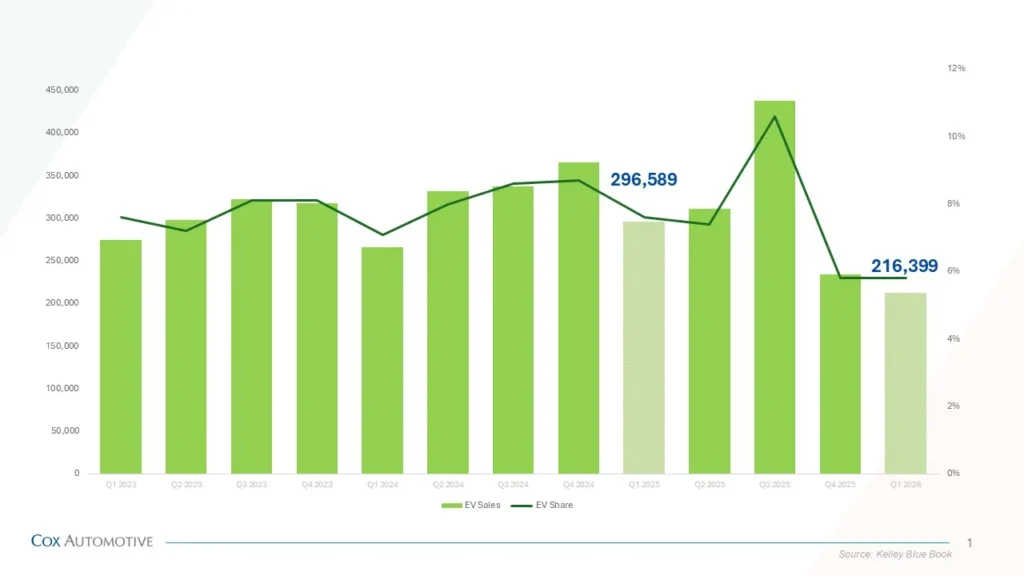
The decline in new electric vehicle sales in the US became expected after the Trump administration canceled the long-term federal tax credit of $7,500 in late September. New data shows that sales plummeted in the last quarter of last year but have since begun to stabilize somewhat, which may indicate reaching a new level.
In the first three months of this year, an estimated 216,399 new electric vehicles were sold nationwide. This is 27 percent less than in the first quarter of 2025, and also 7.8 percent less than in the fourth quarter of 2025.
Although this decline is noticeable, it was not as significant as the drop observed in the fourth quarter of last year, when sales decreased by 36 percent compared to the same period last year and by 46 percent compared to the previous quarter, which was the last quarter before the tax credit cancellation.

“The US electric vehicle market has clearly entered a new phase,” noted Cox Automotive’s Director of Analytics, Stephanie Valdez Streaty. “With the cancellation of federal incentives, the first quarter reflected a necessary reset — sales slowed, and market shares shifted. What comes next will depend less on policy and more on fundamental factors: more affordable products, smarter pricing strategies, and continued investment in infrastructure. These long-term fundamentals continue to support EV growth. The timeline has changed, but the direction has not.”
Winners and Losers
Most brands experienced a significant drop in electric vehicle sales in the past quarter compared to the same period in 2025. For example, Audi’s electric vehicle sales fell by 89.6 percent, BMW’s by 63.3 percent, Dodge’s by 87.7 percent, Genesis’s by 89 percent, and Honda’s by 65.3 percent. However, there were a few exceptions to this general trend.
For example, Lexus electric vehicle sales increased by 206.7 percent to 4,456 units, Rivian’s by 21.2 percent to 10,365, Cadillac’s by 19.8 percent, Lucid’s by 3.5 percent, and Toyota’s electric vehicle sales grew by 79 percent to 10,042 due to strong demand for the updated BZ.
Detailed Sales Statistics
The table below provides detailed electric vehicle sales statistics by brand in the US for the first quarter of 2026 compared to the same period in 2025.
| Brand | Sales Q1 2026 | Sales Q1 2025 | % Change |
| Acura | 73 | 4,813 | -98.5% |
| Audi | 635 | 5,905 | -89.6% |
| BMW | 4,963 | 13,538 | -63.3% |
| Cadillac | 9,551 | 7,972 | 19.8% |
| Chevrolet | 13,359 | 19,186 | -30.4% |
| Dodge | 240 | 1,947 | -87.7% |
| Fiat | 68 | 448 | -84.8% |
| Ford | 6,860 | 22,550 | -69.6% |
| Genesis | 164 | 1,496 | -89.0% |
| GMC | 2,941 | 4,728 | -37.8% |
| Honda | 3,319 | 9,561 | -65.3% |
| Hyundai | 12,662 | 12,851 | -1.5% |
| Jeep | 193 | 2,595 | -92.6% |
| Kia | 5,279 | 8,695 | -39.3% |
| Lexus | 4,456 | 1,454 | 206.7% |
| Lucid | 2,551 | 2,464 | 3.5% |
| Mercedes | 1,112 | 3,570 | -68.9% |
| Mini | 202 | 669 | -69.8% |
| Nissan | 724 | 6,471 | -88.8% |
| Porsche | 1,280 | 4,358 | -70.6% |
| Ram | 223 | – | – |
| Rivian | 10,365 | 8,553 | 21.2% |
| Subaru | 3,041 | 3,131 | -2.9% |
| Tesla | 117,300 | 128,100 | -8.4% |
| Toyota | 10,042 | 5,610 | 79.0% |
| Volvo | 2,343 | 3,026 | -22.6% |
| VW | 1,177 | 9,564 | -87.7% |
| Other brands | 1,276 | 3,334 | -61.7% |
| Total (estimates) | 216,399 | 296,589 | -27.0% |
These figures clearly illustrate how the policy change affected different market players. Although the overall picture is negative, the success of companies like Toyota and Rivian shows that even in difficult conditions, opportunities for growth can be found. This may be related to successful models, aggressive marketing, or better product positioning. The stability of Hyundai and Subaru sales, which showed only a slight decline, is also noteworthy, as it indicates customer loyalty or the effectiveness of their business strategies in the new conditions. The future of the market will now likely depend on how quickly manufacturers can adapt to the reality without government subsidies, focusing on cost, technology, and the real needs of the end consumer.