


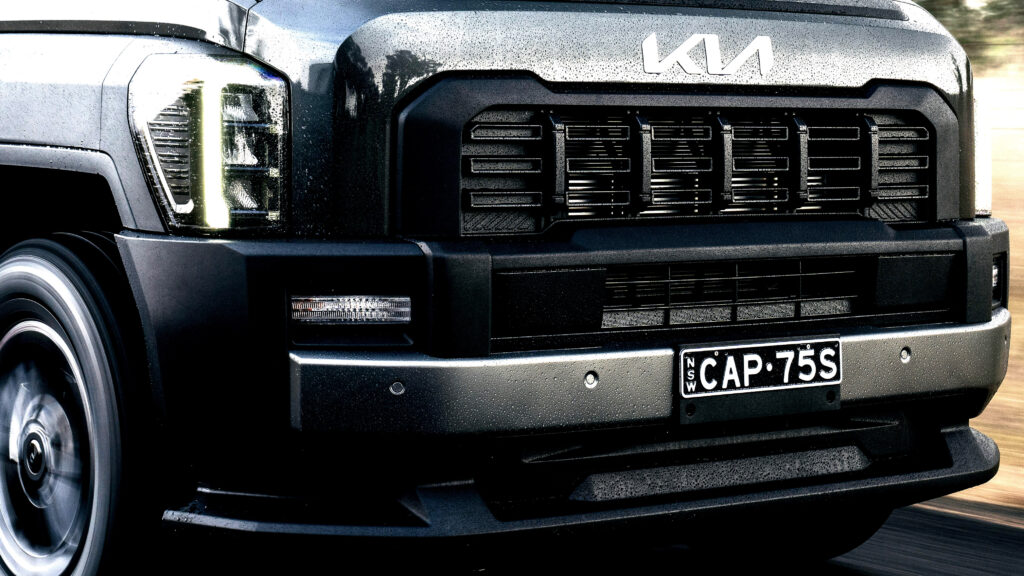
The start of sales for the mid-size Kia Tasman pickup in Australia has proven to be significantly more difficult than the company’s management expected. Instead of ambitious plans, the real numbers show a serious lag.
Unoptimistic Starting Results
Dreams of selling 20,000 Tasman pickups in the first year in the Australian market have collided with harsh realities. According to GoAuto, only 3,716 vehicles were registered in the first five months since its debut in Australia. From July to September, this figure was 2,262 units, clearly indicating the brand’s overly optimistic initial forecasts.
At this rate, the annual sales volume will barely reach 11,148 cars, which is only 19% of the planned production of 60,000 units at the plant in South Korea. As CarExpert reports, the Tasman’s share in Australia’s mid-size pickup market today fluctuates at just 1-1.8%, where experienced competitors dominate.
The Problem with Base Trims
Kia Australia’s Chief Operating Officer, Dennis Piccoli, acknowledged the model’s weak points during a media briefing. He noted that the top X-Line and X-Pro versions are performing “relatively okay,” but the base trims are not attracting the expected share of buyers. This gap is particularly noticeable in the segment aimed at corporate fleets, where competitors traditionally have large sales volumes.
We see where we are losing. With Tasman, our goals have always been quite ambitious. The reality is that the dual-cab segment has become much more fragmented. This can relate to powertrains – hybrid or diesel – the number of brands present there that are heavily reliant on their product, and the overall level of aggressiveness in the market… it is extremely competitive.


Competition is not easing up. The next year looks challenging due to the launch of the new Toyota Hilux, the updated Nissan Navara, and the constant improvement of the bestseller Ford Ranger. The Tasman will have to fight seriously for buyers’ attention.
Searching for a Path to Success
Despite this, Kia believes in the possibility of correcting the situation. Piccoli is confident that sales will increase in early 2026, mainly thanks to upcoming deals with corporate fleets. Currently, the company has orders from large fleets, as well as a number of organizations, including government structures, that are testing the Tasman and giving quite favorable feedback.
To make the model more attractive, Kia is currently offering a financial contribution of 2,000 Australian dollars on S, SX, and SX+ trims, which increases to 4,000 dollars for X-Line and X-Pro versions. Additionally, Australian dealers are reportedly offering discounts of over 10% on vehicles in stock.
We are working on it, but our growth plan at this stage to reach 20,000 units may take more than 12 months. Can we sell 20,000? Without a doubt, yes. Do we want to get into a scrap and do what it takes? That is the big question.
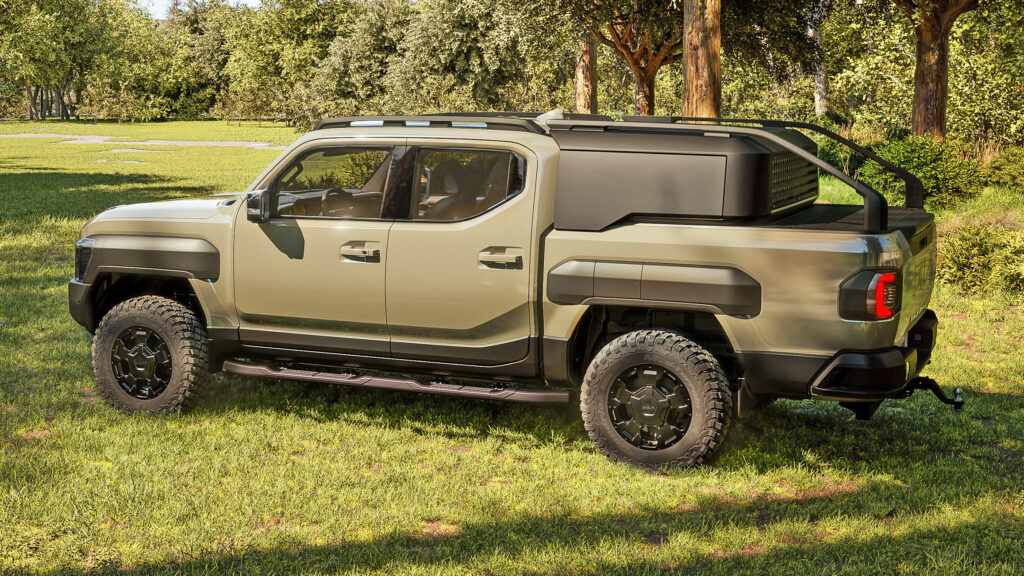
The COO also noted that Tasman sales are not critical for Kia as a whole, emphasizing the importance of a balanced model portfolio for a healthy business.
Future Updates and Changes
According to Roland Rivero, General Manager of Product Planning at Kia Australia, the existing Tasman trim lineup is quite complex and may need simplification based on sales analysis, rather than expansion.
Fleet-oriented models, including more affordable single-cab variants, are expected to arrive between January and March. The question of whether these versions will be accompanied by additional discounts remains open.


Earlier, Rivero revealed that throughout its long lifecycle, the Tasman will receive a number of updates. These are expected to include a hybrid powertrain, a potential facelift, and the appearance of an off-road trim inspired by the Weekender concept.

The Tasman’s situation in the Australian market is a vivid example of the challenges faced by new players entering already established segments with strong competitors. Success here depends not only on product quality but also on flexible pricing policy, correct positioning of different trims, and the ability to quickly respond to changes in market dynamics. Future fleet deliveries and planned updates could be the steps that help correct the initial failures, but achieving the initially announced ambitious indicators will require time and, possibly, a review of the marketing strategy.