


California, which for years set the pace for electric vehicle adoption in the US, is now showing alarming signals. Latest sales data indicates a significant drop in EV registrations in the state in the first quarter of the year, primarily due to a sharp decline in demand for new Tesla models.
Overall ZEV Market Decline
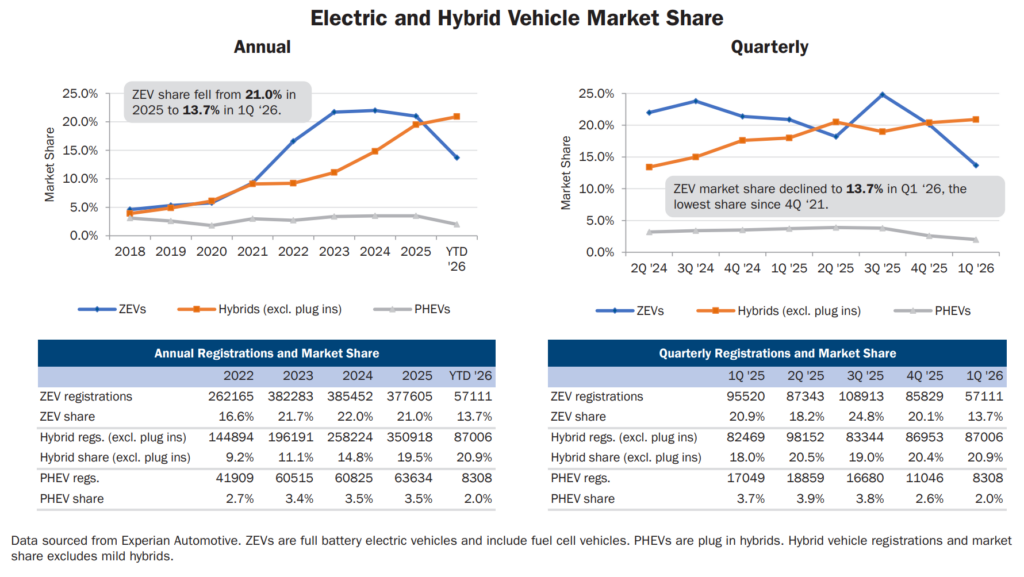
In the first three months of 2026, only 57,111 zero-emission vehicles (ZEVs) were sold in California. This is a 40.2% decrease compared to 95,520 units in the same period last year. Overall new car registrations fell by 8.9% — from 457,525 to 416,810.
The ZEV market share dropped to 13.7% in the first quarter of 2026. For comparison, it was 16.6% in the first quarter of 2022, peaked at 22% in the first quarter of 2024, then declined to 21% in the first quarter of 2025.
Tesla’s Situation
The situation looks particularly challenging for Tesla. Registrations in the first quarter fell by 24.3% — to 31,958 units, compared to 42,211 a year earlier. In absolute terms, no brand lost more. However, in percentage terms, Tesla weathered the storm better than most competitors. Tesla’s share of the EV market rose from 44.2% in the first quarter of 2025 to 56% in the past quarter, but this was not due to improved Tesla performance, rather the collapse of other manufacturers.

Most Brands Suffer Losses
The situation surrounding Tesla is indeed brutal. Acura ZEV sales plummeted from 1,279 to just 11 units in the first quarter — a 99.1% drop. Audi recorded 210 registrations versus 2,319 a year earlier, down 90.9%. BMW lost 58.9% (from 5,301 to 2,180), Chevrolet — 59.6% (to 1,875), Ford — 58.8% (to 2,374). Honda fell by 81.6% (to 832), and Dodge by 79.7% (to 16 units). Hyundai showed relatively better results, losing 30.4% (to 3,586).
Only a few brands managed to grow. Lexus posted an impressive jump of 192.1% — to 1,405 units. Toyota grew by 37.8% (to 2,599), and Lucid added 37.1% (to 1,315). Cadillac edged up by 17.1% (to 1,771).
Reasons for the Downturn
Several factors caused this decline. Vehicle affordability issues remain widespread across the state, as in other regions of the country. High financing costs due to current interest rates, tariffs raising prices, and general inflation also play a role. Additionally, the gradual phase-out of the federal tax credit completed the picture. All these factors together led to a significant downturn.
Top 25 Selling Models (Hybrids, ZEVs & PHEVs)
| Rank | Model | Sales |
| 1 | Tesla Model Y | 22,907 |
| 2 | Toyota Camry | 14,903 |
| 3 | Honda CR-V | 8,315 |
| 4 | Tesla Model 3 | 5,688 |
| 5 | Honda Civic | 5,507 |
| 6 | Toyota RAV4 | 4,770 |
| 7 | Honda Accord | 4,330 |
| 8 | Toyota Corolla | 3,639 |
| 9 | Toyota Sienna | 3,252 |
| 10 | Toyota Grand Highlander | 3,027 |
| 11 | Hyundai Ioniq 5 | 2,778 |
| 12 | Lexus RX | 2,714 |
| 13 | Ford Maverick | 2,631 |
| 14 | Kia Sportage | 2,588 |
| 15 | Toyota bZ4X | 2,527 |
| 16 | Hyundai Santa Fe | 2,201 |
| 17 | Hyundai Tucson | 2,194 |
| 18 | Toyota Prius | 2,139 |
| 19 | Mazda CX-50 | 1,963 |
| 20 | Lexus NX | 1,827 |
| 21 | Kia Niro | 1,805 |
| 22 | Subaru Forester | 1,704 |
| 23 | Tesla Model X | 1,652 |
| 24 | Ford Mustang Mach-E | 1,578 |
| 25 | Rivian R1S | 1,520 |
California ZEV Sales by Brand (2026)
| Brand | Q1-25 | Q1-26 | % Change |
| Acura | 1,279 | 11 | -99.1 |
| Audi | 2,319 | 210 | -90.9 |
| BMW | 5,301 | 2,180 | -58.9 |
| Cadillac | 1,512 | 1,771 | 17.1 |
| Chevrolet | 4,641 | 1,875 | -59.6 |
| Dodge | 79 | 16 | -79.7 |
| Ford | 5,758 | 2,374 | -58.8 |
| Genesis | 546 | 92 | -83.2 |
| GMC | 913 | 376 | -58.8 |
| Honda | 4,510 | 832 | -81.6 |
| Hyundai | 5,156 | 3,586 | -30.4 |
| Jeep | 147 | 42 | -71.4 |
| Kia | 3,002 | 1,554 | -48.2 |
| Lexus | 481 | 1,405 | 192.1 |
| Lucid | 959 | 1,315 | 37.1 |
| Mazda | 2 | 0 | -100.0 |
| Mercedes-Benz | 3,617 | 654 | -81.9 |
| MINI | 207 | 61 | -70.5 |
| Nissan | 1,447 | 150 | -89.6 |
| Others | 1,059 | 133 | -87.4 |
| Polestar | 316 | 219 | -30.7 |
| Porsche | 1,335 | 409 | -69.4 |
| Ram | 1 | 14 | 1,300.0 |
| Rivian | 2,872 | 1,841 | -35.9 |
| Subaru | 924 | 465 | -49.7 |
| Tesla | 42,211 | 31,958 | -24.3 |
| Toyota | 1,886 | 2,599 | 37.8 |
| Volkswagen | 2,404 | 445 | -81.5 |
| Volvo | 636 | 524 | -17.6 |
| TOTAL | 95,520 | 57,111 | -40.2 |
This data shows that the electric vehicle market in California is experiencing a serious crisis that has hit almost all manufacturers. Although Tesla lost the most in absolute numbers, its relative resilience against the backdrop of competitor collapse suggests that the industry’s problems are systemic, not just related to one brand. Growth from Lexus, Toyota, and Lucid demonstrates that consumers are still interested in electric vehicles, but under conditions of more affordable prices or more attractive offerings. The continued decline of ZEV market share could have long-term consequences for California’s environmental goals and the overall development of EV infrastructure in the US.