


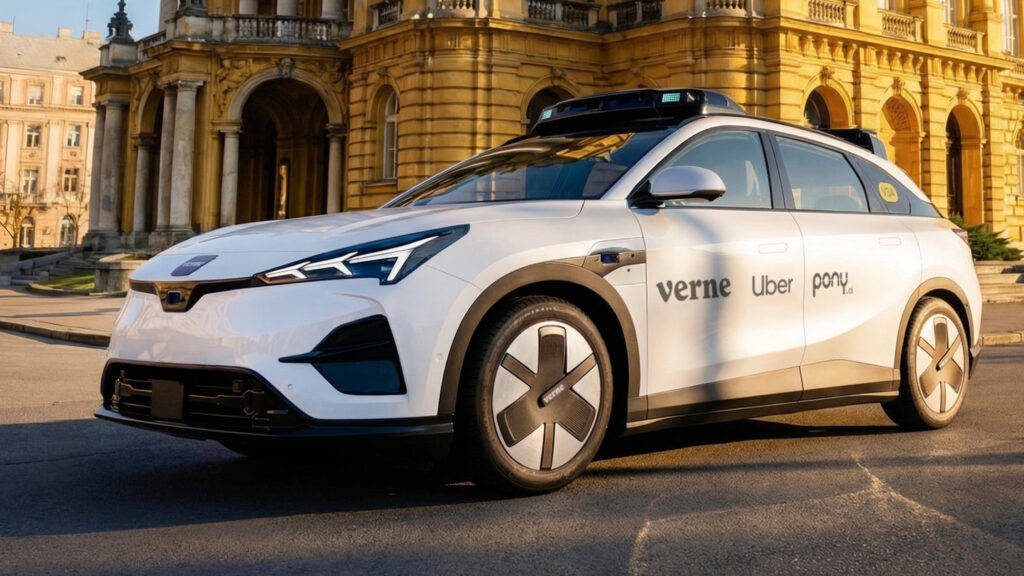
Croatia launches Europe’s first robotaxi fleet using Chinese electric vehicles
Europe has long watched as America and China surge ahead in the autonomous taxi race, but Croatia has finally kicked off this movement in the EU. A startup called Verne, backed by Mate Rimac, has officially launched Europe’s first commercial autonomous taxi service. Self-driving electric vehicles have hit the streets of Zagreb, with early passengers paying almost a symbolic fare for rides.
To impress the public during this month’s launch, Verne set a fixed fee of €1.99 ($2.22) per ride. That is less than many spend on a bottle of water while waiting for an Uber. This cost covers Verne’s entire initial operating zone in Zagreb—an area of 35 square miles (91 sq km) that includes parts of the Croatian capital and the city’s international airport. More roads will be added to the routes later.
How the service works and who is behind it
Currently, the company operates a fleet of 10 electric SUVs based on the Arcfox Alpha T5 from Chinese automaker BAIC. The complex autonomous component is provided by Pony.ai, one of China’s leading self-driving technology companies. Customers can order a ride through Verne’s own app, although integration with Uber is also planned for the future, which will undoubtedly significantly boost demand. For now, only 300 people have access to the app, but several thousand are already waiting for verification.
Do the robotaxis truly drive without a driver?
Before anyone imagines empty robotic shuttles wandering the medieval streets unsupervised, it is worth noting: for now, there is a catch. Each robotaxi currently has a trained safety operator behind the wheel to comply with local regulations during this initial phase. However, Verne plans to remove the human supervisor by the end of the year.
Confident driving in traffic
Even now, the actual driving is largely autonomous. AFP journalists who tested the service described how the cars confidently maneuver through traffic, overtake slower vehicles, and handle unexpected obstacles without human intervention.
During one of AFP’s rides, the car braked sharply after another driver pulled into the oncoming lane. The robotaxi politely apologized via an electronic voice assistant—more courtesy than you might get from most regular taxi drivers.
Ambitious plans for the future
The startup is backed by Mate Rimac, a Croatian entrepreneur better known for creating extremely fast electric hypercars and running Bugatti Rimac. But Verne’s ambitions extend far beyond testing autonomous vehicles in Rimac’s homeland.
The company reports that negotiations are already underway with 11 cities in Europe, the UK, and the Middle East. In total, over 30 additional cities are under consideration. Verne also plans to eventually replace the adapted Chinese SUVs with its own two-seat autonomous module, first shown several years ago.
The launch of Verne in Zagreb is not just a local experiment but a significant signal for all of European mobility. While regulators in other EU countries remain cautious about autonomous technologies, Croatia is effectively becoming a testing ground for the future of transportation. The symbolic price of €1.99 is a marketing move, but it allows for quickly gathering statistics and acclimating residents to the new reality. If Verne succeeds in fulfilling its promise to remove the operator by the end of the year, it will set a precedent that could accelerate the adoption of robotaxis in other European capitals, especially given the expansion plans to over 30 cities.