


Rivian refuses to bring back physical buttons, betting on voice control
Some automakers, such as Volkswagen, Audi, Mercedes-Benz, and Hyundai, have yielded to customer demands and begun bringing back physical buttons. However, Rivian has no intention of joining this trend. The company insists that its advanced AI-based voice assistant is a better way to control the car’s features.
Recently, Rivian’s Chief Software Officer and co-CEO of the Rivian and Volkswagen joint venture, Wassym Bensaid, spoke with The Verge. He talked about the new Rivian Assistant, which appeared on existing R1 models in mid-May. This assistant is built on a shared multimodal AI foundation and can control the car’s primary functions, including climate control.
Existing Rivian R1 models, as well as the new R2, are almost completely devoid of physical buttons. Given the brand’s commitment to its new assistant, this situation is unlikely to change anytime soon.
“I deeply believe that voice has a chance to become the primary interface in the car. I also believe that buttons can exist, but they should not be the primary way of interacting with the machine. I think you can do more with voice because it allows you to perform more than one function. You don’t need to fiddle with many functions,” Bensaid said.
Are scroll wheels the solution?
“You don’t need to delve into the touchscreen to find certain functions. A great voice experience can elevate all of this to a new level, allowing users to communicate with the car as if it were a person and truly take the overall experience to the next level,” he added.
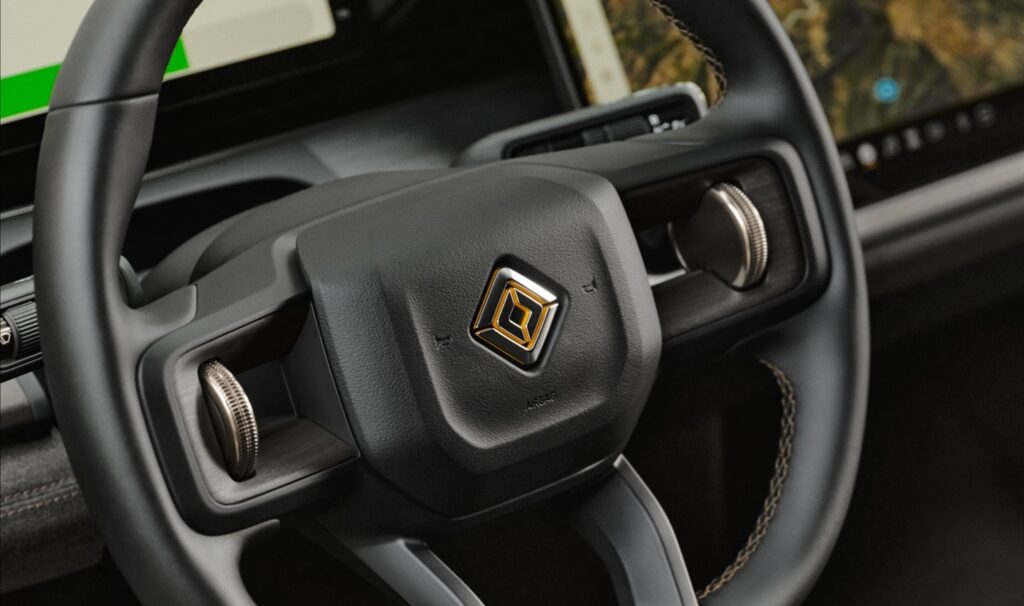
Bensaid also noted that the R2 model does not have traditional climate control buttons. Instead, large scroll wheels on the steering wheel allow you to adjust settings such as fan speed on the go. While not quite buttons, this solution seems better than tapping a small icon on a touchscreen to change the fan speed.
According to Rivian, “the only reason drivers and consumers do not interact with the car through voice is that, frankly speaking, the technology up to this point has been broken.” The key difference between Rivian’s assistant and its competitors is that it uses its own Android-based infotainment system, which does not support Android Auto or Apple CarPlay. Thus, the AI assistant works seamlessly regardless of which screen is displayed.
Rivian also notes that the system uses a more conversational approach than traditional voice assistants. For example, instead of commanding, “Open the front trunk,” you could simply say, “I have a bag in the front of the car,” and the assistant will open the trunk itself. This sounds quite convenient, although many would still prefer a few physical buttons.
This approach by Rivian demonstrates a bold vision for the future of automotive interfaces, where voice becomes the primary control tool. While the technology looks promising, it requires drivers to have complete trust in artificial intelligence and a willingness to give up the tactile feedback that physical buttons provide. Whether this will become the new standard or remain a niche solution, time will tell, but it is already clear that Rivian is betting on innovation rather than nostalgia.