


Key Facts About Rivian R2 Production Costs
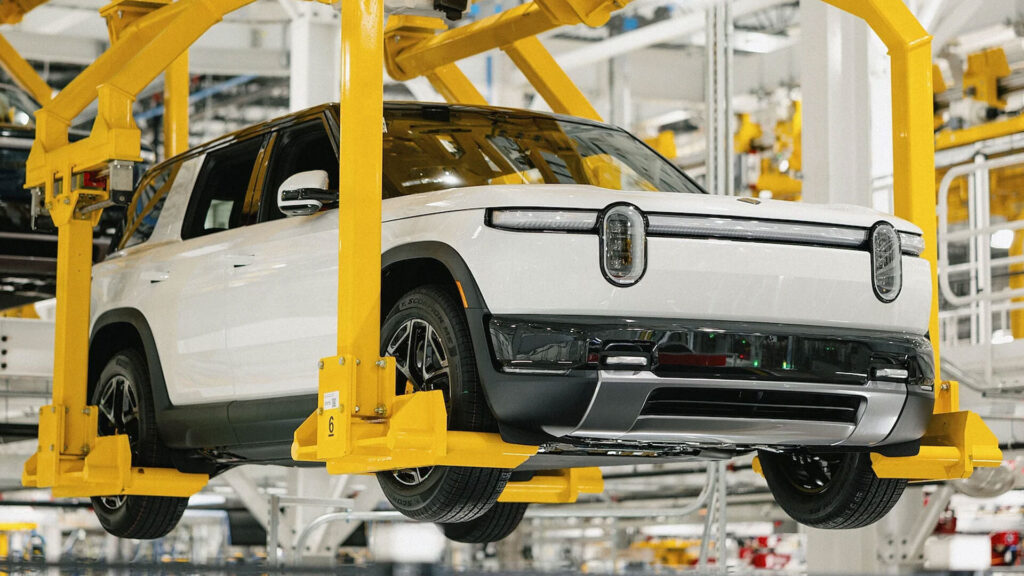
Rivian once broke the mold by launching the electric R1T pickup truck ahead of its competitors. Now, the company is trying to solidify its position in the industry with the all-new R2 SUV. A new report sheds light on how Rivian managed to cut costs without sacrificing quality. According to the brand, producing the R2 costs about half as much as the R1S, while maintaining the performance and functionality that fans have come to love.
Simplicity as the Foundation of Savings
At the core of Rivian’s approach to cost reduction is radical simplification. The new zonal electrical architecture significantly reduces wiring complexity: harness length is cut by 2.3 miles, and the number of connectors is reduced by 60%. High-voltage cabling is reduced by 70% thanks to consolidating several power modules into a single unit.
Innovations in the Powertrain
The same philosophy applies to the powertrain. Rivian’s new drive unit, called “Maximus,” uses 41% fewer parts compared to the Enduro units used in the R1 lineup. By integrating the inverter directly into the drive unit and using its housing as a mounting element, Rivian reduces both material costs and assembly time.
Read also: Rivian Lost $416 Million Last Quarter and Places a Big Bet on Georgia
Rethinking Sensors and Suspension
According to InsideEVs, even the sensors have been reworked. Replacing ultrasonic sensors with corner radars achieves a 50% cost saving. This move reflects a general trend towards using fewer, but more functional, components. Theoretically, this could help Rivian reduce repair costs, a known issue for the brand.
The front suspension has moved away from the more complex double-wishbone design used in the R1 in favor of a simpler McPherson strut setup, reducing costs by 70%. Large cast sections reduce the number of underbody parts by 90%, and the complexity of the rear doors has been reduced by 65%.
Scale and Size as Success Factors
There is also a less obvious but equally important factor: scale. When Rivian launched the R1T and R1S, it was a newcomer producing expensive vehicles in small batches. Now, with higher production volume targets, the company can negotiate better prices with suppliers. For instance, the windshield for the R2 reportedly costs half as much as the one for the R1. Add to that the fact that the R2 is simply smaller and therefore uses less raw material, and the math starts to make sense. For now, it remains to be seen how Rivian will handle production and sales.
This approach to design and manufacturing demonstrates that Rivian is betting not only on lowering the price but also on improving technological sophistication and reliability. Reducing the number of parts and simplifying assemblies typically leads to fewer potential failure points, which could positively impact the brand’s long-term reputation. If the company manages to implement these plans in mass production, the R2 could become not just a more affordable car, but also a more reliable one, which is critically important for conquering the mass market.