


What is the essence of Hyundai’s new approach
Ordinary parking lots are often cramped and overcrowded, but Hyundai believes parking robots could be the solution to this problem. They are expected to reduce the number of minor accidents and improve space efficiency in multi-story garages.
To demonstrate the potential of such technology, a consortium of Hyundai companies, including Hyundai Motor, Hyundai Wia, and Hyundai E&C, will conduct a pilot project in a residential complex in the city of Siheung, southwest of Seoul.
How parking robots work
As part of the program, two sets of Hyundai Wia robots will be installed in the underground parking lot of the residential complex. They will manage 53 parking spaces. This is expected to provide significant benefits to both residents and parking operators.
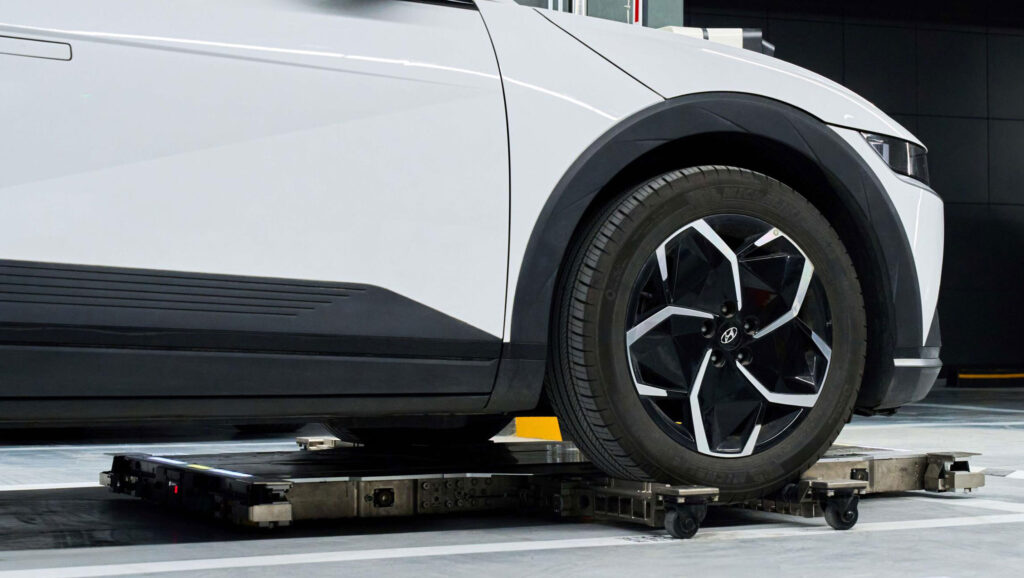
The key element of the system is small robots only 4.3 inches (110 mm) thick. According to Hyundai, they drive under the vehicle, lift the wheels, and move the entire car. The robots are equipped with lidar and can automatically park vehicles weighing up to 7,496 pounds (3,400 kg).
The maximum speed of the robots is low — only 2.7 miles per hour (4.3 km/h). However, this does not cause any inconvenience to the driver: they simply get out of the car in a dedicated zone and leave the rest to the robots. When it is time to leave, the owner calls the robot via a kiosk or terminal, and it brings the car back.
What this gives drivers and parking owners
Since there is no longer any need to worry about opening doors, cars can be parked very close to one another. In addition, the robots can move in “all directions,” allowing them to enter tight spots.
This benefits everyone: drivers will not have to spend time looking for a free spot, and garage owners will be able to make the most of the available space. There are also benefits for the environment and pedestrian safety, because fewer cars are moving chaotically around the parking area.
What they expect from the pilot project
Hyundai hopes to obtain a large amount of data during the trials. The company is interested in “average waiting time, throughput, and robot utilization,” as well as the impact of improved traffic and more efficient use of space. Separately, specialists are working on a methodology for calculating the optimal number of parking spaces and robots for each specific building.
Such solutions are no longer science fiction: Mercedes-Benz has an automated valet parking system that allows cars to independently find a place in a parking lot. However, Hyundai’s approach differs in that the robots can be installed in existing garages without major reconstruction. If the pilot project in Siheung proves successful, the technology could be extended to other residential complexes, office centers, and public parking lots.