


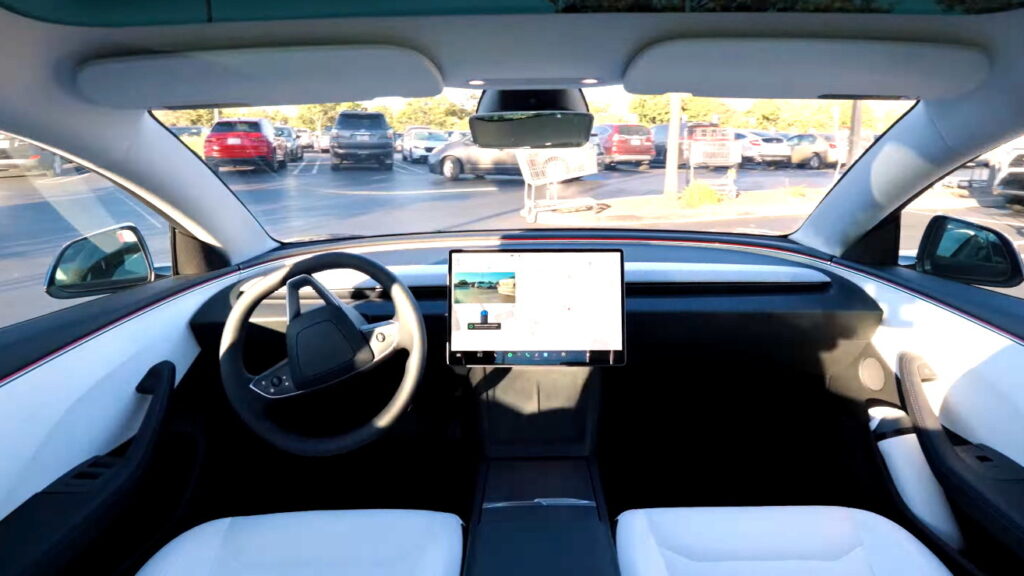
Problems with autonomous driving
Developing and building fully autonomous vehicles is no easy task. Tesla knows this well, having worked on the technology for over ten years, but it has yet to perfect it. Judging by a recent video of a Model Y from the robotaxi fleet in Austin, Texas, getting into trouble, Tesla still has a long way to go.
The video was recently posted on Reddit by a user who frequently uses Tesla robotaxis in Austin. After watching this clip, you might think twice before using such a service yourself. For unknown reasons, the Model Y attempted to make a right turn at a large intersection, but failed to notice that the inner corner of the road was blocked by bollards for pedestrian safety.
Incident at the intersection
A human driver would immediately have seen those bollards and realized they needed to go around them. Instead, the Tesla Model Y simply drove straight into the blocked-off area and froze there for a few seconds, apparently realizing it was stuck. Unable to back up and correct the mistake, the robotaxi tried to squeeze between two bollards, clipping them.
Reddit users quickly identified the intersection where the incident occurred. A Google Street View search showed that the bollards had been there since at least February 2024.
The video was posted on Reddit by user /bladerskb.
Cybercab heading to routes
Despite such incidents, Tesla appears to be continuing to expand its robotaxi fleet in Austin. According to a recent report, the company has completed local testing of the Cybercab with employees on private roads and is now preparing to add the Cybercab to its fleet and make it available to the public.
It is not yet known whether the Cybercab’s self-driving capabilities will be better than those of other Tesla models. It is known to have more RAM and an upgraded AI4 Fully Self-Driving computer. Whether it will actually perform better than the Model Y in this video remains to be seen, but, as has often been the case with Tesla, the public will once again serve as guinea pigs.
It is worth noting that Texas has become a kind of testing ground for Tesla: back in 2023, the company received permission to test autonomous vehicles without a driver behind the wheel in the state. Competitors, including Waymo, are also actively testing their robotaxis in Austin. At the same time, Waymo is much more cautious in expanding its service area and relies on detailed maps and additional sensors. Tesla, meanwhile, is betting exclusively on cameras and neural networks, which worries critics — especially after a robotaxi hit an obstacle that a human would have easily avoided. If the Cybercab runs into similar problems right after launch, it could undermine public trust in Tesla’s robotaxi program.