


Update of the Korean Flagship
It has been ten years since Hyundai discontinued sales of its flagship Azera sedan in the US and Canada. However, in its home market of Korea, this model continues to live on under the Grandeur name and is even the most popular car on the market. Now, three and a half years after the debut of the seventh-generation model, Hyundai is preparing its mid-lifecycle update.
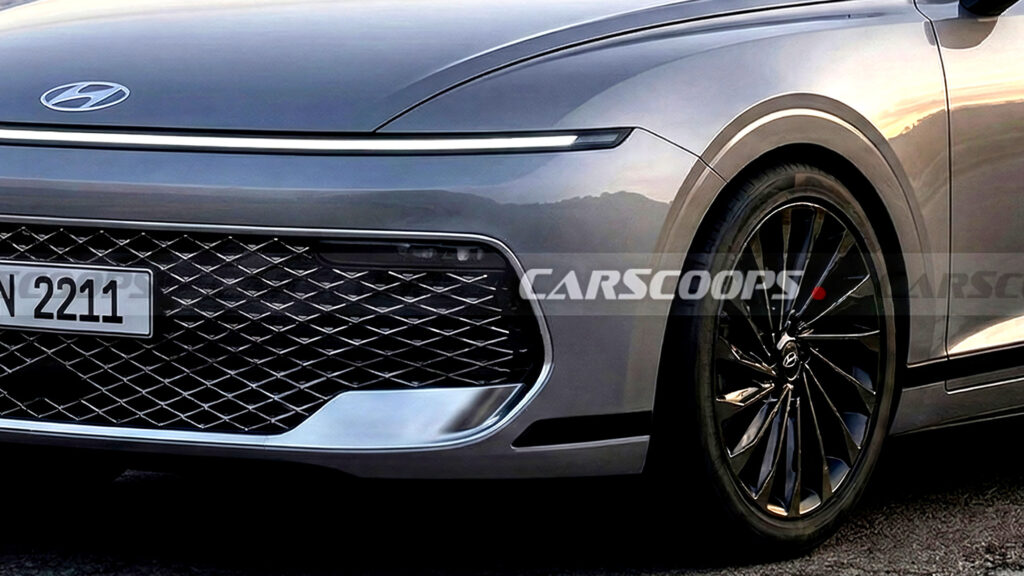
Recently, photos of a camouflaged prototype appeared, followed by leaked images revealing most details of the updated flagship sedan. These photos allowed for the creation of realistic renderings ahead of the official premiere.
Exterior Changes


At the front, the update focuses on a redesigned bumper. The vertical elements of the split LED headlights have given way to horizontal light elements. These headlights are now integrated into a significantly larger honeycomb grille, adorned with chrome accents.
The side view is expected to remain largely unchanged, although Hyundai designers may introduce new paint colors and wheel designs. It is also reported that thin LED elements may appear on the front fenders between the wheels and doors, continuing the graphics of the front headlights, reminiscent of the latest Genesis models.


At the rear, the sedan has received an updated bumper with a chrome trim around the diffuser, as well as updated LED graphics within the full-width light bar. The rear lights are also expected to integrate turn signals, which were previously hidden in the dark trim of the rear bumper.
Updated Interior and Pleos System
Inside, the car takes a decisive step into the digital era while retaining the high-quality materials and premium design of the current model. A towering portrait-oriented display, impossible not to compare to Tesla’s solutions, now dominates the center console, replacing the previous 12.3-inch multimedia screen and separate 10.25-inch climate control display.
The new screen runs on Hyundai’s Pleos software, developed on Android, which will gradually be implemented across the entire brand lineup.
Fortunately, Hyundai hasn’t fully switched to touch controls. The updated Grandeur retains a row of physical buttons and round dials for drivers who prefer tactile feedback.
To help the driver stay focused on the road, Hyundai placed a significantly thinner digital instrument cluster higher on the dashboard. The steering wheel also loses the retro look of the current model in favor of a cleaner, more modern design with dual central spokes, though the clickable buttons remain. Additionally, the gear selector moves to a steering column stalk, freeing up extra space in the center console for two wireless charging pads.
Technical Part Remains Unchanged
The technical underpinnings appear to remain largely unchanged. The powertrains are expected to be carried over from the previous model. This includes a 1.6-liter turbocharged hybrid setup, a 2.5-liter naturally aspirated gasoline engine, and a top-tier 3.5-liter V6, offered in both gasoline and LPG variants.
The most powerful version of the Grandeur continues to be the V6, producing 295 hp (221 kW / 300 PS), optionally paired with all-wheel drive.
40 Years of Grandeur History
The updated Grandeur is expected to debut around April or May 2026, coinciding with the model’s 40th anniversary at the top of Hyundai’s lineup. The history began in 1986 with the first-generation model, which was essentially a rebadged Mitsubishi Debonair. Since then, the Grandeur has continuously evolved into a modern premium sedan highly valued by many Korean buyers.
In export markets, the Grandeur often wore the Azera badge. It was also sold in North America until 2016, when Hyundai discontinued it as the Genesis brand took over the company’s luxury sedan duties.
The Grandeur’s popularity in the home market shows how important the large sedan segment remains for certain auto markets, even if in other regions of the world they are giving way to crossovers. The update, especially the extensive interior refresh, indicates Hyundai’s desire to keep its flagship relevant and competitive, combining traditional values like build quality with the modern technologies buyers expect. It also demonstrates the brand’s strategy of gradually rolling out the new Pleos infotainment system across the entire lineup, starting with the top model.