


Record Demand for Used Cars in the US: March 2026
As new cars become increasingly less affordable for many Americans, buyers are increasingly turning their attention to the used car market. March showed a sharp increase in activity, which noticeably impacted inventories across the country.
Sales Growth and Inventory Decline
Last month, according to Cox Automotive estimates, approximately 1.62 million used vehicles changed hands through retailers in the US. This is significantly higher compared to the 1.37 million recorded in February. March typically sets the pace for the year, so a strong figure is not unusual, although this number is still 2.9 percent lower than the same month last year. Nevertheless, the daily sales rate increased by 7 percent compared to the previous month, reaching its highest point in the last year.
Importantly, this March’s sales surpassed those of March 2023 and 2024 and were on par with March 2022, when new car supply was constrained due to the Covid-19 pandemic and subsequent microchip shortage, forcing many buyers to turn to used cars.
Inventories Drop to Historic Lows
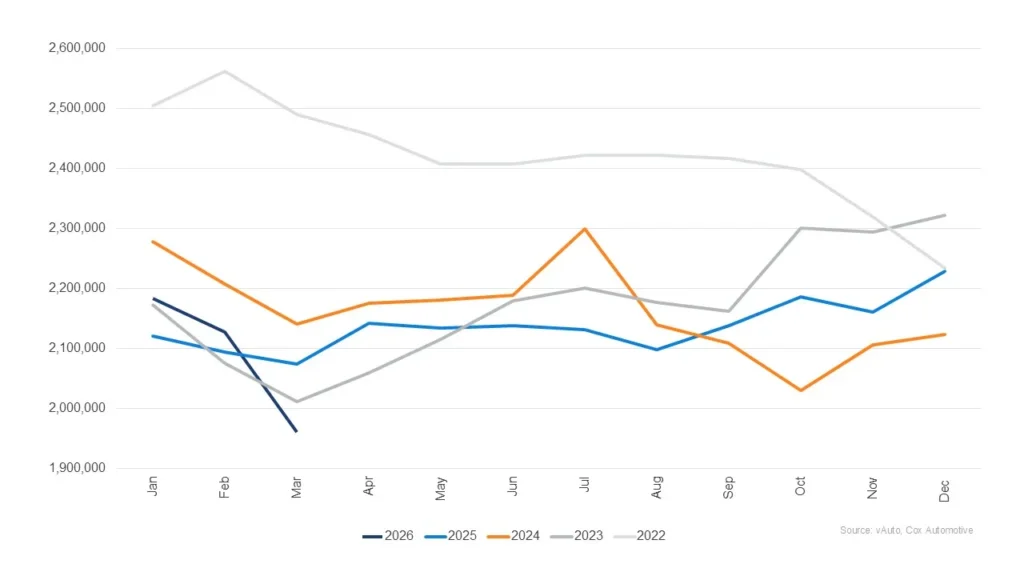
As sales grew, used car inventories at franchised and independent dealers fell to 1.95 million. This is the lowest level since 2019 and 5.9 percent less than in March last year. It is also notably lower by 8.3 percent from the 2.13 million cars that were available in February of this year.
Last month, used car supply fell to 37 days, two days fewer than in March 2025 and seven days fewer than in February. According to Cox Automotive, this is also the lowest day supply indicator since 2021. Overall, this marks the third consecutive monthly decline in inventory levels.
Used Car Market Dynamics (Monthly Data)
| Month | Inventory Volume | Days of Supply | Sales | Average Price |
| Mar 25 | 2,074,208 | 39 | 1,665,898 | $25,206 |
| Apr 25 | 2,141,613 | 42 | 1,526,075 | $25,579 |
| May 25 | 2,134,248 | 44 | 1,514,566 | $25,398 |
| Jun 25 | 2,138,660 | 46 | 1,398,910 | $25,450 |
| Jul 25 | 2,131,032 | 45 | 1,476,304 | $25,397 |
| Aug 25 | 2,098,568 | 42 | 1,550,823 | $25,439 |
| Sep 25 | 2,138,093 | 48 | 1,327,249 | $25,783 |
| Oct 25 | 2,186,513 | 49 | 1,396,327 | $25,875 |
| Nov 25 | 2,160,407 | 49 | 1,314,047 | $25,875 |
| Dec 25 | 2,229,143 | 52 | 1,324,195 | $25,973 |
| Jan 26 | 2,183,361 | 49 | 1,380,480 | $25,570 |
| Feb 26 | 2,127,602 | 44 | 1,366,032 | $25,209 |
| Mar 26 | 1,951,269 | 37 | 1,618,040 | $25,390 |
Prices and Shortage of Cheap Cars
With rising demand for used cars, prices have also increased, albeit slightly. The average used car price in March was $25,390, slightly up from $25,206 in February but lower than $25,570 in January. Overall, average used car prices have remained remarkably stable over the past year, oscillating only between a low of $25,206 and a high of $25,973. This is almost half the average new car price, which exceeds $50,000.
Supply of cars priced below $15,000 remains particularly limited — only 27 days of inventory, significantly below the industry average. The five most popular brands — Ford, Chevrolet, Toyota, Honda, and Nissan — accounted for nearly 51 percent of all used cars sold.
Used Car Inventory in March 2026

This market situation indicates that Americans are increasingly opting for used cars due to high new car prices. The decline in inventories to levels last seen before the pandemic could lead to further price increases, especially for the most affordable models. At the same time, the stability of average used car prices suggests that the market is trying to find a balance between growing demand and limited supply. This creates additional pressure on budget-constrained consumers who face a shortage of cars in the lowest price segment.