


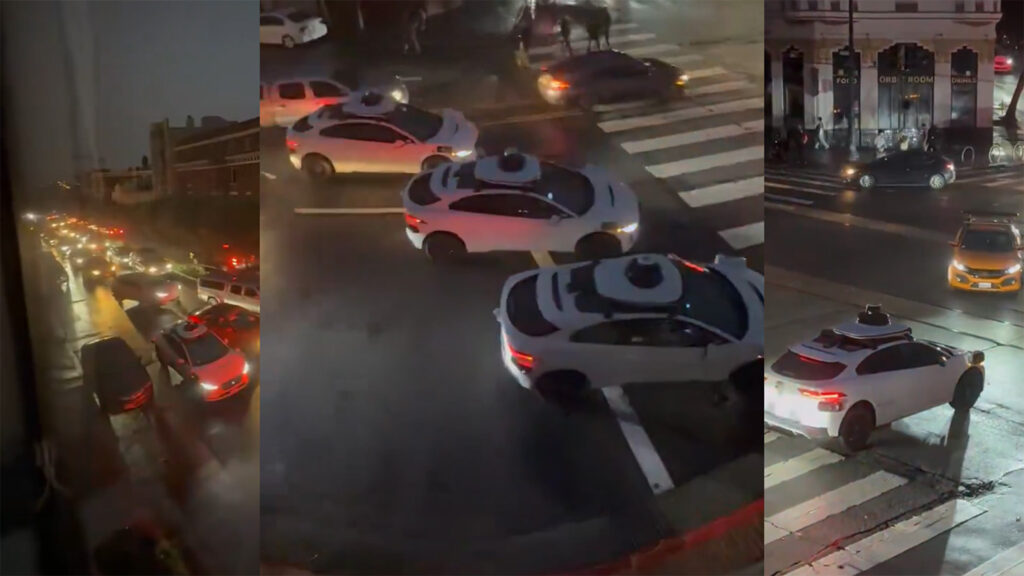
Waymo is considered the undisputed leader in robotaxi development in America due to its wide deployment and relatively stable safety record. However, being first does not always mean being flawless. Despite progress, the company’s autonomous network still cannot handle scenarios that regular drivers navigate without hesitation.
What Happened During the Blackout?
The latest example of such issues was a massive power outage in San Francisco, which revealed a critical vulnerability in the system. This can be considered the most concerning problem today.
The power went out on Saturday afternoon due to a fire at a Pacific Gas and Electric substation. At the peak of the blackout, up to 130,000 customers were left without electricity. Traffic lights went out, public transport stopped, and traffic jams quickly spread through the affected areas.
This is where Waymo’s vehicles began to experience serious problems.
The System Could Not Handle the Scale of the Problem
Videos appeared on social media showing several autonomous taxis stuck in traffic for a long time. One of them, for example, was photographed on Turk Boulevard near Parker Avenue. San Francisco resident Matt Schoolfield told CNBC that he saw at least three Waymo cars standing motionless from 6 p.m. until almost 10 p.m., describing their state as “just stopped in the middle of the street.”
Waymo’s self-driving cars were put on pause by the company on Saturday in San Francisco after the autonomous vehicles were baffled by the lack of traffic signals due to a widespread power outage in the city.
Waymo spokesperson Suzanne Philion confirmed the problem, stating that the power outage overloaded the company’s software logic. Although the cars are programmed to treat malfunctioning traffic lights as a four-way stop intersection, the scale of the blackout pushed them beyond their capabilities.
According to the company, due to the scale of the outage, the cars remained stationary longer than expected, trying to confirm the status of the intersection, which worsened traffic jams during peak hours.
Company Response and Competitor Comments
The company suspended operations on Saturday evening and Sunday, coordinating with city authorities and safely returning vehicles to depots or parking them. This failure by Waymo prompted a comment from Elon Musk, CEO of Tesla, who noted that his brand’s robotaxis had no problems during the blackout.
Tesla Robotaxis were unaffected by the SF power outage
However, this statement has an important caveat. Tesla does not operate a fully driverless robotaxi service in San Francisco. Its local ride-hailing services rely on cars with the “FSD (Supervised)” system, which still require a human driver to be present behind the wheel.
This incident clearly demonstrates how autonomous systems, despite their complexity, depend on the stability of external conditions that a human can compensate for with experience and intuition. The large-scale power outage became a unique stress test that revealed the limits of the logic embedded in the algorithms. The question of adapting to non-standard, large-scale infrastructure failures is becoming one of the key issues for the future of fully driverless vehicles in cities. Similar situations could become a catalyst for the development of new, more flexible action protocols that mimic the human ability to improvise in extreme conditions.