


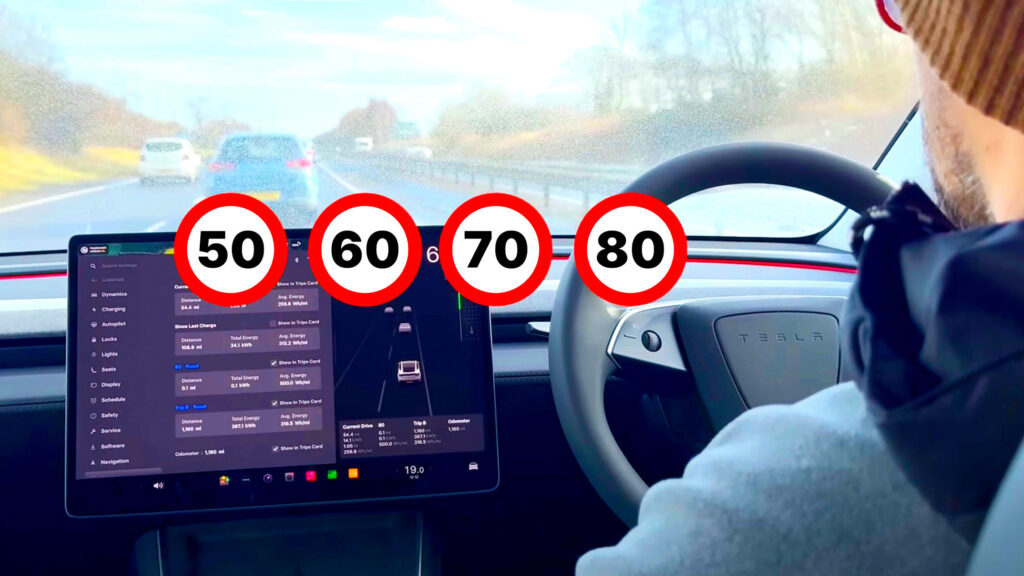
A Tesla owner conducted a series of practical range tests for his rear-wheel-drive, single-motor Model Y. He drove the same 30-mile route at different speeds: 50, 60, 70, and 80 miles per hour. The results showed that driving at 80 mph instead of 50 mph reduces travel time by 38%, but also reduces the range by the same amount.
The Eternal Dilemma: Speed or Efficiency?
Since the dawn of automobiles, drivers have had to grapple with this question. Driving faster means reaching the destination sooner, but it leads to higher fuel consumption and additional costs. In the era of electric vehicles, new factors are added to this dilemma. The real-world range of some EVs is only about 250 miles, and ultra-fast charging stations, such as the planned 1500 kW chargers from BYD, are not yet widespread. This means that stopping to charge en route can easily add 15-30 minutes to the journey, offsetting the time gained from high speed.
Searching for the Perfect Balance
To find the optimal speed, the author of the YouTube channel Carwire conducted a series of test drives in his rear-wheel-drive Tesla Model Y. He covered a 30-mile loop route on multi-lane highways at four different speeds, recording energy efficiency in watt-hours per mile for each trip.
Based on this data and an assumption of a usable battery capacity of 75 kWh, real-world highway range figures were extrapolated, and hypothetical travel times for a 200-mile journey were calculated for each speed. While the methodology is not super-scientific, it provides a useful comparison that vividly demonstrates the enormous impact of speed on efficiency and trip duration.
Test Results
The first run at a constant speed of 50 mph showed that a 200-mile journey would take 4 hours. An impressive efficiency of 224.7 Wh/mile allows for a calculated range of 333 miles. This means you would reach your destination with a significant charge remaining.
Speed of 80 mph drastically reduces the distance
At the opposite end of the spectrum, the run at 80 mph resulted in a drop in efficiency to 366.2 Wh/mile and a range of only 204 miles. Technically, covering 200 miles non-stop is possible in 2 hours 30 minutes, but few would risk not charging before the finish.
The Optimal Speed
As Carwire notes, the optimal speed appears to lie between 60 and 70 miles per hour. Increasing speed from 50 to 60 mph reduces travel time for 200 miles by 40 minutes, while the 300-mile range is only 33 miles less compared to the slower mode.
A further increase to 70 mph saves another half an hour. Although efficiency begins to drop noticeably, the estimated range of 248 miles still allows comfortably covering 200 miles without the need for charging and the associated stress.
Comparison Table: Speed, Time, and Efficiency
| 50 mph | 60 mph | 70 mph | 80 mph | |
| Travel Time (200 miles) | 4 hours | 3 hr 20 min | 2 hr 51 min | 2 hr 30 min |
| Efficiency | 224.7 Wh/mile | 249.9 Wh/mile | 302.2 Wh/mile | 366 Wh/mile |
| Estimated Range | 333 miles | 300 miles | 248 miles | 204 miles |
This data clearly illustrates the compromise faced by electric vehicle drivers, especially during long highway trips. The choice of speed ceases to be merely a matter of personal preference or traffic rules; it directly impacts travel logistics, the need to plan charging stops, and overall comfort. For those traveling long distances in regions with a not-yet-dense network of fast-charging stations, understanding this relationship becomes key. Driving at 70 mph appears to be a reasonable balance between travel time and energy efficiency for many modern EVs of a similar class.