 by
by Opel Confirms Development of the Most Powerful Production Corsa
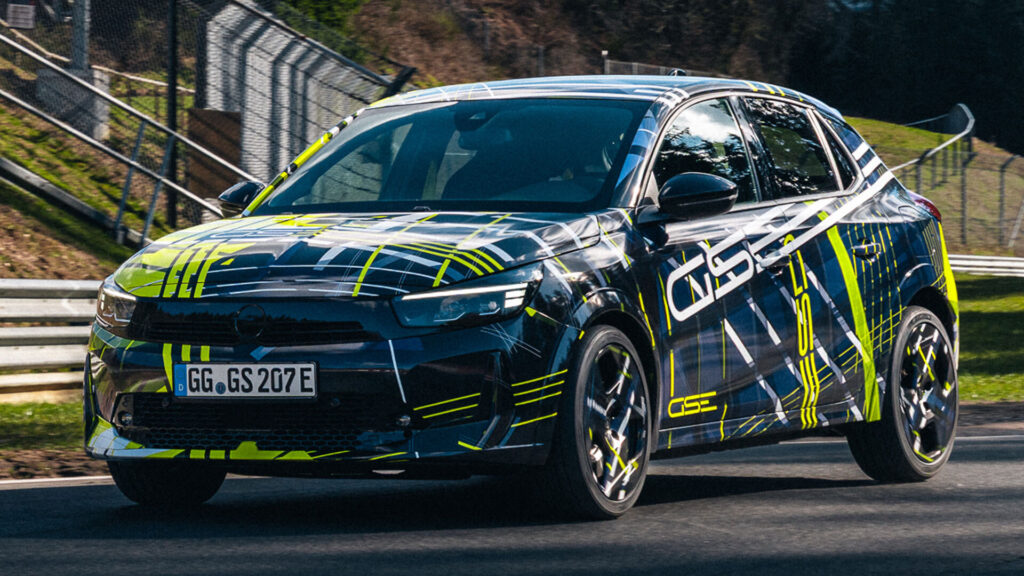
Opel announced plans to create the hot hatch Corsa GSE earlier this year, and recently a prototype of this model was undergoing testing on the Nürburgring track. This car, which will be the brand’s answer to the upcoming Volkswagen ID. Polo GTI, was spotted not only by spy photographers but also recorded by the company’s own cameras.
The tests, according to the manufacturer, were focused on fine-tuning the chassis, steering, and calibrating the electronic stability control system. Opel emphasized that the new model will become the most powerful production Corsa in history and will receive specific throttle pedal, steering, and ESC calibrations.
It will be the most powerful production Corsa ever built and will have specific throttle pedal, steering, and ESC calibrations.
Exterior and Technical Expectations
Although details are still hidden, the prototype shows subtle changes at the front, including triangular accents on the air curtains. These are complemented by widened wheel arches and aerodynamically optimized wheels, behind which yellow brake calipers with the GSE logo are visible.
The changes look quite restrained, but the production model may hide a few surprises. More detailed information will likely become known soon, as the car’s presentation is scheduled for the October motor show in Paris.
The Heart of the New Corsa GSE
The powertrain remains the least secret. The hatchback is expected to borrow it from the Mokka GSE crossover. This means that under the hood, there will most likely be a 54-kilowatt-hour battery powering a front-mounted electric motor with 278 horsepower and 345 Nm of torque. A similar setup allows the Mokka GSE to accelerate from 0 to 100 km/h in 5.9 seconds, with a top speed limited to 200 km/h.
The updates will likely not be limited to the powertrain. The Corsa GSE will most probably receive a locking differential, unique axles, and a sports suspension with special dampers.
The emergence of the Corsa GSE clearly demonstrates Stellantis’s strategy to strengthen its presence in the sports electric vehicle market. This is not just about adding power to an existing model, but comprehensive work on the chassis and control systems, promising a true driver’s experience. The success of this model could significantly influence the perception of the Opel brand, restoring its image as a manufacturer of affordable yet exciting cars adapted to the new era. Competition with Volkswagen in the segment of electric hot hatches is just beginning, and this could benefit buyers in the form of more technological and interesting offerings.