


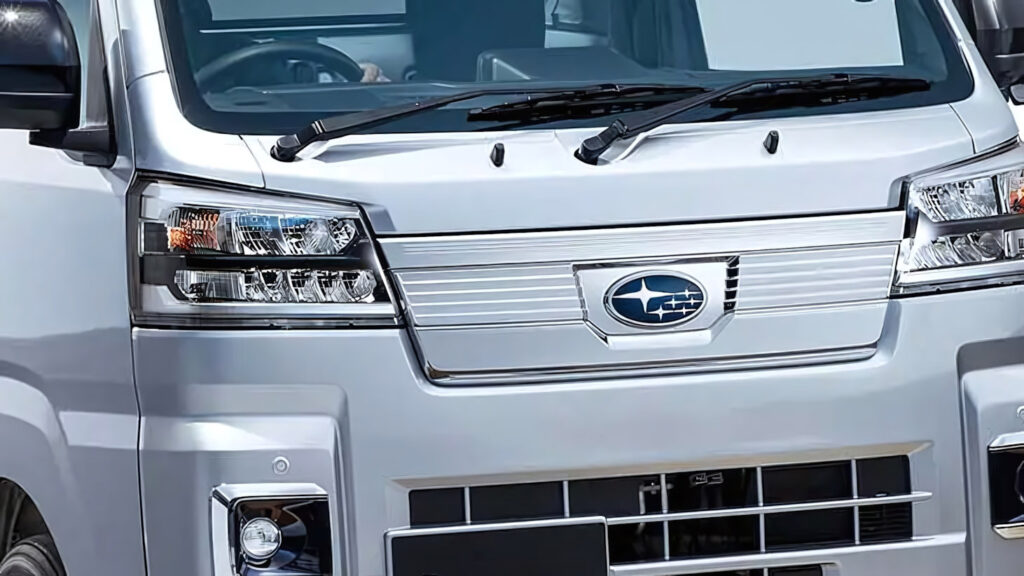
Safety and Technology Updates for the Subaru Sambar
While many eagerly await the arrival of a new Subaru pickup, the company has long been selling such a model in Japan. It’s called the Sambar, and for 2026, this compact van-truck has received a number of updates in technology and safety to remain competitive and comply with local regulations.
Key changes for the 2026 Subaru Sambar include:
Shared Platform and Exterior
This tiny workhorse is a rebadged version of the Daihatsu Hijet Truck and Toyota Pixis Truck, which received similar updates just a few days ago. Visually, nothing has changed. The cab-over-engine layout remains unchanged, offered in both standard and Gran Cab body styles.
Safety System Improvements
Most significant updates are hidden from view. The updated Subaru “Smart Assist” safety suite now better recognizes threats thanks to recalibrated sensors capable of identifying more scenarios. This includes oncoming traffic when turning right at intersections, as well as pedestrians crossing the road from either side during maneuvers.
Furthermore, the little van-truck is equipped with more driver assistance systems than one might expect from a vehicle of this size. Front and rear sensors, adaptive high beams, side marker lights, road sign recognition, and a lane departure warning system are all part of the package.
Modern Interior and Practicality
Inside, the kei van-truck finally steps into modernity with an available 9-inch touchscreen multimedia system and smartphone connectivity, though this is offered only for certain trims. If you choose the base model, you’ll be left without a screen.
The rest of the interior retains old-school charm. Manual climate controls and a sea of hard plastics create a distinct early-’90s atmosphere, yet there are plenty of practical touches. After all, it’s built for work: deep trays on the dashboard, adjustable cup holders, an overhead shelf, a bag hook, and even a pocket on the seatback.
Engine and Drivetrain Options
The heart of the vehicle is a tiny 660cc three-cylinder engine, which in naturally aspirated form produces 46 hp. Unlike its Daihatsu and Toyota counterparts, Subaru does not offer a turbocharged option that boosts power to a more respectable 63 hp.
The drive can be rear-wheel or all-wheel, paired with a five-speed manual transmission or a CVT. The most interesting are the versions with a manual gearbox and all-wheel drive, which offer more than one might expect thanks to a full-fledged Hi-Lo range selector and a locking rear differential.
Accessible Price Category
This is still a truly budget-friendly vehicle. The price for the 2026 Subaru Sambar starts from 1,094,500 yen (approximately $6,800) for the base TB model with a manual transmission and rear-wheel drive, which is fully in line with the prices of the Daihatsu Hijet Truck and Toyota Pixis Truck.
On the other hand, the top version with the more spacious Gran Cab body, CVT, and all-wheel drive will cost 1,628,000 yen (approximately $10,200). If off-road capability is a higher priority than comfort, the most affordable option with a manual and all-wheel drive comes in at 1,226,500 yen (approximately $7,700).
Competition comes from the usual representatives of the kei van-truck class: the Subaru, Toyota, and Daihatsu trio compete with similar offerings from Suzuki, Nissan, Mazda, and Mitsubishi.
The Subaru Sambar updates clearly demonstrate the trend in the specialized commercial vehicle market, where even the most utilitarian models must meet modern safety and basic comfort requirements. The preservation of manual options, especially in combination with all-wheel drive, underscores an orientation towards customers who value reliability, simplicity, and true work capability in real-world operating conditions. Price accessibility remains a key argument, making such cars a viable alternative for small businesses and rural farms, despite the emergence of an increasing number of electric counterparts.