 by
by Subaru has introduced a new special edition of its crossover and also announced changes in pricing policy for the 2026 model.
New Special Edition
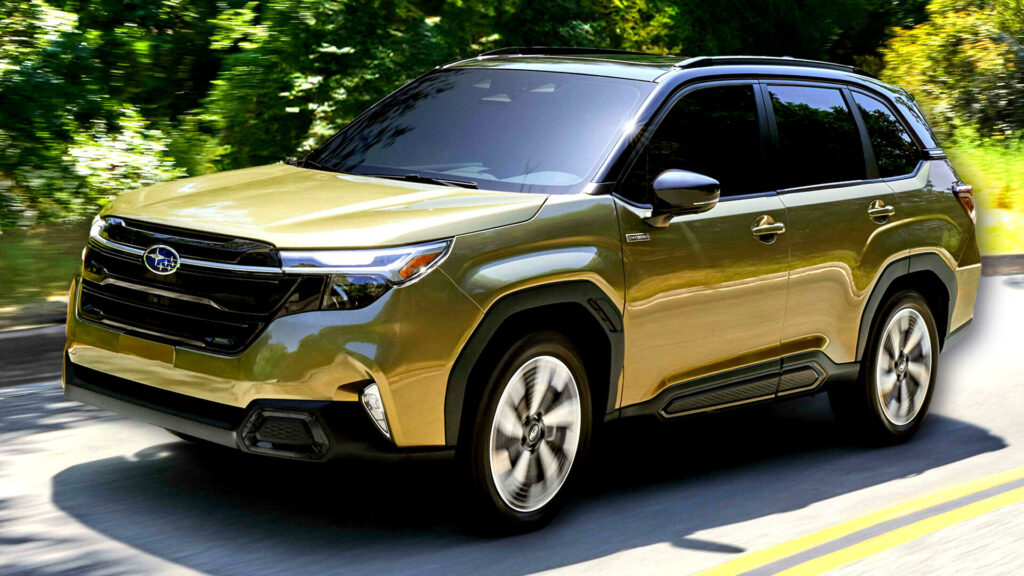
Following the presentation of the updated Forester last summer, Subaru announced the arrival of a new special edition called the Forester Sport Onyx Edition.
This model costs $36,495 and features black exterior accents, dark gray logos, and 19-inch alloy wheels with a dark metallic finish.
Subaru’s Most Rugged Forester Just Got A Lot More Expensive For 2026
The updates also affected the interior, which received StarTex upholstery in black and gray with brown contrast stitching. The steering wheel is leather-wrapped, there are metal accents, and an 11-speaker Harman Kardon premium audio system is installed.
Since the special edition is based on the Forester Sport, it inherited the road-oriented suspension. The driver also has access to the SI-Drive engine power management system with two modes: Intelligent (I) and Sport Sharp (S#).
Price Adjustments
In addition to presenting the Onyx Edition, Subaru published updated prices for the 2026 model line. The company did not explain the reasons for the changes in detail, noting only that they reflect “Subaru’s continued focus on affordability and value.”
The price of the base version remained unchanged at $29,995. However, the price of the Premium trim decreased from $33,385 to $31,995, resulting in savings of $1,390.
Similarly, the Sport version became cheaper, dropping from $36,105 to $34,795 (a reduction of $1,310). The off-road Wilderness version is now $1,390 cheaper, while the more expensive Limited trim became $1,700 cheaper. The top-of-the-line Touring version dropped in price from $41,595 to $39,995, saving the buyer $1,600.
Forester Hybrid Version
Simultaneously, the company officially introduced the hybrid version of the 2026 Forester, which is produced in America. It received several minor updates, including a redesigned gear selector and an updated cup holder design.
The price for the hybrid Premium version starts at $34,730, which is $1,865 less than last year’s model. The Sport Hybrid became cheaper, dropping from $39,595 to $37,930 (saving $1,665). The Limited Hybrid trim became $2,015 cheaper, and the Touring Hybrid became $1,750 cheaper.
We understand that consumers are now focused on affordability like never before. This creates an opportunity to offer even greater value to our customers in one of Subaru’s key models.
As a reminder, the regular Forester is equipped with a 2.5-liter four-cylinder engine producing 180 hp and 241 Nm of torque. It is paired with a continuously variable transmission (CVT) and the standard Symmetrical AWD all-wheel-drive system.
The hybrid version also has a 2.5-liter engine, but it is supplemented by a hybrid system with a lithium-ion battery and two electric motors integrated into the CVT. The total output of such a powertrain is 194 hp. The stated fuel economy reaches up to 35 mpg in the city, 34 on the highway, and 35 combined.
2026 Subaru Forester Prices
Trim / MSRP
Forester / $29,995
Forester Premium / $31,995
Forester Premium Hybrid / $34,730
Forester Sport / $34,795
Forester Sport Onyx Edition / $36,495
Forester Sport Hybrid / $37,930
Forester Wilderness / $36,995
Forester Limited / $35,995
Forester Limited Hybrid / $38,995
Forester Touring / $39,995
Forester Touring Hybrid / $41,545
Prices do not include a destination and delivery fee of $1,450.
The overall trend of price reductions for one of the brand’s most popular crossovers is occurring against the backdrop of general pressure on the auto market and increased competition from electric models. Subaru appears to be trying to retain the loyalty of customers who traditionally value reliability and all-wheel drive but are increasingly considering the total cost of ownership. The introduction of the new Onyx special edition simultaneously with price cuts on other trims may be an attempt to attract both fans of exclusive design and buyers looking for maximum value. The success of this strategy will depend on whether the market perceives the reductions as a real increase in value or as a reaction to a possible decrease in demand.