


Change of Leadership in the US Auto Market
For decades, California has been the undisputed leader in the new car market in the United States. However, this era is coming to an end. Texas is rapidly closing the gap, and the cars that Texans are buying may be a harbinger of where the entire American market is headed in the coming years.
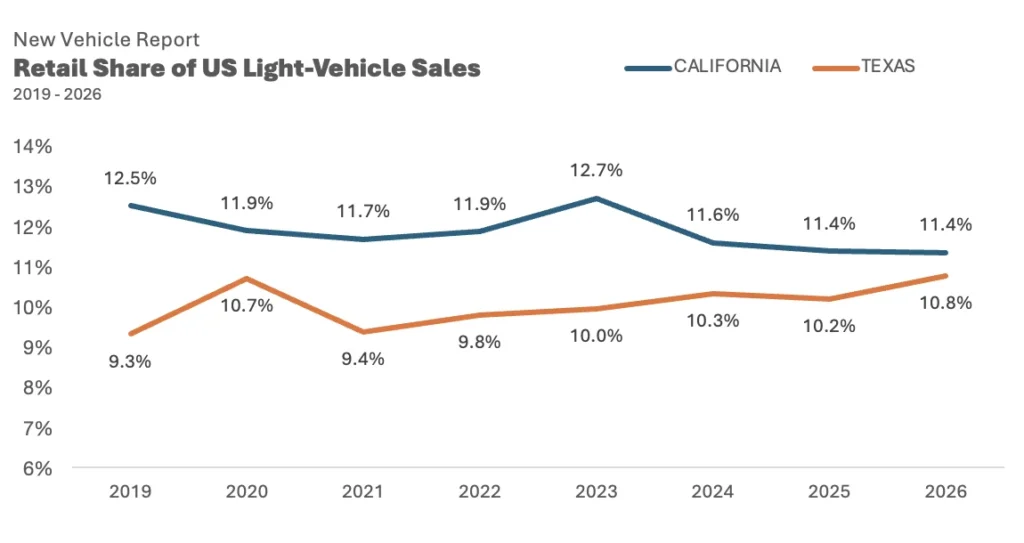
This shift has been brewing for some time. California’s share of U.S. passenger car sales has fallen from a peak of 12.7% in 2023 to just 11.4% this year. Texas, on the other hand, has grown from a low of 9.3% in 2019 to 10.8%, and the gap is narrowing with each passing month.
Why Texas is Surging Ahead
Compared to the average figures for 2019, Texas will add approximately 197,000 sales this year, while California is likely to lose about 158,000. The main driving force behind this growth is the enormous demand for pickup trucks in the state, which has also raised the average price that Texans pay for a new car.
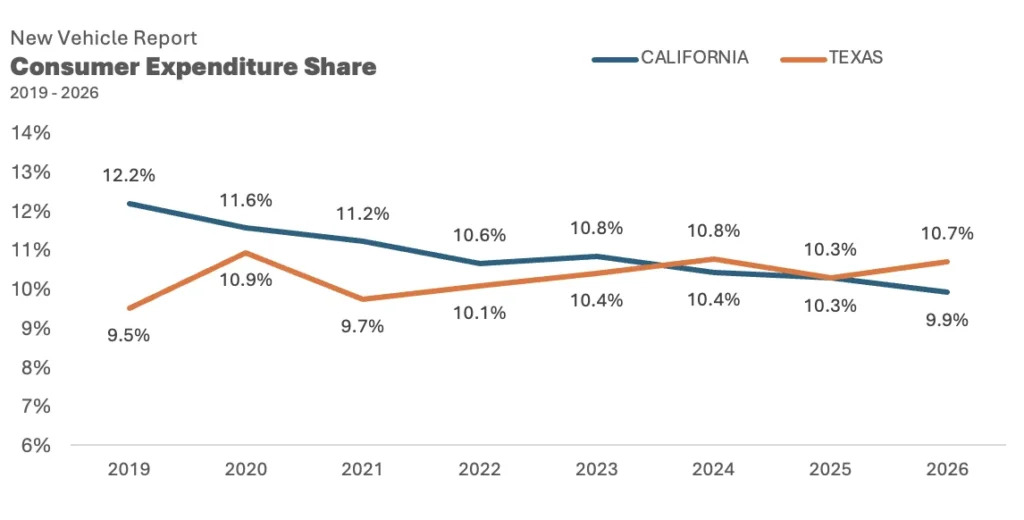
According to JD Power, the Lone Star State leads the U.S. in consumer spending on new vehicles, accounting for 10.7% of the national total, compared to 9.9% in California. Currently, pickup trucks make up 27% of sales in Texas, while in California this figure is only 17%. As is well known, pickup trucks can be expensive.
For comparison, California remains one of the last strongholds where sedans are still sold, even though this body type is disappearing in the rest of the country. However, as fewer sedans enter the market each year, Californians will likely switch to SUVs and pickup trucks, following the path already paved by Texas.
It is worth noting that JD Power also points out that Texas is one of the few markets where the share of electric vehicles remains relatively stable, even as demand for EVs has weakened in several other states.
Payment Peculiarities: Cash vs. Leasing
The method of paying for cars also differs significantly between the two states. In Texas, 69% of buyers either pay in cash or arrange financing outside the dealership. This figure is 23% higher than in California, where leasing is particularly popular, accounting for 30% of all new car transactions.
According to JD Power, Texas tax policy makes leasing relatively expensive, which partly explains the difference between the two states. Additionally, loan terms in Texas are on average 1.5 months longer, and local dealers earn approximately $2,200 in finance and insurance income per vehicle sold, which is about $400 more than their California counterparts.

Interestingly, such a high proportion of buyers paying with cash or using external financing suggests greater financial independence among Texas consumers, or at least a desire to avoid dealer financial services. At the same time, the popularity of leasing in California may be linked to a desire for a newer car with lower monthly payments, which is especially relevant in a high-cost-of-living region. Overall, these trends indicate that the U.S. auto market is becoming increasingly fragmented, and the Texas model, focused on pickup trucks and direct purchases, may become dominant in the near future, especially given the population and economic growth in the southern states.