


Rapid Sales Start
Black Friday is still seven months away, but Toyota is probably already feeling its mood. The manufacturer received a real flurry of orders – 3100 for the new electric sedan in just the first hour after sales began. This seems incredible until you learn about its price.
Affordable Flagship for the Chinese Market
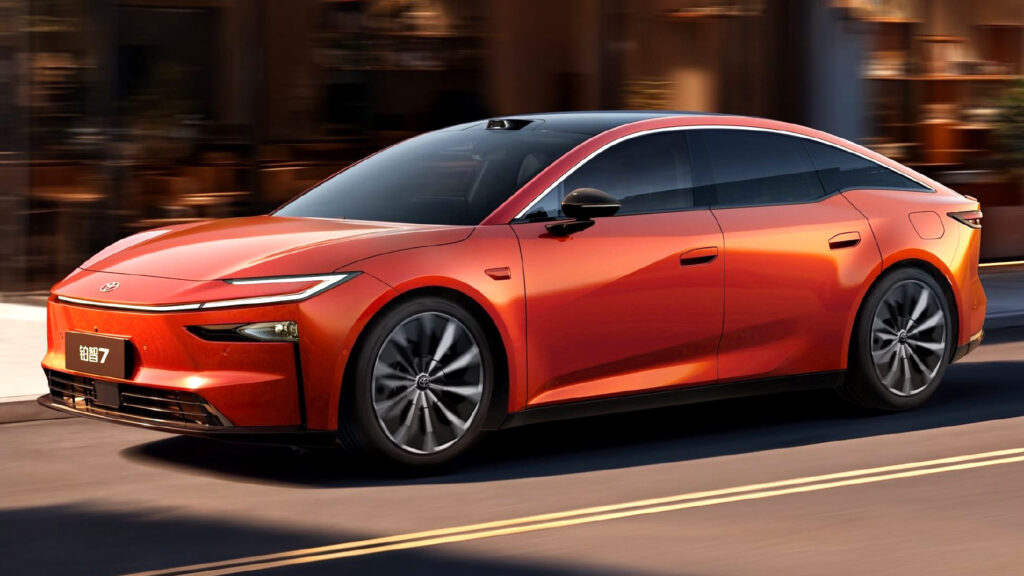
The bZ7 is Toyota’s new flagship electric vehicle for China, introduced through the GAC-Toyota joint venture. The car is large and filled with modern technology, yet incredibly affordable. Prices start from 147,800 yuan (approximately $21,500 USD) and go up to 199,800 yuan (about $29,000).
Toyota’s Flagship Electric Sedan Undercuts Tesla Model S By Nearly $96,000 In China
The domestic Chinese market is extremely competitive, and buyers are not attracted by a lack of good deals. However, even against this backdrop, the bZ7 looks like an incredibly advantageous purchase. With a length of 5130 mm and a wheelbase of 3020 mm, it is larger than the Tesla Model S, but costs even less than the Model 3, which in China starts from 236,500 yuan ($34,500).
Speed is Not the Main Thing
The largest representative of the bZ family is not a Model S Plaid. Its peak power is 278 hp (282 PS / 207 kW). However, buyers can choose LFP-based battery packs with capacities of 71 kWh or 88 kWh, which, according to the manufacturer, provide a CLTC cycle range of up to 440 miles (710 km) depending on the configuration. Toyota also claims that fast charging can add 186 miles (300 km) of range in 10 minutes.
And while this car won’t win many acceleration races, it will impress many drivers with its technology. Available front seats with a zero-gravity effect offer heating, ventilation, and massage functions. The dashboard is dominated by a floating 15.6-inch central display, complemented by a smaller driver’s display and a head-up display.
Technologically Rich Interior
The interior runs on Huawei’s HarmonyOS system, installed on the floating 15.6-inch central display. Integration with the Xiaomi smart home ecosystem is also provided, meaning the ability to control household appliances directly from the car. Furthermore, an advanced driver assistance systems package can be ordered, which includes a roof-mounted lidar, five millimeter-wave radars, 11 high-definition cameras, and 10 ultrasonic radars.
These 27 sensors are supposed to ensure your safety. Or, depending on your point of view, they will become 27 potential sources of electrical problems for a future used car owner in a decade.
Such a successful sales start underscores how important price affordability remains for the mass consumer, even in the segment of advanced technologies. Competition in the Chinese electric vehicle market forces global giants like Toyota to offer true technological complexes at prices that were previously characteristic of much simpler models. It also demonstrates the strategic importance of local partnerships, such as with GAC, and integration with local technology leaders like Huawei and Xiaomi to create products perfectly tailored to the demands of a specific market. Similar steps could become a model for other manufacturers seeking to gain a foothold in key regions.