


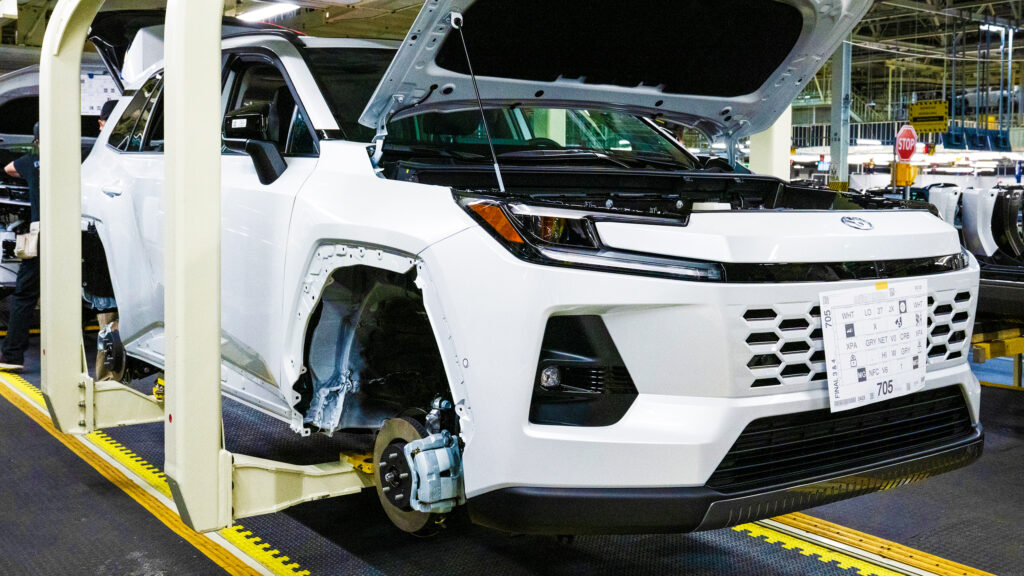
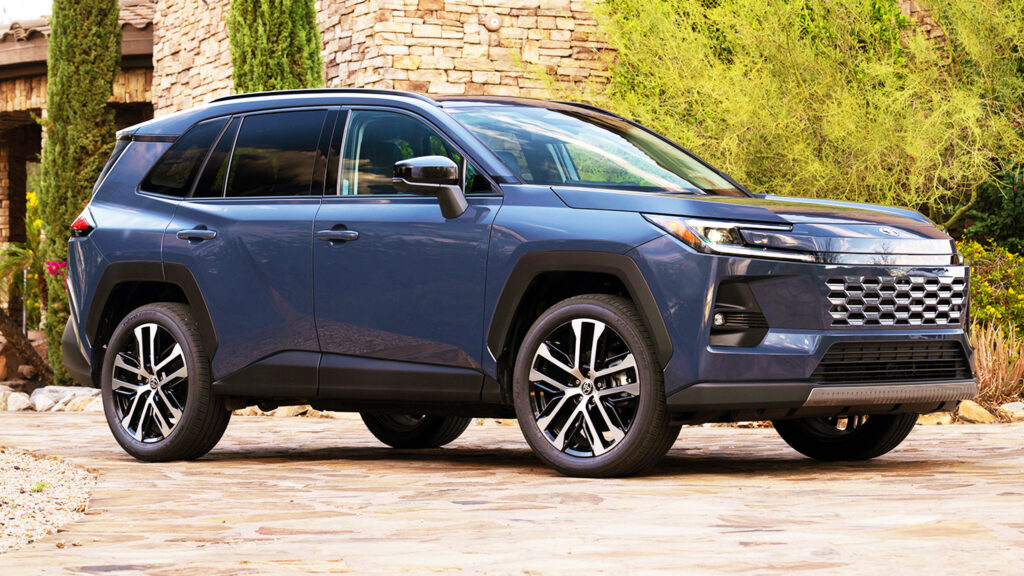
Deliveries of the new Toyota RAV4 have begun to first owners as the company ramps up production capacity at its plant in Woodstock, Ontario, Canada. From there, the crossover will also be exported to the United States. Toyota does not seem overly concerned about potential tariff risks associated with trade policy, which can change with political winds.
A Hybrid Future for North America
For the first time in RAV4 history, the new model for North American markets will be offered exclusively as a hybrid. Toyota has invested over 1.1 billion Canadian dollars to continue RAV4 production in Canada. Production is being rolled out not only in Woodstock but also at the neighboring Toyota plant in Cambridge. Capacity will increase over the next five weeks and is expected to reach full capacity by March. Both Canadian plants have undergone significant upgrades to prepare for the production of the 2026 model year RAV4, including the creation of sections for assembling battery packs for this SUV.
Production in the USA and Global Distribution
Production of the 2026 RAV4 has not yet begun in the United States, but, like the previous model, it will also be produced at the company’s plant in Lexington, Kentucky. The future electric Highlander will also be assembled at this same site. Moreover, RAV4 production specifically at this plant will be increased. Previously, Kentucky produced versions of the old RAV4 with internal combustion engines only, while hybrid models were built in Canada. All plug-in hybrid (PHEV) versions of the new-generation RAV4 will be assembled in Japan.

Exciting Uncertainty of Trade Deals
Toyota Motor Manufacturing Canada is the largest automaker in Canada, producing over 535,000 vehicles last year. However, excitement is on the horizon. US President Donald Trump recently called the United States-Mexico-Canada Agreement (USMCA) “irrelevant,” just as negotiations on it are set to begin this year. According to Scott McKenzie, Director of Corporate and External Affairs at Toyota Canada, the company is closely monitoring the situation. It remains an open question whether Canadian production will remain viable if the agreement is scrapped.
We believe the most effective way for the North American industry to function is an integrated model involving all three countries. The times are turbulent now. We don’t know what the landscape will look like – in two years, three years, five years. We are making long-term investments. We are weathering storms.
McKenzie also noted that while Toyota has absorbed some of the costs associated with current tariffs, a long-term consequence could be further price increases for cars.
Toyota’s decision to fully transition the North American RAV4 to hybrid power is a bold move, reflecting the company’s overall electrification strategy. However, the significant investments in Canadian capacity accompanying this transition make the company particularly vulnerable to political fluctuations in the region. Trust in the stability of integrated supply chains exists alongside an open acknowledgment of the unpredictability of the future. The success of this large-scale initiative will depend not only on demand for hybrids but also on Toyota’s ability to adapt to potential changes in trade rules that could fundamentally alter the economics of production in Canada and export to the USA.