 by
by Export of Left-Hand Drive Cars
If you’ve always thought navigating Tokyo traffic is probably tough in a large SUV, imagine trying to do it from the wrong side of the car. Honda and Acura are now shipping models made in the USA to Japan, and they aren’t even bothering with such a complicated thing as moving the steering wheel to the right side before loading them onto the ship.
Models for Export
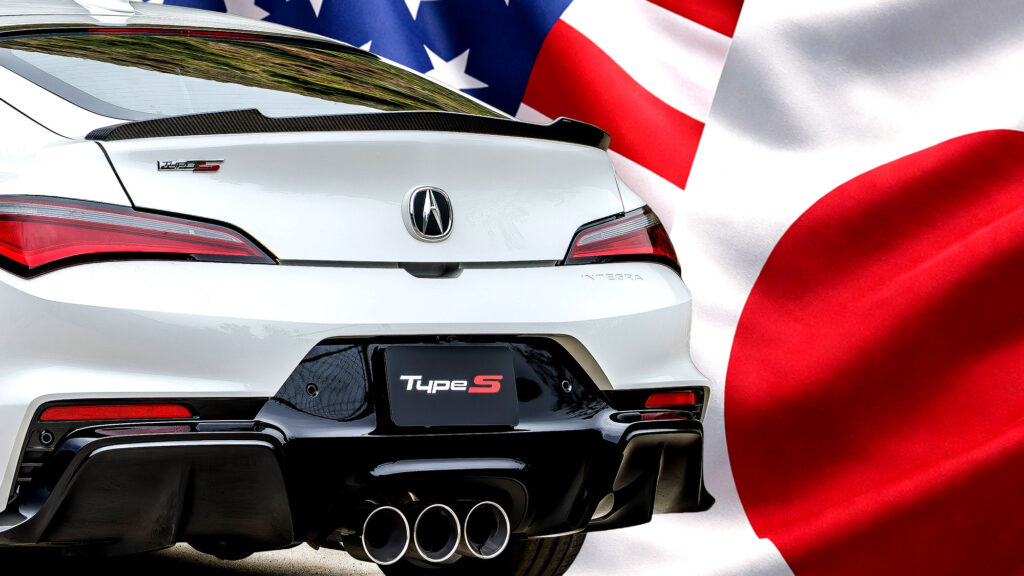
The two export models are the Acura Integra Type S, the business-suited sedan sibling of the Civic Type R, and the Honda Passport SUV. They roll off American production lines in Ohio and Alabama, but a small number are now heading straight across the Pacific.
They arrive in Japan in full American specification. The front-wheel-drive Type S is equipped with a 2.0-liter turbocharged K20 engine producing 320 hp (324 PS), a six-speed manual transmission, and a limited-slip differential. The all-wheel-drive Passport comes exclusively in the rugged Trailsport Elite trim and is powered by the same 3.5-liter V6 producing 285 hp (289 PS) and a 10-speed automatic as all US models.
The Steering Wheel Placement Feature
However, the American specification also includes left-hand drive placement, despite Japan, like the UK, Australia, and South Africa, being a right-hand drive market. Toll highways, parking garages, and drive-through coffee shops are designed for just that.
Nevertheless, Japan has a long-standing subculture of enthusiasts who adore something a little different. For years, enthusiasts have prized coveted German sports cars with left-hand drive just as American fans revere Japanese Domestic Market (JDM) right-hand drive models and are happy to sit on the wrong side of the car.
Niche Appeal and History
Thus, the Integra and Passport will have niche appeal, similar to the first American-made Honda cars exported to Japan in 1988—a run of Accord coupes, also produced with left-hand drive. By that time, Honda had already been exporting American-made Goldwing motorcycles to Japan for eight years.
Geopolitical Context
However, this move is about geopolitics no less than car lovers. Supplying US-made cars to Japan helps address long-term trade imbalances, albeit slightly, and cools political tensions that have flared up repeatedly over the past year.
And Honda is not the only company taking such a step. Toyota recently confirmed it will begin importing three American-made models to Japan starting in 2026, including the Camry sedan, Highlander SUV, and Tundra pickup. Yes, the possibility of seeing a Texas-made Tundra on the streets of Tokyo is now very real.
Interestingly, this practice of exchanging cars built for one market to another where they are exotic has deeper roots than just business or politics. It reflects the growing globalization of car culture, where uniqueness and authenticity are sometimes valued above convenience. For Japanese buyers, American Hondas and Acuras are not just transportation, but a piece of a different engineering philosophy and design, materialized in metal form. It also demonstrates how major automakers can use historical trade agreements and cultural exchange to create new, unexpected market niches, where a car with the “wrong” steering wheel becomes a symbol of status and individuality for connoisseurs.