


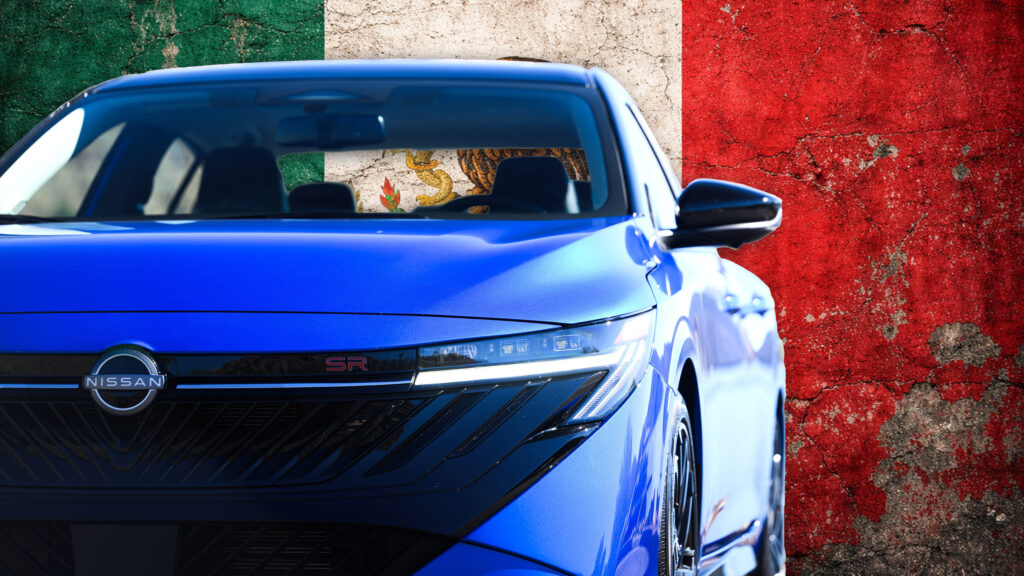
Threat to Affordable Models
Nissan warns that tariffs on Mexican-assembled cars could soon lead to price increases for some of its most affordable models in the United States. The automaker states that if forced to move production to the US, costs would rise, and these increases would likely be passed on to buyers.
Current Production and Pricing
The company currently produces popular models such as the Sentra and Kicks in Mexico, where lower labor costs help keep prices within an affordable range. The Sentra starts at $22,600, while the Kicks starts at $22,430. According to Nissan representatives, tariffs on these models add approximately $2,500 to $3,000 per vehicle. Cars produced in Mexico accounted for over a third of Nissan’s US sales volume last year.
Before being discontinued in the American market, Nissan also produced the Versa model there. It was once the last new car priced below $20,000, starting at $17,390. According to Kelley Blue Book, the average price of a new car recently stood at $49,353, down from a peak of $50,326 in December.
Company Leadership’s Position
We could not produce these affordable cars in the US at the same cost, we could not do it. The issue is the margin.
This opinion was expressed by Nissan Americas Chairman Christian Meunier during a speech at the New York Auto Forum.
Negotiations and Political Context
Nissan is negotiating with lawmakers to mitigate tariffs. According to Meunier, they have received understanding of this idea. “Affordability is something the government cares about, and they understand our concerns,” he said. The question of whether tariffs will be eased remains contentious, especially within the Trump administration.
The direction of these tariffs may be decided in the coming months. The United States-Mexico-Canada Agreement (USMCA) is soon due for a mandatory review ahead of a possible extension on July 1. If the three countries agree to extend the agreement, it will remain in effect for another 16 years.
However, Trump has shown no willingness to revise the trade deal. In January, he stated that he “doesn’t care too much about it,” adding that the deal “doesn’t matter” and “has no real benefits.” During the same interview, he added: “We don’t need cars made in Canada, we don’t need cars made in Mexico, we want to produce them here, and that’s what’s happening.”
The tariff situation highlights a broader issue in the globalized auto industry, where the geography of production directly impacts the final price for the consumer. Increasing the cost of models like the Sentra could significantly narrow the choice for buyers seeking a new but budget-friendly car. It may also force manufacturers to revise their lineups, possibly discontinuing the sale of the cheapest versions. Ultimately, everything will depend on the outcomes of trade negotiations, which will determine not only the future of specific models but also the affordability of new transportation for the general public in an environment where the average car price is approaching $50,000.