 by
by Three Waymo Robotaxis Found Themselves in a Bind in San Francisco
Autonomous vehicles are supposed to eliminate traffic jams, human error, and awkward situations at intersections. However, last weekend, three Waymo robotaxis in San Francisco demonstrated that even artificial intelligence can become paralyzed when faced with a difficult choice and no obvious way out.
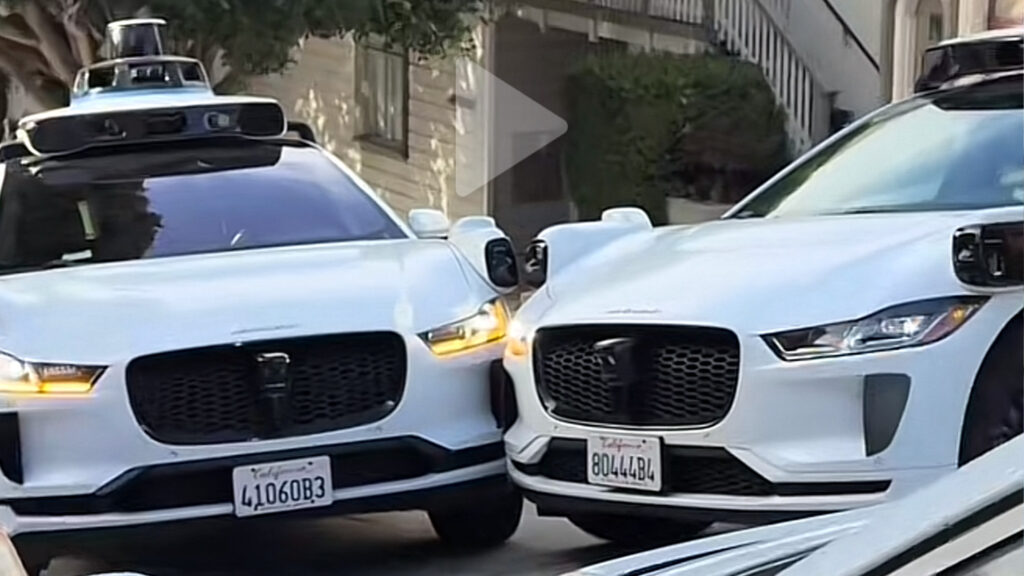
The event unfolded on a hilly residential street in the North Beach district. TikTok recordings captured a low-speed standoff between the robots. Two autonomous Jaguar I-Pace SUVs found themselves nose-to-side at an intersection that also turned out to be a dead end.
A Third Participant and a Complete Blockade
A moment later, a third Waymo vehicle arrived. It assessed the situation, like a confused video game character, and came to a complete stop, effectively blocking the street.
One local resident, trying to drive out, best summarized the situation by asking if the cars were going to “just stand here forever.” For several long minutes, that possibility seemed entirely real.
Autonomous Paralysis and Light Contact
According to a report by ABC7News, two of the robot cars may have made slight contact with each other as one attempted to make a turn on the narrow street. The third vehicle, doing what it was programmed to do, detected an obstacle and politely waited. Unfortunately, polite waiting is of little help when all participants are robots, and none wants to make the first move.
Human Intervention as a Last Resort
Ultimately, a Waymo employee arrived on the scene to manually intervene and restore order. This once again proved that the most reliable fail-safe mechanism in autonomous driving remains a human, capable of putting the car in reverse and looking over their shoulder.
Waymo’s Expansion and Future Challenges
To be fair to Waymo, the company remains a model of functional robotaxis. Its vehicles travel millions of miles in San Francisco, Los Angeles, and Phoenix, mostly without incident, and are now venturing onto highways. The company recently began operations in Miami and plans to launch services in Dallas, Houston, San Antonio, and Orlando.
These cities will, in time, also face their own Waymo technical glitches, as such incidents are a reminder that driverless cars are excellent at following rules but struggle with non-standard situations that humans resolve instinctively.
Such cases become important lessons for autonomous system developers. They indicate that robot logic, while extremely complex, still cannot fully replicate the flexibility of human thinking in the real world, where street geometry, the behavior of other road users, and simple decisions like “who yields first” create millions of possible scenarios. Successful scaling of the technology will depend not only on improving algorithms but also on creating infrastructure and traffic rules that account for the peculiarities of humans and robots coexisting on the roads.