


Hyundai Unveils Staria Camper Concept at CMT Exhibition
At the Caravan, Motor und Touristik (CMT) show, Hyundai presented a camper concept based on the electric Staria minivan. The project’s goal is to explore how this vehicle can be transformed into a premium leisure vehicle adapted for the European market.
Features for Off-Grid Travel
The Staria Camper concept is designed for autonomous travel. It is equipped with a pull-out awning and an electrically operated pop-up roof, which is fully integrated into the structure to reduce wind noise and rattling while driving.
The roof is also notable for being covered with a 520-watt solar panel, which can generate up to 2.6 kWh of electricity per day.
This energy can power onboard equipment or increase the vehicle’s driving range.
Innovative Technologies and Comfort
Another interesting feature is the use of adjustable electronic smart glass for privacy. The rear windows are controlled by a special touchscreen, allowing for instant adjustment of their transparency.
In addition to protection from prying eyes, the smart glass provides significantly improved ultraviolet, thermal, and acoustic insulation compared to regular glass. Despite this, Hyundai has also added traditional curtains.
The vehicle’s exterior is largely preserved, but water and electrical connection points can be seen near one of the rear taillights.
Modular Interior for Comfortable Living
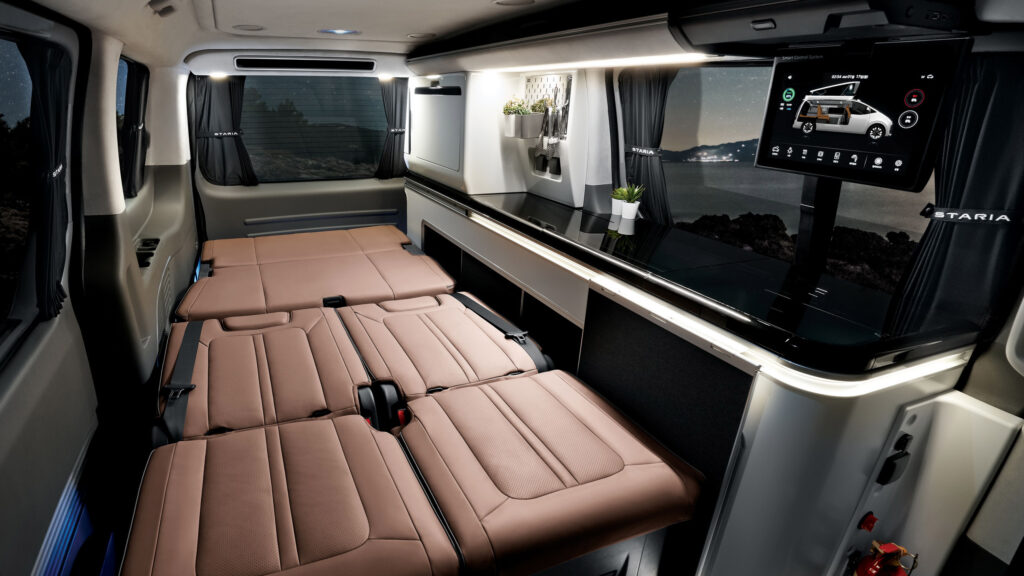
Inside, the second and third-row seats fold down to create a spacious sleeping area for two adults. The concept also features a long counter housing a sink, storage compartments, and a 36-liter refrigerator.
Also present are a folding table inside, a stylish pegboard, and special lighting. Key features include a swiveling front passenger seat and a climate control system that can warm you up on cold nights.
Furthermore, the rear doors open to reveal a deployable rear table, as well as an outdoor shower setup.


Potential for Series Production
Although this vehicle is a concept, Hyundai is not hiding the possibility of series production. In fact, the company is actively seeking feedback from camping, caravanning, and adventure enthusiasts from across Europe and beyond.
The company stated that this will help them assess interest in bringing the concept to life.
Hyundai also noted that a production model would be similar to the regular Staria Electric, which has an 84 kWh battery pack and a front-mounted motor producing 215 horsepower.
This allows the minivan to have a WLTP-estimated range of approximately 400 km. When the battery charge is low, DC fast charging can replenish it from 10 to 80 percent in about 20 minutes.
The emergence of such a concept indicates the growing demand for electric recreational vehicles that combine environmental friendliness with autonomy. The European market, with its developed caravanning culture and high environmental standards, is an ideal field for such experiments. The success of similar initiatives could significantly expand the electric vehicle market, transforming them from urban commuters into full-fledged homes on wheels for modern travelers.