


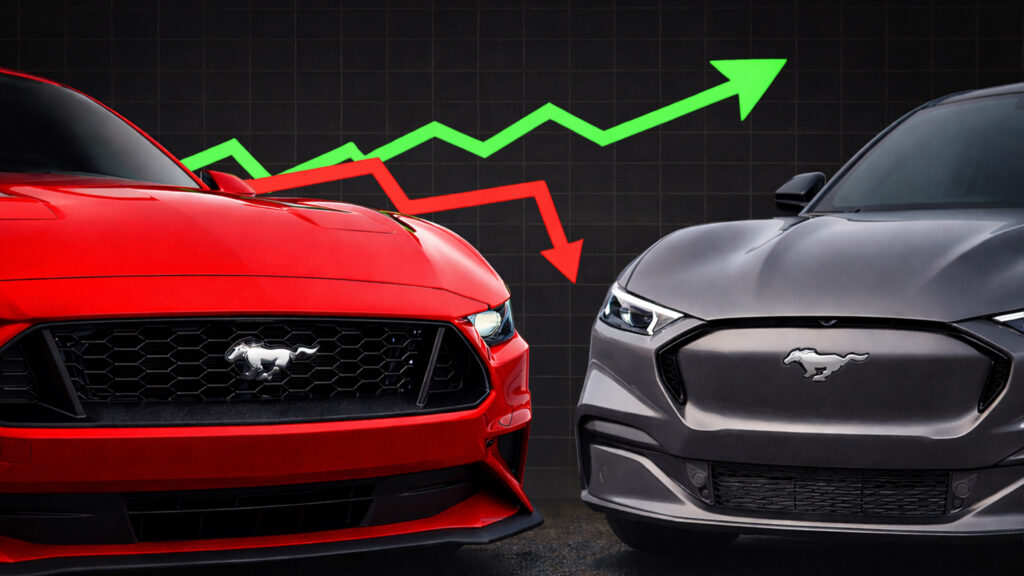
Here are the key points from Ford’s U.S. sales report for January 2026:
The V8 Era Isn’t Over Yet
If anyone doubted that the V8 era isn’t ready to give up, Ford provided clear evidence. In January 2026, Americans bought more than three times as many gasoline Mustangs as electric Mach-Es. Moreover, sales of regular Mustangs doubled the volume of all Ford electric vehicles combined. It turns out that nostalgia and strong emotions still work at full capacity.
The company sold 3,609 traditional Mustangs for the month, which is 50.4% more than last year. At the same time, only 1,040 units of the Mustang Mach-E were sold, representing a drop of 70.5%. It seems the classic sports car has finally begun to leverage its advantage as the last retro coupe on the market, while the Mach-E desperately needs its expected facelift.
The Overall Picture for Electric Vehicles
The overall picture for Ford’s electrified models also didn’t look optimistic. Total electric vehicle sales amounted to only 1,743 units, which is 69.2% less than last year. Hybrid sales declined more modestly—by 6.1%, to 12,485 vehicles. The main load is still carried by models with internal combustion engines: 121,134 sales, despite a slight drop of 2.3%. It is precisely gasoline that ensures stability for the Blue Oval.
Small Pickups Show Success
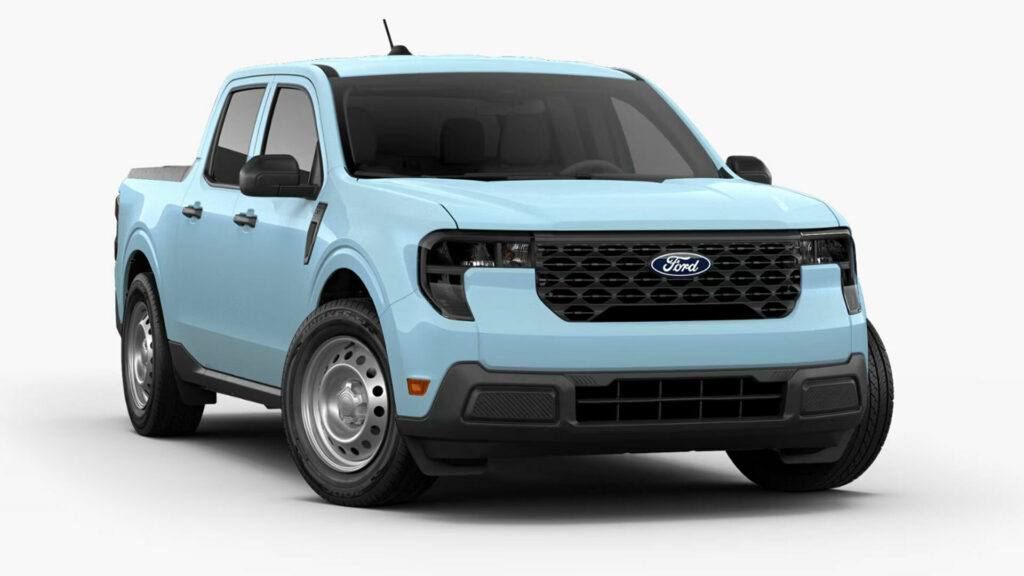

SUVs remain Ford’s main source of income with 55,939 sales, albeit with a slight decline. The situation with pickups was mixed. Sales of the F-Series fell by 18.2% to 47,981 units, but the smaller Maverick grew by 13.2%, and the Ranger by 26%.
The F-150 Lightning, whose production has been discontinued, fell by 66.1% to just 647 units, continuing a difficult period for the company’s flagship electric pickup. Compact and mid-size pickups are clearly having their moment, as long as they don’t bear a Hyundai badge.
Unexpected Drop for the Escape
One of the biggest mysteries at first glance is the Escape model. Its sales fell by 65.5% to just 3,418 units, even though production is not scheduled to cease until the end of the 2026 model year. The likely key factor in this collapse was Ford’s decision not to certify this model to meet California Air Resources Board requirements this year. This makes sales impossible in California and states like New York, Massachusetts, Oregon, Washington, and Vermont.
Missing Models and Future Plans
Dealers are not thrilled about the future discontinuation of the Escape. Many would like to get an affordable new SUV to take the compact’s place. They also want a simple, affordable sedan to compete with the Toyota Camry and Corolla, but that ship has probably already sailed.
Ford seems much more interested in its future $30,000 electric pickup, expected in 2027. However, dealers are also excited about that prospect.
Highlights and the Lincoln Lineup
There were also bright spots in the market. Explorer sales grew by 30.7%, and the Bronco by 19.4%. On the luxury side, the Lincoln Navigator jumped by 69.4%, proving that large luxury SUVs are still very much in vogue.
These numbers clearly illustrate a transitional period for the automaker. On one hand, strong emotional attachment to iconic models like the Mustang and demand for practical compact pickups show that traditional segments remain viable. On the other—the sharp decline in sales of electric models, even flagship ones, indicates challenges on the path to an electric future. The company’s strategy, betting on a new affordable electric pickup instead of responding to dealer requests for compact SUVs and sedans, will be tested by time. The success of models like the Maverick and Bronco simultaneously points to where buyer preferences are headed: practicality, affordability, and image.