


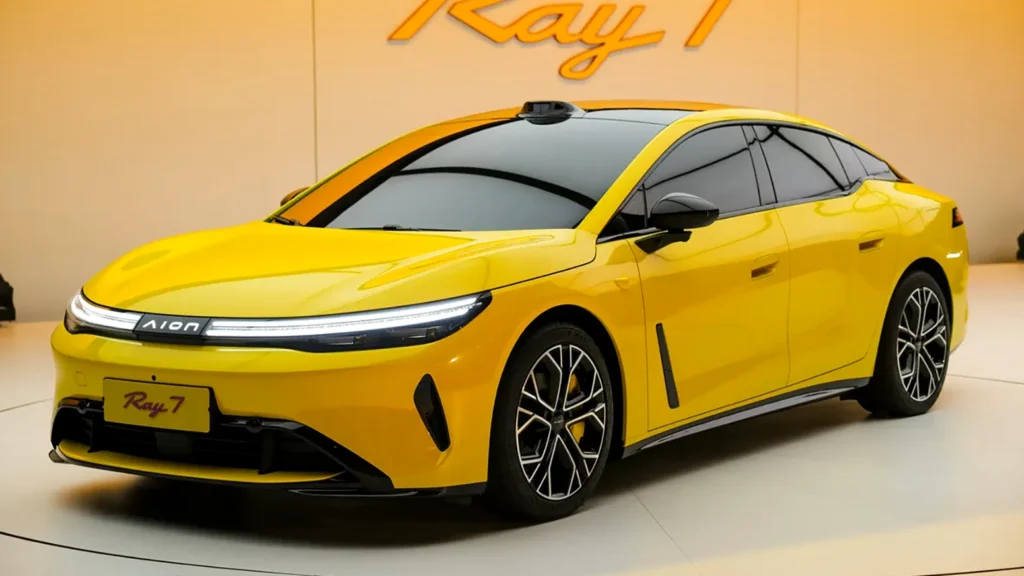
New Ray 7 Series
GAC Aion is one of the largest and most important Chinese electric vehicle brands, and now it has another brand-new model. Known as the Ray 7, it is a sleek aerodynamic sedan, but unlike many others, including the Xiaomi SU7, it does not emphasize performance, so it should be more affordable.
Specifications and Range
The Ray 7 is the first model in GAC Aion’s new Ray series and is based on a rear-wheel-drive platform. The front has a double-wishbone suspension, and the rear has a five-link suspension. Two battery options will be available: one supplied by CATL, and the other by its own Yinpai Battery division. The characteristics of these batteries have not yet been announced.
Review: China’s GAC Aion UT 2026 — a budget electric car that doesn’t feel cheap
Power is provided by a single rear electric motor with 241 hp. Compared with some new electric cars from China that have more than 1,000 hp, this does not sound impressive, but it is enough for everyday use. GAC Aion claims a range of about 700 km on the CLTC cycle. Energy consumption is said to be only 9.7 kWh per 100 km, which, if true, would make it one of the most efficient electric cars on the market.
Design and Dimensions
Recent government documents reveal that the Ray 7 is 4,960 mm (195.2 in) long, 1,900 mm (74.8 in) wide, and 1,455 mm (57.2 in) tall, with a generous wheelbase of 2,920 mm (115 in). Key design features include a full-width LED strip at the front and a sleek fastback roof and rear door.
Autonomous Driving Technologies
It uses Level 4 autonomous driving technologies from WeRide robotaxis, including 27 sensors such as Huawei lidar and three 4D millimeter-wave radars. Although this system will not allow the Ray 7 to achieve Level 4, it will still be able to move between addresses and park by itself.
This approach looks pragmatic: instead of chasing power records, GAC Aion is betting on efficiency and affordability. This could be a key factor for the mass market, where most buyers are looking for practicality rather than sporty performance. In addition, the use of robotaxi developments shows that even budget models can receive advanced driver assistance systems, albeit with limitations. And if the Ray 7’s real efficiency matches the claimed figures, it could become a serious competitor to more expensive electric cars, while offering a modern design and decent autonomy at a reasonable price. All that remains is to wait for official pricing and trim details to see how attractive this offering will be on the market.