 by
by This week, the United States is experiencing a sharp increase in fuel prices, with some states seeing particularly significant jumps. The main reasons cited are the rising cost of oil and a seasonal increase in demand.
Record Increases Across the Country
Gasoline prices are rising across the United States. Of course, they always increase slightly in the spring, but now we are talking about significant jumps, and the main reason cited is the war in Iran, which is driving up global oil prices. On average, in every state of the country, a gallon now costs at least $3, and in some, the price has exceeded the $5 mark. This is equivalent to an increase of 30 percent or more in most regions. One state had to face an increase of as much as 47 percent.
This state is New Mexico, where the average gas price a month ago was only $2.61. Today it is $3.84. The average car in America has a tank that holds approximately 15 gallons of fuel. A month ago, filling it up in New Mexico would have cost $39.15. Today it costs $57.60.
Diesel crossed the $5 mark for the first time in many years, while at one gas station, gasoline is being sold for $7.69.
The American Automobile Association (AAA) reports that just last week, the national average price rose by 28 cents, and the usual seasonal increase associated with warmer weather is being amplified by higher oil prices and market uncertainty due to the conflict in Iran. The White House’s decision to release 172 million barrels from the Strategic Petroleum Reserve did not bring immediate relief, which means drivers are still seeing prices rise as demand increases.
A Wave of Increases Has Swept Many States
In other words, New Mexico is not alone. According to Business Insider, several other states were not far behind. Kentucky, Oklahoma, Louisiana, Arizona, Texas, Colorado, Indiana, Mississippi, and Tennessee showed increases of approximately 40-44 percent over the same period. In many cases, local metropolitan areas are already approaching the $4 per gallon mark.
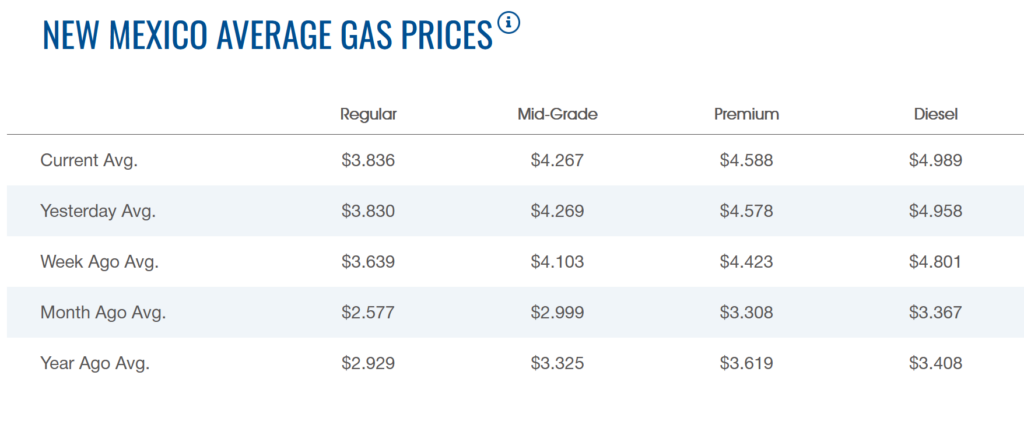
Even despite the sharp increase, prices are still lower than the record highs set in June 2022, when average prices in several states significantly exceeded $4.50 per gallon. However, the speed of the current increase is unusual.
According to AAA, the main reason for the sudden jump at gas stations is a combination of seasonal demand and rising oil prices. Spring typically brings more consumption due to increased travel. Add to this the war in Iran and supply concerns, and we get the prices we see. Aggressive steps, such as using the Strategic Petroleum Reserve, may only be reflected in gas station prices after weeks or months.
Top 20 States by Fuel Price Increase Rate
Below is a ranking of states where gasoline prices are rising the fastest. The table shows the current average price, the price a month ago, and the percentage change.
- 20. Minnesota: $3.44 (a month ago: $2.57) – increase 34.0%
- 19. Missouri: $3.40 (a month ago: $2.52) – increase 35.0%
- 18. South Carolina: $3.60 (a month ago: $2.66) – increase 35.2%
- 17. Florida: $3.95 (a month ago: $2.91) – increase 35.7%
- 16. Iowa: $3.34 (a month ago: $2.45) – increase 36.2%
- 15. Arkansas: $3.37 (a month ago: $2.46) – increase 36.8%
- 14. Alabama: $3.60 (a month ago: $2.63) – increase 36.8%
- 13. Ohio: $3.73 (a month ago: $2.70) – increase 38.0%
- 12. Indiana: $3.83 (a month ago: $2.75) – increase 39.1%
- 11. Georgia: $3.79 (a month ago: $2.71) – increase 39.9%
- 10. Tennessee: $3.62 (a month ago: $2.58) – increase 40.1%
- 9. Mississippi: $3.51 (a month ago: $2.49) – increase 41.0%
- 8. Arizona: $4.46 (a month ago: $3.16) – increase 41.1%
- 7. Texas: $3.60 (a month ago: $2.55) – increase 41.3%
- 6. Louisiana: $3.55 (a month ago: $2.51) – increase 41.4%
- 5. Colorado: $3.92 (a month ago: $2.76) – increase 42.0%
- 4. Oklahoma: $3.26 (a month ago: $2.29) – increase 42.2%
- 3. Wisconsin: $3.63 (a month ago: $2.55) – increase 42.4%
- 2. Kentucky: $3.73 (a month ago: $2.59) – increase 44.0%
- 1. New Mexico: $3.84 (a month ago: $2.61) – increase 47.0%
Sources: AAA, Business Insider
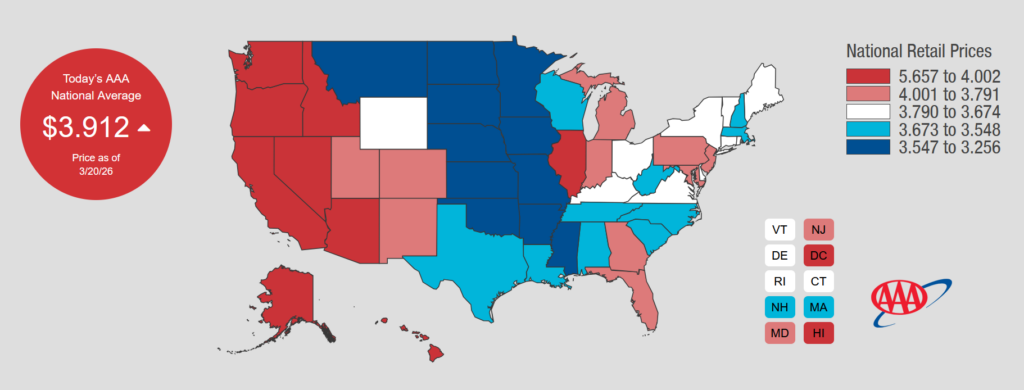
Such trends often point to deeper economic processes. A sharp increase in fuel costs directly affects the cost of transportation and logistics, which may later be reflected in the prices of consumer goods for the end user. Although the administration is taking measures aimed at stabilizing the market, their effect is typically delayed. Meanwhile, for many American families, especially in states with the largest increases, monthly transportation costs may rise significantly, creating additional pressure on household budgets amid already high inflation.