


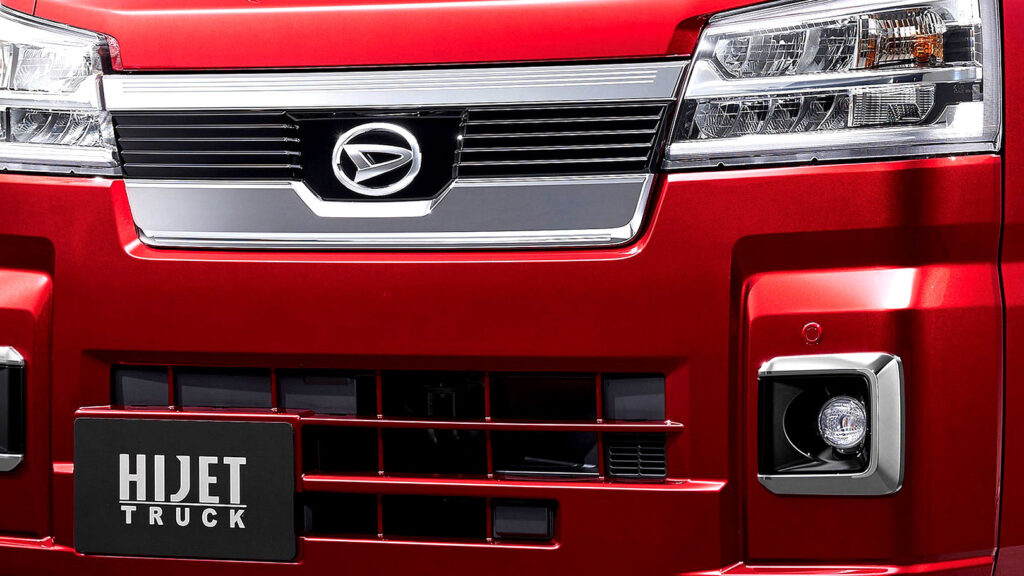
Update for the Japanese Market
Daihatsu has introduced the updated 2026 model year version of the Hijet Truck for the Japanese market to comply with the latest safety requirements. The Toyota Pixis Truck model has received identical changes. This allows both vehicles to compete with similar kei trucks from Suzuki, Mazda, Nissan, and Mitsubishi.
Model Evolution
The current generation of the Hijet Truck debuted back in 2014, with a facelift occurring at the end of 2021. Following minor updates in early 2025, this is already the second recent update focused on expanding functionality.
The main news for 2026 is the updated “Smart Assist” system, which now includes 13 preventive systems adapted for urban driving. It can recognize bicycles crossing the road ahead, detect oncoming traffic when turning right at an intersection, and also notice pedestrians approaching from the opposite side when turning left or right.
Exterior and Details
Externally and in the interior, these kei trucks have remained virtually unchanged. The changes have affected details. The Extra trim now comes standard with LED headlights featuring the Adaptive Driving Beam function (automatic high beam), as well as side clearance lights for maneuvering in narrow alleys.
Differences Between Brands
If you ignore the emblems, the Daihatsu Hijet Truck and Toyota Pixis Truck are practically the same model. The real difference is that Daihatsu offers a Jumbo version with a higher roof and an extended cab. Furthermore, both models can be ordered in various body styles: from dump trucks and refrigerated vans to panel vans and simple flatbed trucks.
Technical Specifications
Both trucks are equipped with 660cc gasoline engines. Naturally aspirated versions produce 46 hp, while the turbocharged variant delivers 63 hp. Buyers can choose rear-wheel or all-wheel drive, as well as a five-speed manual transmission or a CVT. For challenging conditions, the optional all-wheel-drive system can be equipped with a differential lock for improved traction.
Pricing Policy
The 2026 model remains one of the most affordable options in the Japanese kei truck segment. Prices start from 1,094,500 yen for the base version with a manual transmission and go up to 1,628,000 yen for the top turbocharged model with all-wheel drive and an automatic transmission. For commercial needs, special versions can cost up to 2,733,000 yen.
According to Daihatsu, since the first model appeared in 1960, over 4.58 million units of the Hijet Truck have been sold, confirming its status as the most popular kei truck in Japan.
The twin models from Daihatsu and Toyota compete in a crowded market with the Suzuki Carry, Nissan Clipper, Mazda Scrum, and Mitsubishi Minicab. Earlier this year, these four competitors also underwent updates, receiving new safety technologies and revised front-end designs.


The popularity of such compact trucks in Japan is explained not only by their affordable price but also by their versatility and adaptation to local conditions: narrow streets, and size and power restrictions for vehicles in the “kei” category. The continuous improvement of safety systems, especially for the urban environment, makes them increasingly attractive for both business and private use, while preserving their main advantage—simplicity and functionality.