 by
by Pros: Off-roader, good power, more efficient than V6
Cons: Lack of left footrest, uncomfortable seats, limited cargo space
Unwavering Classic in the Modern World
The Jeep Wrangler today, more than ever, goes against the grain of general automotive industry trends. While many manufacturers are focused on electrification and filling new models with the latest technology, the Wrangler retains all that authentic charm that made it an icon.
You won’t find a tablet glued to the dashboard here, or complex menus instead of simple functions. Even in 2026, the Wrangler sticks to real buttons and physical controls that can be used without thinking. The construction also remains traditional – a body-on-frame architecture that prioritizes true off-road capability while remaining surprisingly suitable for daily use.
Against a sea of quiet, comfortable, technology-laden crossovers, the 2026 Jeep Wrangler feels decidedly old-school. The question is whether that’s a strength or simply stubbornness.
Key Model Specifications
Eternal Success of an Old Platform
Jeep has been producing the current generation Wrangler since 2017, so the model is already quite old. There haven’t been many significant updates, yet it continues to sell in incredible numbers, especially in the US. Last year, 167,322 units were sold in its home market.
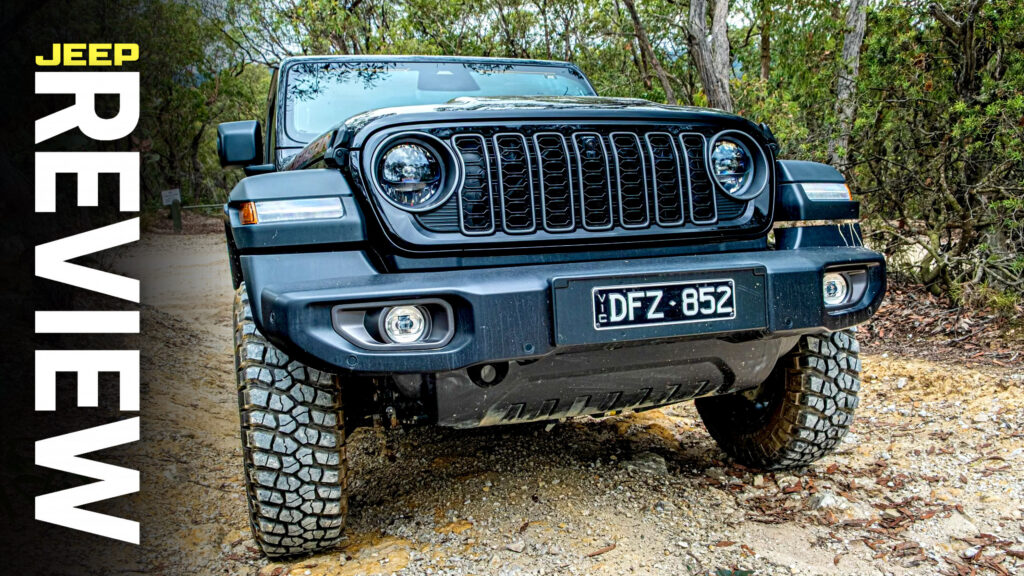
Testing the 2026 model in Australia in the top Rubicon trim with two doors is perhaps the best configuration for off-roading. In the Australian market, the Wrangler has never been sold with the 4xe hybrid powertrain or V8 engines available in other regions, and until recently the only option was the 3.6-liter naturally aspirated Pentastar V6 engine.
Now the situation has changed. The V6 has been removed from the lineup and replaced with a 2.0-liter turbocharged four-cylinder engine. It is slightly weaker than the 3.6-liter – 200 kW (268 hp) versus 209 kW (280 hp) for the V6, but the turbo helps increase torque from 367 Nm to 400 Nm.
An eight-speed automatic transmission and all-wheel drive work with this engine. All the necessary off-road attributes have been retained despite the smaller engine, including locking differentials, sturdy Dana axles, and a sway bar disconnect system.
Questions of Price and Equipment
Although the Wrangler has remained quite traditional over the past decade, the Rubicon model has become significantly more expensive. In the US, the two-door version starts from $48,660, but in Australia it costs significantly more – 81,990 Australian dollars. The four-door version costs even more.
Despite the age of the Wrangler’s interior, it somehow doesn’t feel outdated, which was a surprise.
The central multimedia screen has grown to 12.3 inches. The Uconnect 5 software is convenient and comprehensive, with many menus and settings. The presence of wireless Android Auto and Apple CarPlay is also a nice bonus.
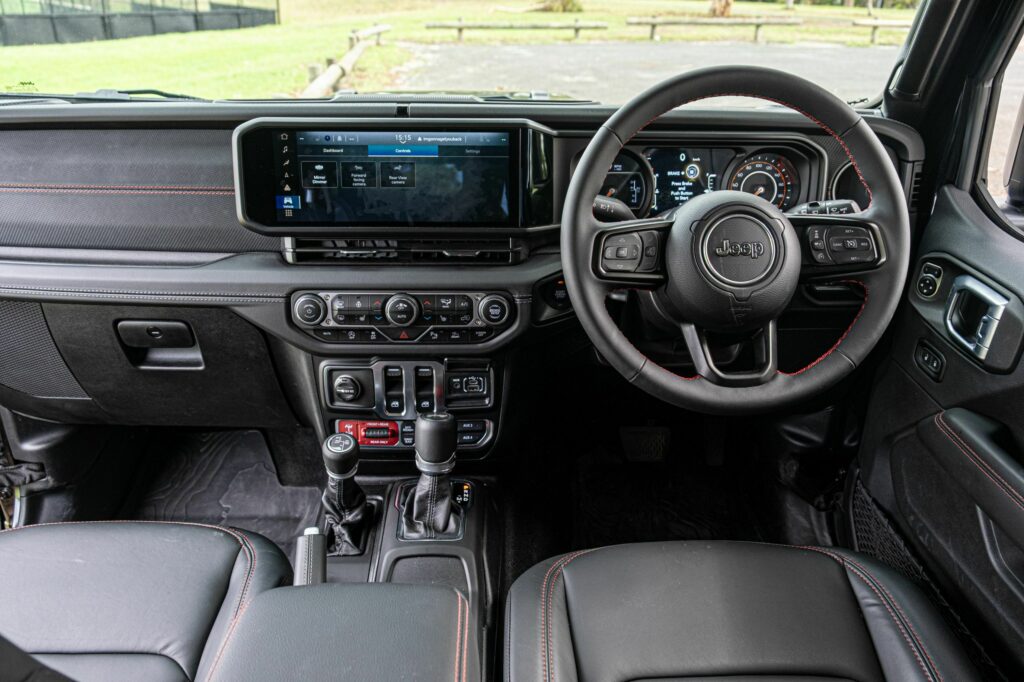
The Wrangler’s ability to perfectly balance modernity and classic is demonstrated by the partially digital, partially analog instrument cluster, which has become a pleasant alternative to fully digital but often cheaper-looking solutions.
Overall, the interior finish quality is high; you might even feel guilty about getting it dirty, although this is a Jeep that wouldn’t look strange being constantly covered in mud. The interior nicely combines soft leather and black plastic with bright red contrast stitching.
Features and Quirks
Some things take getting used to. For example, the window switches are located in the center of the dashboard because the doors can be removed by unscrewing just a few bolts. The door opening is quite narrow, so taller drivers will have to duck their heads when getting in or out. Also, there is no left footrest, so the foot ends up almost under the brake pedal.
It would be nice if Jeep added wireless smartphone charging – it’s one of the most obvious modern conveniences that’s missing. The front seats are also quite uncomfortable, with minimal lateral support and limited lumbar adjustment, making them more like church pews than seats in an $80,000+ Australian dollar car.
While the two-door configuration may seem completely impractical for more than two people, that’s not actually the case. Of course, getting into the back row is difficult, but there is sufficient head and leg room there.
The real impracticality of the two-door version lies in the cargo compartment capacity – only 365 liters with the rear seats up. But presumably, most two-door Wrangler owners keep those seats folded or remove them altogether.
The New Turbocharged Engine
This was the first experience driving a Wrangler with the new 2.0-liter turbocharged four-cylinder engine. The difference in driving impressions is significant.
If the old Pentastar V6 engine, dating back to 2011, had a somewhat raspy growl and felt muscular, the 2.0-liter engine is much quieter and less intrusive. It doesn’t feel as rev-happy at low RPMs, and you need to spin it up for the turbo to deliver full power. While driving, a pleasant turbo sound is heard when lifting off the accelerator.
One of the main advantages of the 2.0-liter engine is improved fuel economy. The claimed average fuel consumption for the old V6 was 10.3 L/100 km, while for this model it is 9.7 L/100 km. However, during a week of testing, the four-cylinder engine showed an average consumption of 12.6 L/100 km, despite a significant portion of the journey being on highways where it should have been most efficient. This is partly explained by the off-road driving.
On-Road Behavior
On the road, the two-door Wrangler feels quite suitable for daily use, albeit a bit strange to drive. Largely due to the off-road tires and recirculating ball steering, the first few degrees of steering wheel turn feel absolutely numb, as if nothing is happening. Then the steering becomes a bit heavier and starts to feel more natural.
It also requires many turns of the steering wheel from lock to lock, so during turns, especially in parking lots, you’ll have to shuffle the steering wheel quickly. A key advantage of the two-door version is the excellent turning radius thanks to the 2459 mm wheelbase. This is useful not only on the road but also for owners who will inevitably venture off-road.
Undisputed King of Off-Road
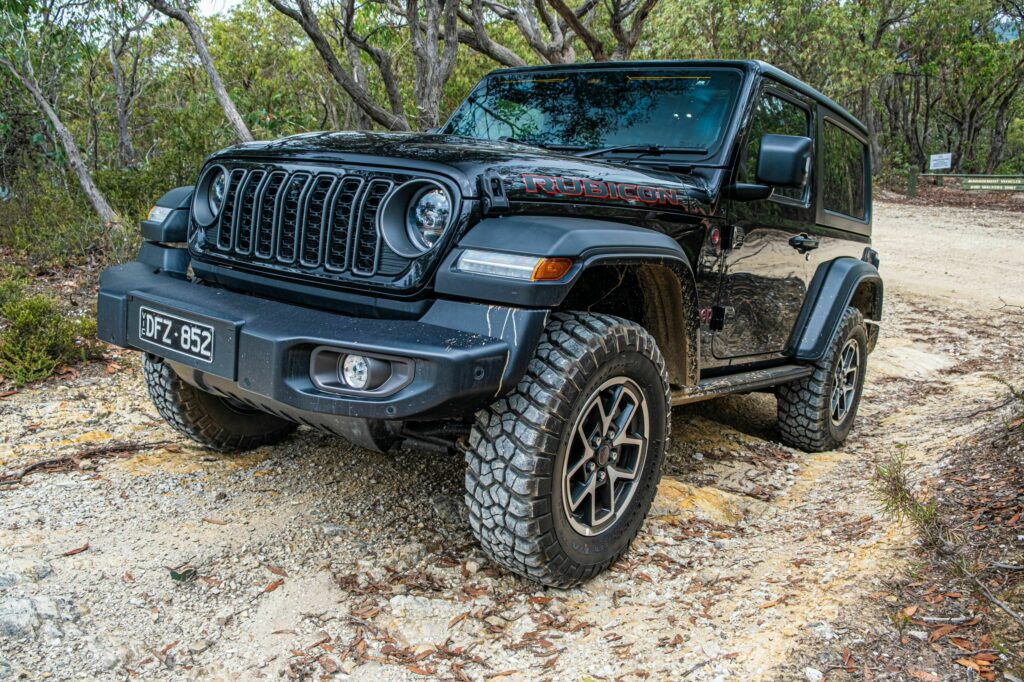
As one might expect, the Wrangler’s primary purpose remains conquering off-road terrain, and in this area it continues to be a leader.
During testing, the Jeep overcame various obstacles: muddy puddles, narrow rocky trails, and steep rocky climbs, without even needing to engage low-range, lock the differentials, or disconnect the sway bar. Simply in 4H Auto mode, the 2026 Wrangler fully lives up to its Trail Rated badge. No wonder there were more Wranglers than any other off-roader on the route.
Although the Jeep provides good wheel articulation and has suspension tuned for off-roading, this doesn’t mean it absorbs bumps as wonderfully as, for example, the Ford Ranger Raptor. It remains noticeably stiffer, but never becomes uncomfortable.
Conclusions and Market Position
The Jeep Wrangler has always been quite specialized, offering unbeatable off-road capabilities that were almost never challenged until Ford decided to revive the Bronco.
In 2026, the Wrangler retains the same advantages and character as its predecessors, and the 2.0-liter turbo engine helps it feel a bit more refined on the road. It’s worth remembering that tire and wind noise remains significant, especially at highway speeds, and if you need a comfortable and practical car for daily use, there are better ways to spend the money.
Despite its shortcomings, the Wrangler remains incredibly appealing to those who can afford it. One can only regret that the V8 engine version is not supplied to the Australian market.
Interestingly, the Wrangler’s resistance to change may be its strongest market advantage. In a world where cars are becoming increasingly similar to each other, it offers an authentic experience that cannot be replicated. Its value as an adventure tool and as