


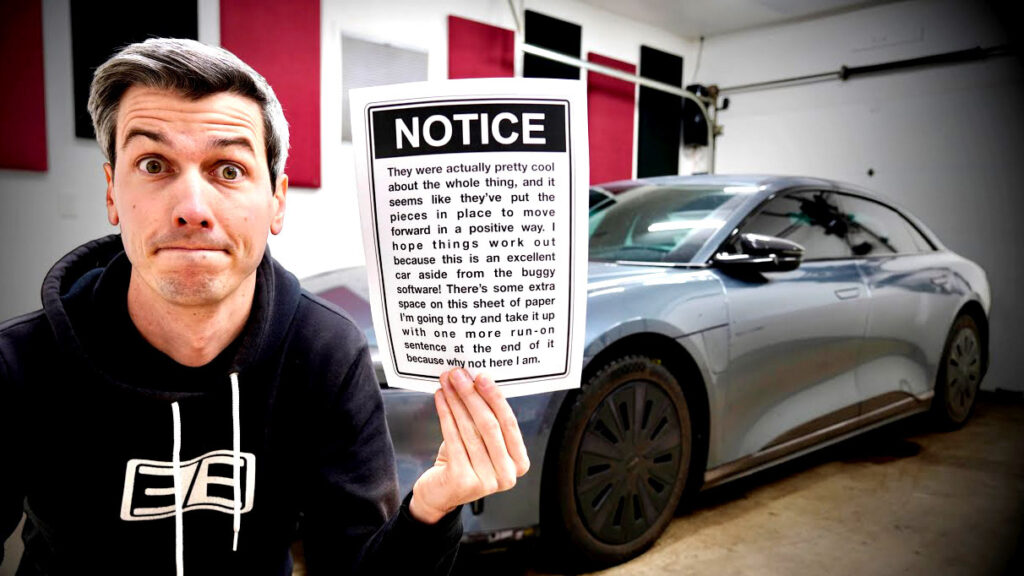
A Critical Review from a Popular YouTuber Led to a Direct Dialogue with Lucid Engineers
Negative car reviews on YouTube sometimes have far-reaching consequences, even being accused of possibly causing the collapse of entire automakers. However, a recent critical video review of the Lucid Air electric sedan triggered a completely different reaction. Instead of being ignored or causing a scandal, it became the start of a constructive conversation that could improve the experience for all owners of this brand.
Jason Fenske, the author of the “Engineering Explained” channel, published a detailed technical breakdown of the problems he encountered after renting a Lucid Air Touring. His main complaint was that the technically perfect electric car suffers from unfinished software, an inconvenient interface, and some hardware quirks.
This wasn’t a typical malicious review; it was a technical analysis of how a brilliantly mechanically created electric car is hampered by software issues.
Manufacturer’s Reaction: From Criticism to Collaboration
Unlike many other cases, Lucid did not ignore the criticism. Instead, they reached out to Fenske. According to him, a constructive conversation took place with the company’s engineers, even with Senior Vice President of Engineering Imad Dlaia. The Lucid team shared details of upcoming updates and plans to fix existing shortcomings.


What Awaits Lucid Owners: Software Fixes and a Major Update
The most important changes concern software. Lucid confirmed that it is actively working on improving the reliability of the “phone as a key” feature, the behavior of door handles, mirror positioning when reversing, as well as on aligning the display of range in percentages and miles. Support for the Plug & Charge function at Tesla Supercharger stations will also be added.
However, the most significant announcement is that of a complete user experience (UX) update to version 3.0, scheduled for early fall 2026. It is expected to bring:
Access to it will be granted to owners of cars with the latest hardware or those who agree to a paid upgrade.
Technological Advantages: The Electric Car as a Power Source for the Home
Lucid also confirmed that vehicle-to-home (V2H) technology, which allows powering a home from the car, will appear in the first half of 2026. The system promises a peak power of up to 17 kW without the need for a separate home inverter. This could become a real advantage of the Lucid hardware platform.
According to Fenske’s estimate, his Lucid Air could power his house for four days in case of a power outage, without forcing his family to change their usual behavior.
Cautious Optimism and the Context of the Event
Jason Fenske remains cautious, emphasizing that promises are not yet fixes, and that problems with the daily usability of the Lucid Air remain relevant today. However, the very willingness to acknowledge problems, engage in dialogue with substantiated criticism, and outline specific solutions already sets Lucid apart from many other automakers.
It is important to understand the context: such a reaction is not typical for an ordinary customer. Jason Fenske is a popular technical reviewer with a million-strong audience who speaks the same language as Lucid engineers. This certainly influenced the outcome. Nevertheless, the information he shared and the plans announced by Lucid have real significance for all current and future owners of this brand’s cars, as they indicate the company’s priorities and the direction of its product development.
This case demonstrates a paradigm shift in the interaction between manufacturers and informed users in the age of social media. When criticism is based on facts and technical expertise, it can become a catalyst for positive changes beneficial to the entire owner community. The success of these initiatives will depend on how quickly and how well Lucid implements the announced updates, turning words into a real, tangible experience behind the wheel.