


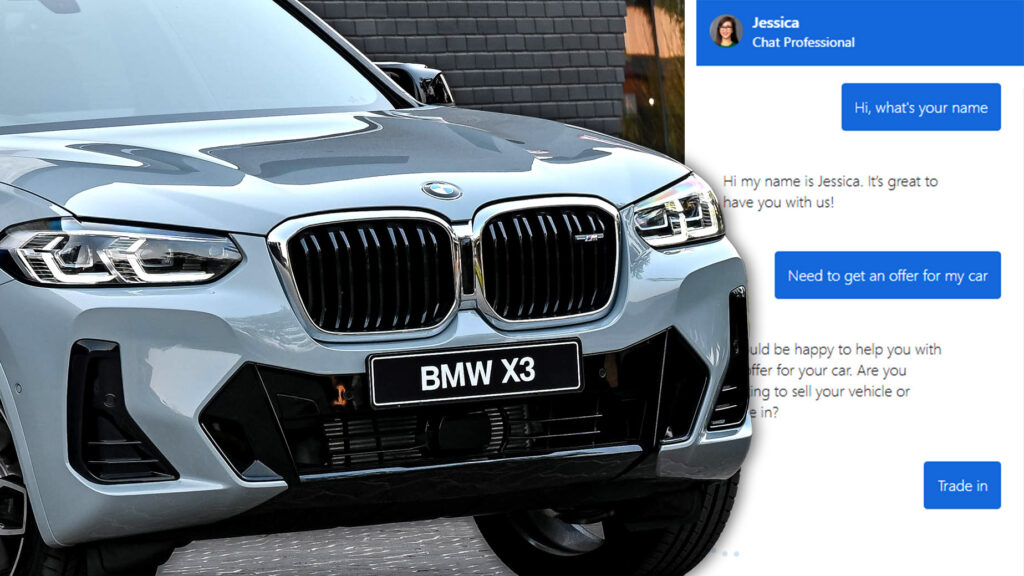
Sometimes a phone call, no matter how tedious it may be, is the easiest way to ensure something gets done. A BMW Toronto client recently found this out after what he thought was a pleasant online exchange with a dealership employee. They had agreed on a deal to buy back his aging X3. Then they called him. It turned out he had made a deal with artificial intelligence, and initially, that was enough to render it invalid.
Meet “Quinn”
According to CBC News, funeral home owner Zac Giacomelli was trying to sell his 2021 BMW back to the same dealership that sold it to him. After sending an online inquiry to BMW Toronto, he began corresponding with “Quinn,” who appeared to be a representative of the dealership.

The conversation quickly turned to the deal. Reports state that Quinn offered $27,162.79 for the car — an amount that exactly matched what Giacomelli still owed on his loan. For the first time, the process seemed to lean in his favor. “I felt that this person, Quinn, had finally heard me,” Giacomelli said. “I felt really good.” Even better, the AI even scheduled a meeting to complete the transaction, telling him: “Let’s lock this in today at 3:30 PM.” Then it all fell apart.
AI Mistake
A dealership employee called Giacomelli and explained that Quinn was not a person at all. Instead, it was an artificial intelligence chatbot that had made the offer by mistake. “He said the offer is invalid,” Giacomelli recalled. “I was shocked, I was stunned, my jaw dropped to the floor.” The actual buyback value, according to the dealer, was closer to $20,000. That left a difference of over $7,000.
“I was devastated,” he told the news service. “If they are going to replace their employees’ jobs with artificial intelligence, then they should follow through on what that AI says.”

The situation became even more awkward as Giacomelli says he had no idea he was talking to an AI. The chatbot never identified itself as artificial intelligence during the conversation. After CBC News contacted the dealership, BMW Toronto reversed its decision and reinstated the original offer of $27,162.79. Giacomelli immediately accepted it.
Who Should Be More Careful
A sales manager at the dealership told the CBC that the error stemmed from a communication failure. According to the dealer, the AI mistakenly interpreted the amount remaining on the customer’s loan as the amount the dealership should pay for the car. BMW Toronto says it is now changing its procedures so that only human employees present buyback offers, and thus customers are clearly informed when they are interacting with AI.
It seems everyone has an opportunity to learn something here. Dealers looking to cut costs with AI chatbots might want to be more vigilant. Clients need to be even more cautious. Dealers can absorb thousands of dollars from erroneous deals. Most customers, even at BMW, do not have such a margin of safety.

This story highlights how fragile trust can be in the age of automation. While AI promises efficiency, its implementation without proper oversight can lead to significant financial and reputational losses. For consumers, it is a reminder to always verify who they are communicating with and insist on written confirmation of agreements, especially when large sums are involved. For businesses, this case serves as another signal about the need for transparency in the use of AI and the creation of clear protocols to prevent such incidents, as responsibility for the actions of algorithms ultimately lies with the company.