


Mustang GTD Owner Chooses Paint Inspired by Porsche
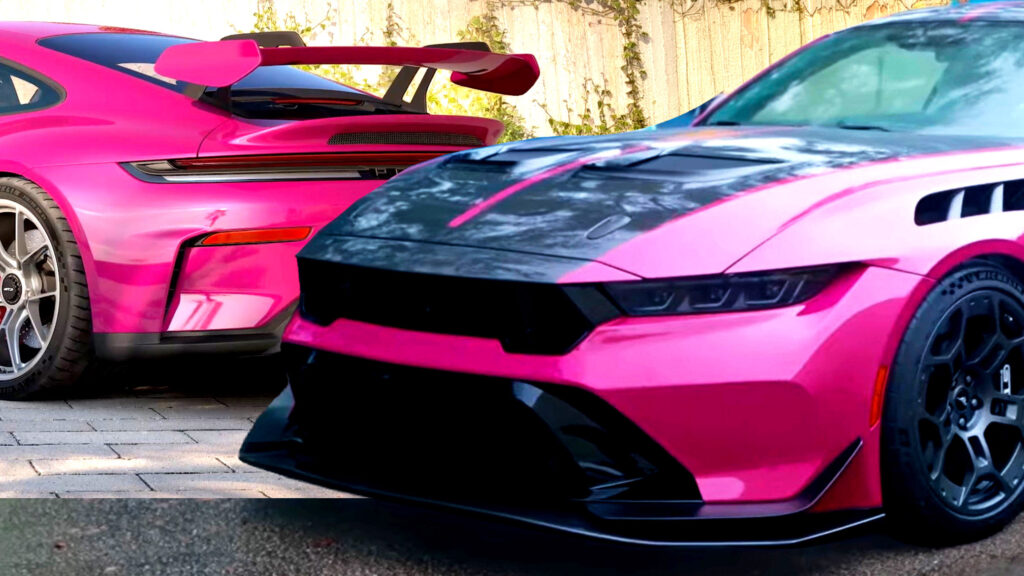
The owner of a Ford Mustang GTD decided to take a non-standard path when configuring his supercar, choosing a color associated with Porsche rather than Ford’s traditional palette. He demonstrated this choice on YouTube.
The car is painted in a bright purple-pink shade called Rubystar Neo. This color is typically seen on Porsche sports models like the GT3, making its choice for the American Mustang quite unexpected.
Identity Conflict and Provocative Undertone
Entrepreneur Pejman Ghadami, who owns this car, explained his color choice as a provocation aimed at Porsche. He has been quite vocal in his criticism of the GT3 RS model, which makes his decision to “dress” the Mustang in a competitor’s colors even more ironic.
Ghadami, who controversially described the GT3 RS as “the biggest piece of shit,” explained his color choice as a “direct (expletive) gesture” towards Porsche.
The result is simultaneously impressive and slightly bewildering. From a distance, the car could be mistaken for a Porsche, but upon closer inspection, the aggressive aerodynamic body kit, massive rear wing, and the car’s overall stance clearly identify it as a Ford Mustang GTD. It’s a kind of visual identity crisis executed in the best possible way.
Technical Specifications and Cost
Beneath the bright paint lies serious technical hardware. The Mustang GTD is equipped with a supercharged 5.2-liter V8 engine producing over 800 horsepower. This specific model also received the optional Performance Package.
Color and Model Availability Context
It should be noted that the Porsche GT3 RS is not currently offered in the US market. For comparison, last year its price was around $252,000. The regular GT3, however, remains available in 2026.
The Rubystar Neo color is a modern interpretation of the Rubystar shade used on cars like the Porsche 964 RS in the 1990s. While Rubystar Neo is no longer offered as a standard option, the original Rubystar can still be ordered through the Porsche Paint to Sample program, but this costs an additional $17,210.
This story well illustrates how car culture is ceasing to be rigidly tied to brands. Owners of high-performance vehicles are increasingly seeking personalization methods that go beyond traditional corporate palettes, creating hybrid images. Choosing a competitor’s color is not just an aesthetic decision, but a firm statement of individuality and a certain attitude towards automotive history. Such a step blurs the lines between automotive “camps” and reminds us that high technology and the emotions of driving are often common to all supercar manufacturers.