


The Volkswagen Group faced serious financial difficulties in 2025. Key points of the situation:
Sharp Drop in Profits
Volkswagen has just released data showing that its operating profit plummeted last year, more than halving. This was influenced by tariffs, Chinese competition, and strategy changes, which severely impacted financial results. This situation is forcing the group’s management to resort to strict austerity measures, including plans to cut up to 50,000 jobs by the end of the decade.
The German automaker reported an operating profit of 8.9 billion euros for 2025. This is a full 53 percent less than the previous year and significantly below analysts’ expectations. Revenue, meanwhile, remained almost unchanged, slightly decreasing to approximately 322 billion euros.
Causes of the Crisis
What went wrong? It can be called a perfect storm. First, tariffs imposed by the US government proved costly for global manufacturers, and Volkswagen states they have already cost the company billions. Then there’s China, which remains VW’s largest market but is also becoming much more competitive as local brands rapidly gain momentum.
Problems Even at Porsche
Even Porsche ultimately added to the pain. The sports car manufacturer recently adjusted its strategy and decided to stick with internal combustion engines longer after demand for electric vehicles proved lower than expected. This reassessment caused over 3 billion euros in special expenses for the group.
Porsche’s struggle with its electric vehicle strategy was also clearly evident in its own results. In 2025, the brand’s operating profit fell by 98 percent to just 90 million euros, and its operating margin was only 0.3 percent. A year earlier, this figure was 14.5 percent.
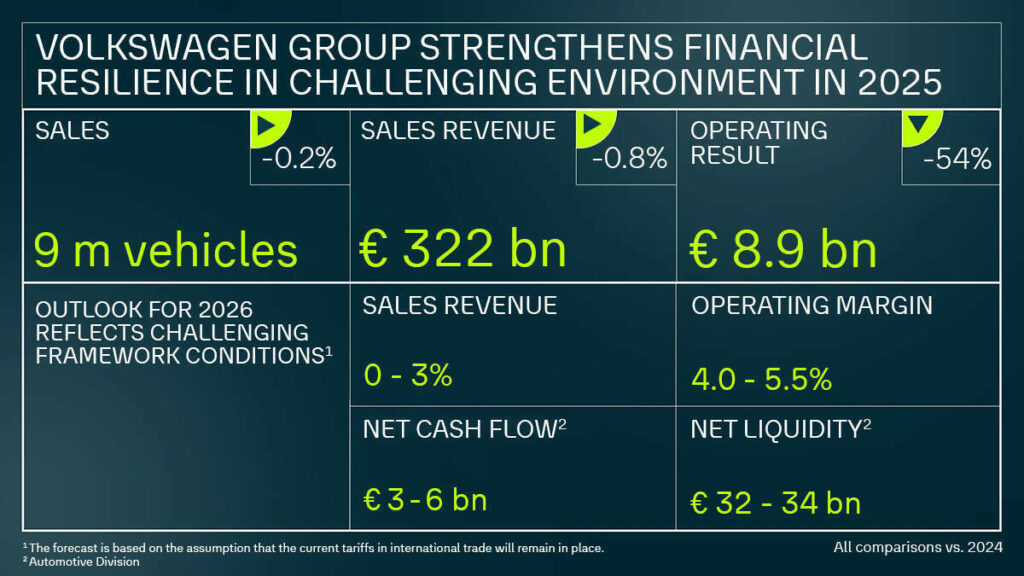

In summary, Volkswagen’s operating margin fell to just 2.8 percent in 2025, compared to 5.9 percent a year earlier. Company executives acknowledge that this is simply not a good enough result. CFO Arno Antlitz called the year truly difficult, although he stated that Volkswagen is still holding its ground in Europe and increased its electric vehicle market share to 27 percent.
Austerity Measures
To return to healthier figures, the company is resorting to a familiar corporate strategy: cut costs, restructure operations, and spend money a bit more cautiously. This includes potentially painful staff reductions. Volkswagen has already agreed to cut 35,000 jobs at its core brand in Germany, and further reductions at Porsche and the software unit Cariad could bring the total to approximately 50,000 by 2030.
The ultimate goal is to raise the operating margin back to a level between 8-10 percent, as stated by VW CEO Oliver Blume. For now, Volkswagen’s message is quite straightforward: the industry is getting tougher, and even giants sometimes need to tighten their belts.
VW Group Financial Data
The table below illustrates key financial indicators of the Volkswagen Group for 2025 compared to 2024, showing a decline in virtually all key parameters, from customer deliveries to operating result and net profits after tax.
Volkswagen’s 2025 financial results vividly demonstrate how vulnerable even the largest global automakers can be in the face of geopolitical changes, such as trade tariffs, and structural shifts in key markets. The drop in profitability at Porsche, which has always been one of the group’s most profitable assets, is a particularly telling signal of the difficulties in transitioning to electric vehicles. The planned large-scale staff reductions indicate that the company is preparing for a prolonged period of consolidation and likely a reassessment of its business model to meet new realities where competition from China is becoming increasingly defining for the entire industry.