


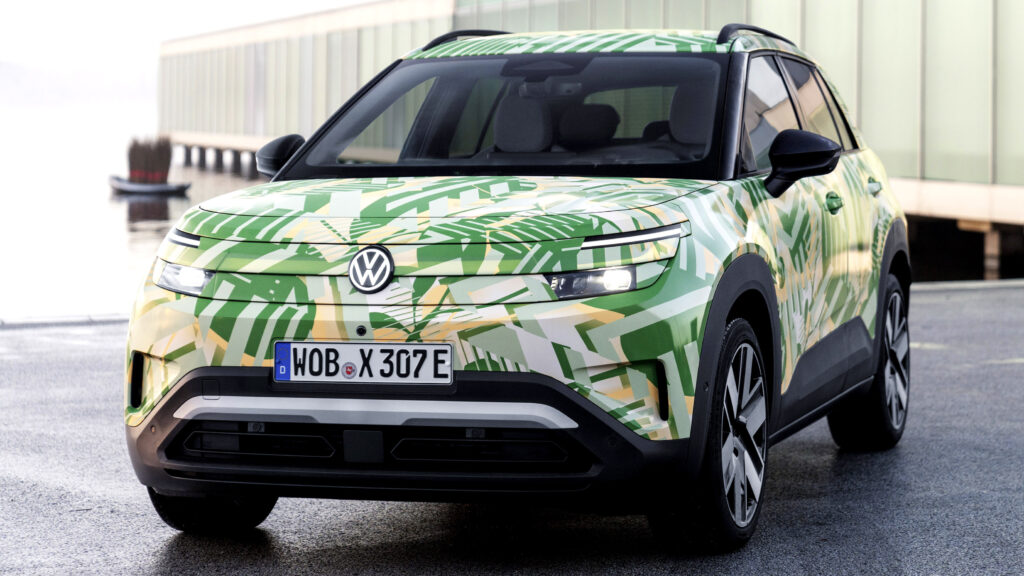
Volkswagen has finally provided the first details about its new compact electric crossover, the ID. Cross, by previewing it in official photos from Amsterdam. Although the car was recently caught by spy photographers almost without camouflage, it was covered up again for the official presentation.
Key Features and Price
According to the manufacturer, the model will debut in Europe this autumn. Its base price will be around 28,000 euros. The car is built on the updated MEB+ platform and will have much in common with another new model—the ID. Polo.
Buyers will be offered a choice of three front electric motors with power outputs of 114 hp, 133 hp, and 208 hp.
Two Battery Options
Volkswagen also confirmed the availability of two battery options with capacities of 37 kWh and 52 kWh. The smaller battery will likely use lithium-iron-phosphate (LFP) technology and support fast charging at up to 90 kW. It will be available for versions with the 114 hp and 133 hp motors.
The larger 52 kWh battery will most likely be nickel-manganese-cobalt (NMC). The stated range with it will reach up to 450 kilometers. This battery will also have a slightly higher peak fast-charging power—105 kW.
Dimensions and Practicality
The overall dimensions of the new crossover are 4153 mm in length, 1794 mm in width, and 1581 mm in height. The wheelbase is 2601 mm. Among the options, 20-inch diameter wheels will be available. The model will also be able to tow trailers weighing up to 1200 kg.
The interior of the ID. Cross is expected to be similar to the ID. Polo’s cabin, with a 10.25-inch digital instrument cluster and a 13-inch multimedia system. The trunk volume will be 475 liters, increasing to 1340 liters with the rear seats folded. Additionally, the car will have a front trunk (“frunk”) with a volume of 22 liters.
The question of a sports version remains open for now. It is known that the ID. Polo model will receive a GTI variant with 223 hp in the spring of 2027; however, Volkswagen has not yet revealed similar plans for the ID. Cross crossover. The appearance of this model is an important step for the brand towards making electric transport more affordable and popular, offering a compact yet practical car in a rapidly developing segment. Its success may largely depend on the final build quality, real-world range, and the speed of charging infrastructure deployment, which remains a challenge for many European markets.