


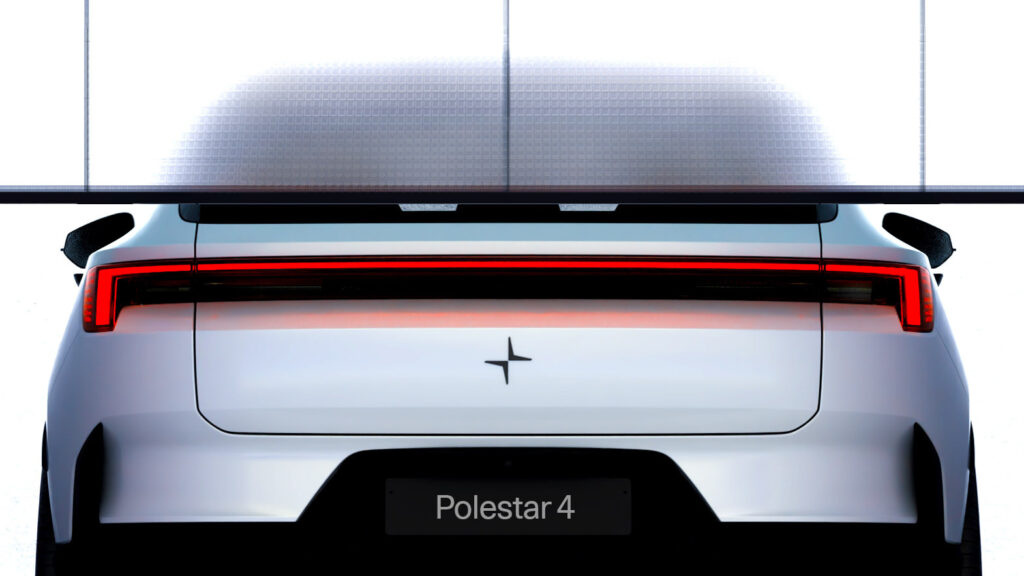
Polestar’s Plans for the Coming Years
Despite financial difficulties, the Geely-owned Polestar brand is not planning to slow down. The company has announced plans to launch four new electric vehicles by 2028. These new models are designed to strengthen the brand’s position in key market segments. The roadmap includes the Polestar 5 grand tourer, a more practical station wagon version of the Polestar 4, a fully updated Polestar 2, as well as an all-new compact crossover, the Polestar 7.
The “Universal” Polestar 4
The currently most popular Polestar 4 model, with its coupe-like roofline, is known more for its striking looks than practicality. The situation will change in the last quarter of 2026 with the appearance of a new version. It will receive roof rails and a redesigned rear end with a proper rear window.
CEO Michael Losseler notes that the updated Model 4 “combines the space of a station wagon and the versatility of an SUV with the dynamic performance characteristic of Polestar.”
Essentially, the car will retain the same technical base but will get a new silhouette and a more spacious interior. The same “bones,” but with greater potential for carrying things and pets.
The Next Generation Polestar 2


A completely new generation of the Polestar 2 is expected in early 2027. The current model, a competitor to the Tesla Model 3, has been on the market since 2019 and received an update in 2023, so a major overhaul seems timely. The official teaser, albeit blurry, hints that the Polestar 2 will lose some of its raised crossover silhouette in favor of a lower and more aerodynamic profile, with separate LED headlights and a simplified bumper design.
Compact Crossover of European Production

In 2028, the Polestar 7 will debut, becoming a player in the largest European electric vehicle segment. This model will be manufactured in Slovakia and will share a technical base with Volvo cars. The company’s management describes it as a “progressive, performance-oriented car” that will be offered at a “very attractive price.”
The Grand Tourer is Already Here
At the top of the lineup will be the Polestar 5 grand tourer. Its production version was unveiled at the Munich Motor Show in 2025, and deliveries in Europe are set to begin in the summer of 2026. This is a halo car that symbolizes the brand’s ambitions. It is built on a lightweight bonded aluminum platform. The Performance version features two electric motors with a combined output of up to 872 hp, clearly demonstrating that Polestar cares not only about sustainability but also about high dynamic qualities.
Optimism Despite Losses
All these plans are unfolding against the backdrop of a difficult financial situation. Last year, Polestar reported record retail sales of 60,119 cars, a 34% increase from the previous year, while the company’s losses deepened.
Despite what Losseler calls a “challenging geopolitical and economic environment,” he remains optimistic about the future: “We are targeting the heart of the electric vehicle market, where customer demand and profit potential are high.”
These confident statements now need to be backed up by real results.
The announced plans indicate Polestar’s strategic vision aimed at diversifying the model range and capturing the most mass-market segments. The emphasis on practicality, as in the case of the Polestar 4 station wagon, could be the key to attracting new categories of buyers for whom design is not a priority over functionality. Parallel work on the powerful halo car Polestar 5 and the affordable Polestar 7 crossover shows the brand’s desire to combine the image of a technology pioneer with the pursuit of commercial success. The success of this strategy will depend not only on the appeal of the new models but also on the company’s ability to manage production capacity and logistics amid global economic challenges.