


How to pass a vehicle inspection in Japan: A story about a Jeep Wrangler and cardboard headlights
Anyone who has tried to import or modify a vehicle in Japan knows that even the slightest deviation from official standards can cause a failure on the mandatory compulsory inspection (JCI). One U.S. Air Force serviceman found a loophole in this logic. Compliance doesn’t necessarily have to be beautiful. The main thing is to comply with the letter of the law.
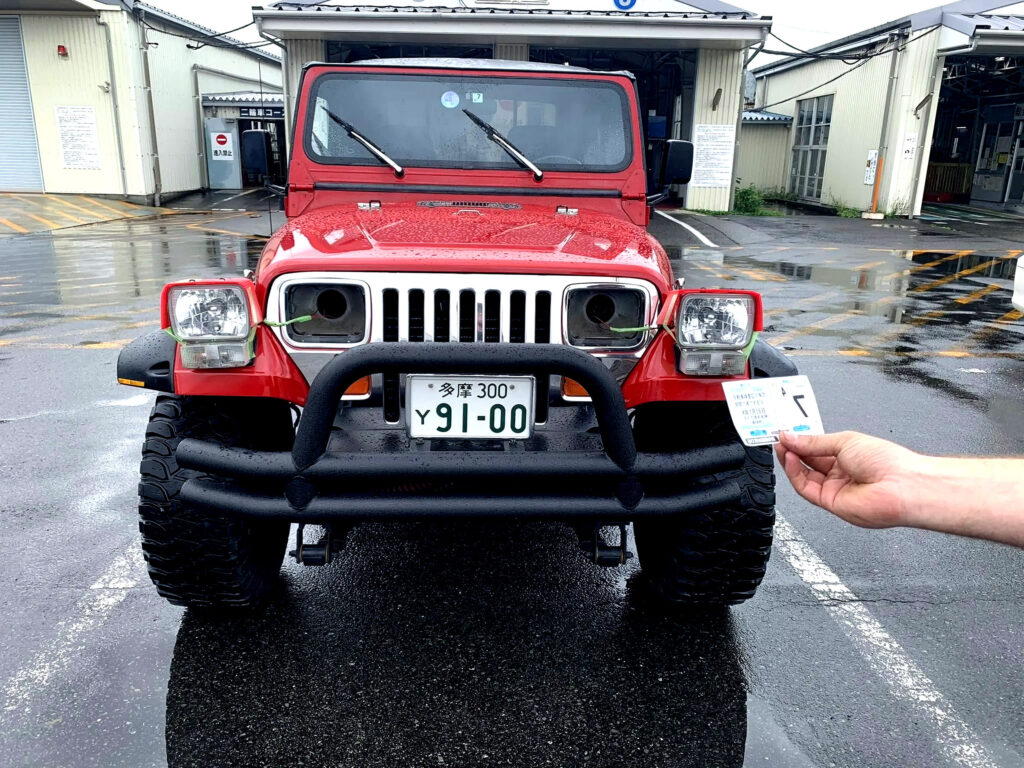
The Jeep Wrangler in these photos, with all its headlights, passed the safety check and received registration. And all this thanks to the owner’s ingenuity and his willingness to do the work himself.
The story of the owner and his SUV
Matt Norton grew up between upstate New York and southern New Hampshire before moving to Japan with his wife in 2019. Shortly after arriving, he purchased a 1993 Jeep YJ nicknamed “Buford.” The SUV was equipped with a lift kit, 33-inch tires, and wheel arch flares. These modifications gave it a truly rugged look, but also created regulatory problems during the inspection.
The problem: an extra inch of width
During the JCI check, officials told Matt that the distance between the headlights and the outer edge of the arch flares exceeded the permissible limit by 3 cm (1.18 inches). Instead of removing the flares, the inspectors suggested moving the headlights. Matt wasted no time: he headed to the local hardware store for duct tape, red cardboard, electrical wire, and connectors.
The solution: cardboard and duct tape
With the help of a friend, Matt unscrewed the square headlights from the radiator grille, leaving two empty holes. Then they fabricated makeshift outer housings from cardboard, extended the factory wiring, and attached the headlights directly to the fenders using duct tape.
When the modified Wrangler drove back onto the inspection line, the staff initially laughed. However, the setup was still approved because it technically complied with the headlight positioning rules.
The last hurdle: headlight aiming
The final test was a digital scanner that checks the aiming of the headlight beams to ensure they don’t blind oncoming traffic. During the scan, one of the tape-mounted headlights was found to be slightly misaligned. Matt’s friend ran up to the front fender, manually adjusted the cardboard box until the machine showed a passing result, and then secured it with another piece of duct tape.
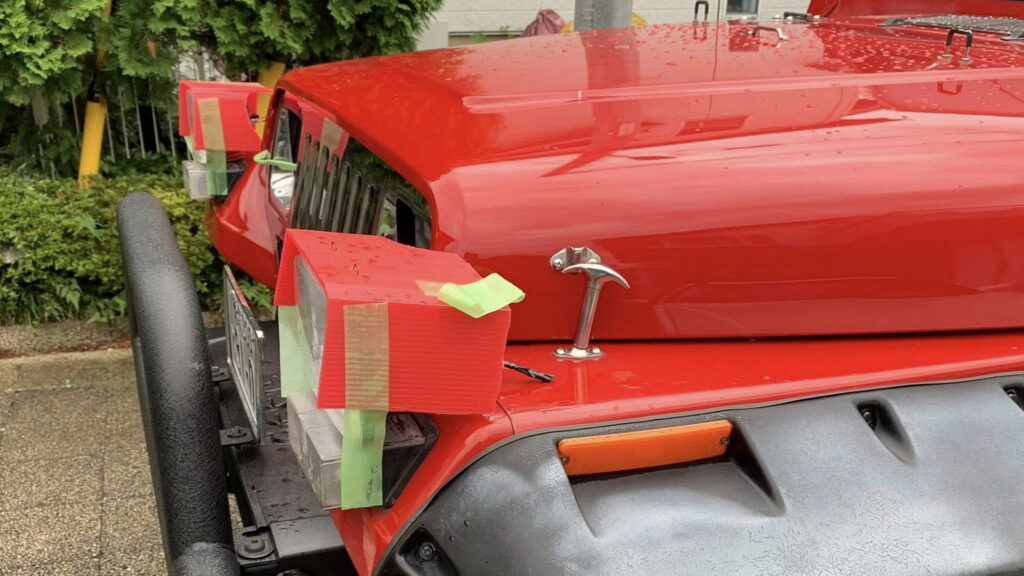

When the Jeep owner jokingly asked the inspectors how a temporary construction of cardboard and duct tape could be safer than the factory setup, they just smiled and replied that they were simply following the law.
End of the story
Unsurprisingly, the improvised setup didn’t last long. As soon as the inspection sticker was obtained, Matt pulled over in a parking lot, removed the cardboard boxes, and put the square headlights back in their factory positions.
Matt has since moved to Hawaii, where the family garage continues to grow with Jeeps. Along with the classic 1993 YJ “Buford,” the household now has a 2012 Jeep JK Arctic Edition and a 2018 Jeep JLU driven by his wife. All three Wranglers have manual transmissions, as the family are fans of driving with three pedals.
This story demonstrates how formal the approach to technical regulations can be in Japan. Inspectors do not evaluate the overall safety of a design; they only check compliance with specific rule items. For owners of non-standard vehicles, this means that sometimes creativity and knowledge of the law can be more important than technical perfection. At the same time, this approach raises questions about the appropriateness of rigid regulations that can be circumvented with cardboard and duct tape, while a factory design is deemed unacceptable.