


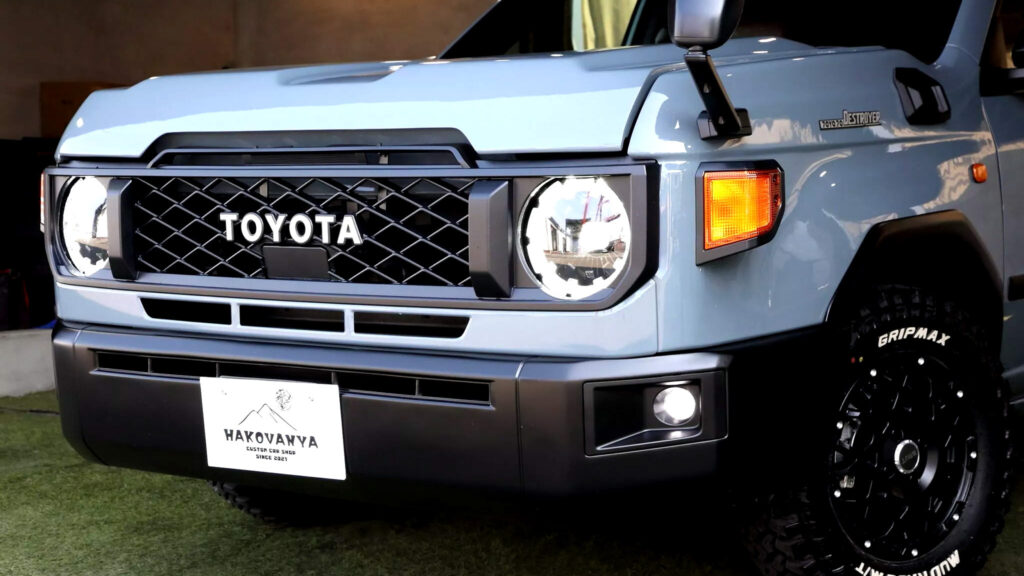
Tuner Hakobanya transforms the utilitarian Toyota ProBox into an off-roader in the style of the Land Cruiser 70
The Japanese utilitarian Toyota ProBox, known for its simplicity and affordability, has undergone a radical transformation thanks to the tuning company Hakobanya. Instead of an inconspicuous appearance, it now boasts an aggressive exterior inspired by the legendary Land Cruiser 70 Series off-roader.
The main exterior changes are:
Detailing and design variations
The tuners have even thought through small details, such as fender mirrors and indicators characteristic of the Land Cruiser. On social media, the company presented three different versions of its creation: a black one with retro decals, a beige one in an “overlanding” style, and a blue one with a vintage hue. Each has unique accents, allowing the car to be tailored to personal taste.
Interior updates and technical features
In the interior, customers are offered various options: leather-like seat upholstery, new floor mats, a multimedia system, wooden inserts on the steering wheel and instrument panel, as well as cargo area protection. It is important to note that the technical underpinnings remain standard for the ProBox. The car is equipped with a 1.5-liter gasoline engine producing 107 hp or a hybrid powertrain. The drive can be front-wheel or all-wheel drive, with the all-wheel-drive versions being best suited for such an “off-road” transformation.
Conversion cost and market context
Converting a base ProBox into a 70 BOX costs from approximately 1.5 million yen (about $9,400). A new donor car will cost another 1.9-2.2 million yen, although more affordable used options can be found. Road-ready examples from the tuner are priced from approximately 3.85 million yen. Interestingly, Toyota still produces the original Land Cruiser 70 Series in a station wagon body, but it is a true frame-based off-roader, unlike the converted ProBox.
Projects like the 70 BOX demonstrate how profound the cultural heritage of cars like the Land Cruiser can be. It becomes a source of inspiration even for modifying completely different, utilitarian models. This also shows the vitality of the individual tuning market in Japan, where even the simplest car can be reimagined and given a completely new character and purpose, combining nostalgia for classic design with modern technology and owner needs.