


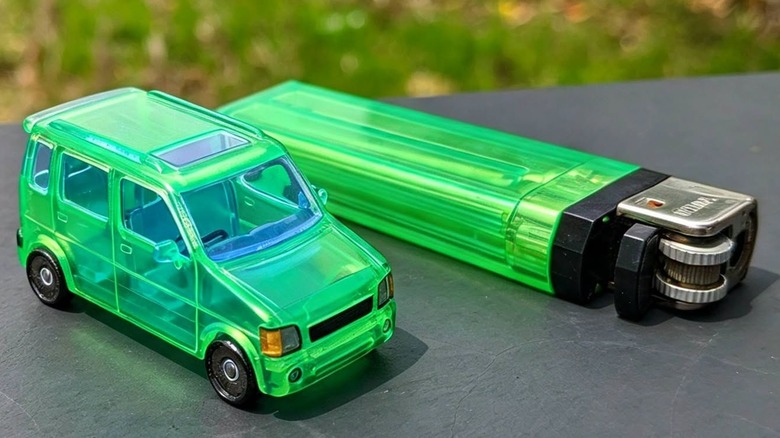
A miniature that looks like the work of artificial intelligence
The level of craftsmanship is truly impressive. Social media feeds today are filled with images and videos created by artificial intelligence. Sometimes they are so convincing that they are hard to distinguish from real things made by a person. Usually a simple rule works: if the result looks too perfect, an algorithm was probably involved. That is exactly how photographs of a miniature van, supposedly made from plastic from disposable lighters, were initially perceived. But after closer examination, it turned out that these cars are actually created by a human — by hand and very carefully.
Most people throw away a disposable lighter after the gas runs out. But one very patient large-scale model maker decided not just to get rid of such plastic, but to give it a second life. From the recycled material he created a classic Japanese kei van, similar to the Suzuki Every. A 12-minute video on the ANK Creative channel shows the entire process: from the transparent plastic casing of a lighter to a small Suzuki Karimun model that fits in the palm of a hand. This version is the Indonesian counterpart of the Japanese Wagon R.
Even after watching the video, some disbelief remained: modern content generation tools have already learned to maintain consistency of details and work very convincingly. However, the channel’s history suggests otherwise. Similar posts appeared there several years ago — long before artificial intelligence began mass-producing videos with strange and impossible plots. That is, this is not a generated image, but genuine manual work that can be traced over time.
Every part was cut, shaped and glued by hand
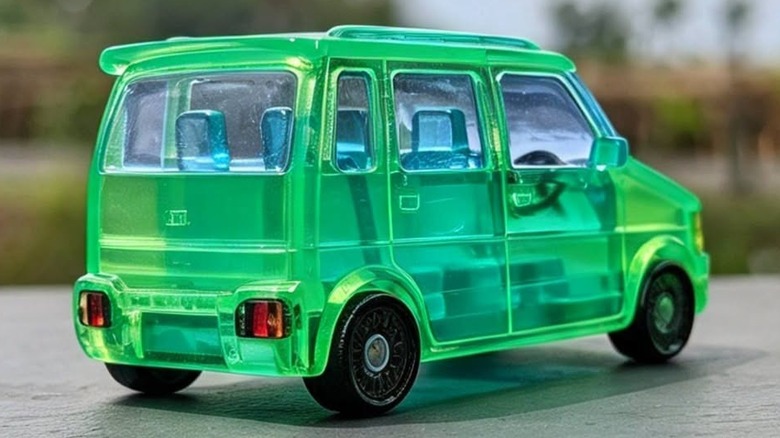
Creating such a model requires precision, endurance and meticulousness. All small elements were cut, sanded and joined with glue by the craftsman by hand. Work began with a green transparent lighter box: the plastic casing was cut, leveled and sanded into smooth panels. A drawing of the Suzuki Wagon R served as a reference. Using it, the craftsman cut out the side windows and wheel arches using a rotary tool, a jeweler’s saw and a precision hobby knife.
After that, the same shape was made for the opposite side. Both parts were connected with flat plastic fragments that later became bumpers, hood, roof and rear doors. To reproduce the light fixtures, the craftsman used pieces of transparent plastic from red, orange and colorless lighters. Blue plastic was needed for the interior: the floor, dashboard and seats were made from it. The steering wheel was bent from thin wire, and a small gearshift lever was formed from the inner metal valve of a lighter.
Even the radiator grille was cut from the black plastic of the ignition mechanism — so almost everything was used. The toothed metal flint wheels were used as discs. They were wrapped with stripped wire insulation to imitate tires, and then fixed on metal axles made from pins. Thanks to this, the miniature model does not just stand still but can also roll.
Years of practice against modern algorithms
The precision with which this model is made may seem machine-like, but in fact it is backed by years of training and experience. ANK Creative has been publishing similar works from discarded household materials for more than seven years. During this time, the channel has grown to more than 300 thousand subscribers and almost 300 videos. Among the early popular projects was a DeLorean DMC-12 made from used items: it collected 6.7 million views. Another video compilation in which Toyota Supra, Nissan Skyline R34, Toyota AE86 and Honda NSX were created from gas lighters has 4.4 million views.
If you compare these earlier publications with newer works, the difference becomes obvious. Later projects include a Datsun 620 King Cab, complex structures made from PVC sheets such as the A-Team GMC Vandura van, a Peterbilt truck from the film Duel, as well as detailed models of various buses. The proportions and clarity of detail in the latest miniatures are already approaching the level of mass-produced cast models. And this shows how much the author has improved his technique over the years.
Craftsmanship that cannot be replaced by an algorithm
The story of ANK Creative demonstrates that in social media overflowing with generated content, human patience and skills still have enormous value. What matters here is not only the final result but also the process itself: finding material, calculating the shape, fine work with tools and the ability to see a car in an ordinary lighter. Such projects remind us that genuine manual work leaves a trace that is difficult to imitate even by a very convincing algorithm. The Suzuki Karimun model with a transparent body is not just a toy, but a clear example of how perseverance turns waste into a creation that you want to examine up close.