


Florida Lawmakers Approve Controversial Bill on Noisy Cars
Florida lawmakers appear to be cracking down on loud exhaust systems and engine revving, but their chosen approach may raise more questions than it answers. The Florida House of Representatives just approved a massive transportation bill, HB 543, covering a wide range of aspects—from control in school zones to license plate recognition systems.
However, drivers might be surprised by a new provision aimed at combating intentional engine revving that creates “excessive noise.”
Current Norms and Planned Changes
Current Florida law already requires vehicles to have properly functioning exhaust systems designed to prevent “excessive or unusual noise.” This rule is reinforced by specific decibel limits: typically 72 dB at speeds up to 35 mph and 79 dB on faster roads. Bill HB 543 proposes to completely repeal these objective limits.
Subjective Standard Instead of Measurements
Objective measurements may be replaced by a general formulation. The new legal text stipulates that drivers are prohibited from “intentionally increasing engine speed or unreasonably accelerating in a manner that results in excessive or unusual noise.”
This change essentially creates an “audible to the ear” noise standard, similar to how some cities regulate loud music.
Vehicles must still have a properly functioning exhaust system with a muffler, manifold, and tailpipe. Interestingly, motorcycles and mopeds are exempt from the new rules if they comply with federal EPA noise standards.
Law Enforcement Challenges and Potential Consequences
Analysts, citing Click Orlando, note that it is difficult for law enforcement to enforce decibel limits. Instead, enforcement will likely depend heavily on a police officer’s subjective opinion on whether the noise was excessive and intentional.

This could simplify law enforcement but could also make it easier to challenge. Since the rule lacks a clear measurement threshold, fines may depend on factors such as witness testimony, audio recordings from body cameras, or an officer’s observation.
This could also lead to interesting cases where cars with a relatively loud idle receive fines, even if the driver is not revving the engine.
There have already been precedents where completely stock cars received fines for excessively loud exhaust in other states. Florida could be next on that list.
Next Steps and Effective Date
Florida House lawmakers approved the bill on Wednesday with only one “nay” vote. The legislation now heads to the Senate before potentially reaching Governor Ron DeSantis. If signed into law, it will take effect on July 1.
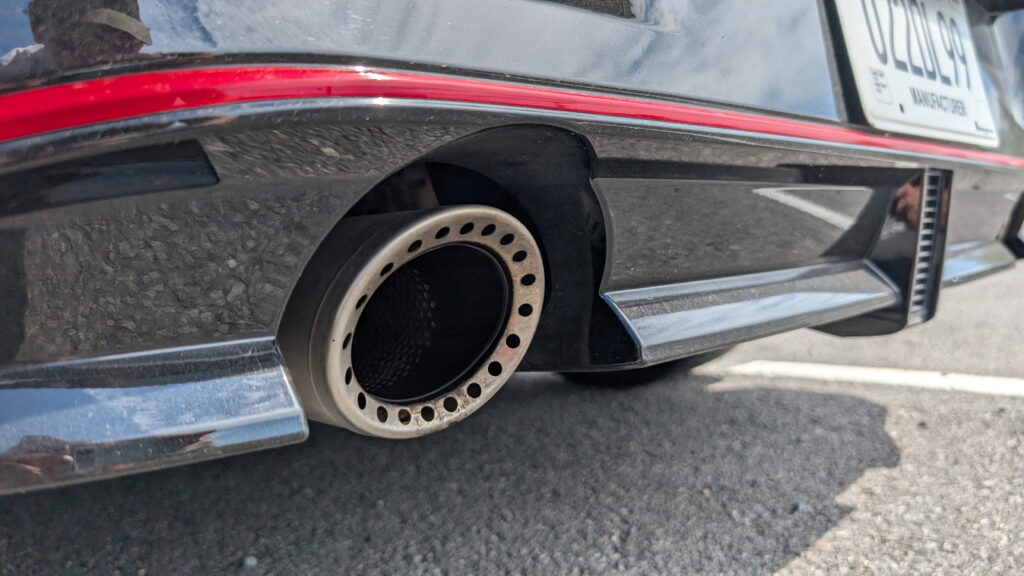
Photo Stephen Rivers / Carscoops
The shift from quantitative measurements to qualitative assessments in regulating vehicle noise is part of a broader trend in some regions. While it gives law enforcement more flexibility, it also creates room for disputes and ambiguities in interpretation. The success of such a policy will largely depend on proper officer training and the ability of drivers to effectively challenge decisions they deem unfair. The question of balancing public peace with car owners’ freedom remains relevant.